
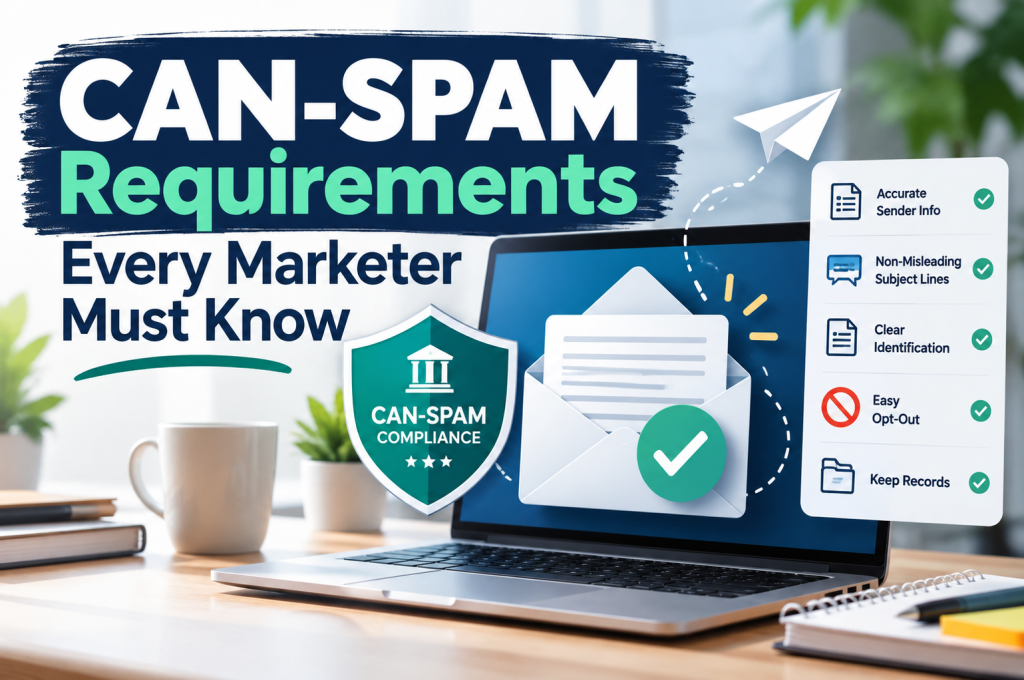
Email marketing can be one of the most effective ways to reach customers, nurture relationships and generate sales. But there’s a catch. Send the wrong message, omit a crucial detail or make it unnecessarily difficult for someone to unsubscribe, and your campaign could become a legal liability.
That’s where the CAN-SPAM Act comes in.
Whether you’re sending promotional newsletters, running automated email campaigns or reaching out to potential business clients, understanding CAN-SPAM requirements is essential for protecting your business and maintaining subscriber trust.
And no, simply including an unsubscribe link doesn’t automatically make your emails compliant.
The legislation covers everything from sender identification and subject lines to physical mailing addresses, advertising disclosures and how quickly businesses must honour opt-out requests.
CAN-SPAM compliance at a glance
Here’s what every marketer needs to know before hitting send:
- Identify yourself accurately. Your From, To, Reply-To and routing information must truthfully identify the sender.
- Keep subject lines honest. Never mislead recipients about what your email contains.
- Disclose advertising clearly. Commercial emails must be identifiable as advertisements unless an applicable exception applies.
- Include a valid postal address. A legitimate physical mailing address is mandatory for commercial marketing emails.
- Provide a straightforward unsubscribe method. Recipients must have a clear, functioning way to opt out of future promotional messages.
- Honour unsubscribe requests within 10 business days. Your opt-out mechanism must also remain operational for at least 30 days after sending.
- Understand who’s responsible. Hiring an agency or email marketing provider doesn’t automatically transfer your legal obligations.
- Know which messages are covered. The law applies to commercial email, including many B2B campaigns, not just unsolicited bulk messages.
- Recognise the consequences. Individual violations can attract substantial civil penalties, making email marketing compliance a business priority.
The key takeaway: CAN-SPAM compliance isn’t about avoiding email marketing. It’s about communicating transparently, respecting recipients’ choices and making sure every commercial message meets the applicable legal requirements.
For businesses targeting American customers, these principles should form the foundation of every email marketing strategy. UK businesses must also consider applicable UK GDPR and PECR requirements, which can impose stricter rules around consent and direct marketing.
What Is the CAN-SPAM Act?
The CAN-SPAM Act of 2003, officially known as the Controlling the Assault of Non-Solicited Pornography and Marketing Act, is a United States federal law regulating commercial email messages.
Introduced to address deceptive and unwanted electronic marketing, it establishes standards for how businesses identify themselves, present promotional content and give recipients control over future communications.
The law is enforced primarily by the Federal Trade Commission (FTC), alongside other authorised regulators.
Unlike some international anti-spam laws, CAN-SPAM doesn’t generally require businesses to obtain advance consent before sending commercial emails.
However, that doesn’t mean marketers have unlimited freedom to contact anyone they choose.
Every covered commercial message must comply with the law’s requirements, regardless of whether the recipient previously subscribed, purchased a product or interacted with the sender.
Why was CAN-SPAM introduced?
Before the legislation took effect, consumers regularly encountered misleading subject lines, disguised sender identities and promotional emails that offered no practical way to unsubscribe.
CAN-SPAM introduced nationwide commercial email regulations designed to address these practices.
Its objectives include:
- Reducing deceptive email practices by requiring truthful sender information and subject lines.
- Improving transparency so recipients can recognise commercial communications.
- Protecting opt-out rights by requiring businesses to honour requests to stop receiving promotional emails.
- Establishing accountability for organisations responsible for sending or advertising through commercial messages.
- Supporting regulatory enforcement against businesses that disregard applicable email marketing laws.
Importantly, CAN-SPAM doesn’t prohibit all unsolicited commercial email. Instead, it regulates how those messages must be sent.
This distinction matters, particularly for marketers who assume that permission-based marketing and legal compliance are interchangeable.
They’re not.
A recipient might willingly subscribe to your newsletter, yet the emails you send could still violate CAN-SPAM rules if they contain deceptive headers or fail to provide a valid postal address.
Does CAN-SPAM apply to UK businesses?
Yes, potentially.
Although CAN-SPAM is American legislation, UK-based businesses conducting commercial email marketing involving US recipients should assess their obligations under the Act.
For example, imagine a British digital marketing agency running an email campaign promoting its services to businesses in New York, Chicago and Los Angeles.
Operating from the United Kingdom doesn’t automatically remove the campaign from the scope of US commercial email regulations.
At the same time, UK businesses must consider domestic legislation, including:
- UK GDPR: Governs the processing of personal data, including the lawful basis for using personal information in marketing.
- Privacy and Electronic Communications Regulations (PECR): Establish specific rules for electronic direct marketing, including consent requirements and exemptions.
- Data Protection Act 2018: Supplements the UK’s data protection framework.
The requirements differ between jurisdictions. A campaign that satisfies CAN-SPAM may not necessarily satisfy UK PECR or European privacy legislation.
For marketers operating internationally, compliance should be assessed according to the recipients, marketing methods and applicable laws rather than relying on a single global email policy.
Who Must Comply With CAN-SPAM Requirements?
One of the most persistent misconceptions about the CAN-SPAM Act is that it applies only to companies sending enormous volumes of unsolicited emails.
In reality, the legislation covers a much broader range of commercial communications.
If the primary purpose of your email is to advertise or promote a commercial product or service, CAN-SPAM may apply.
That includes businesses of almost every size.
Businesses and marketers covered by the Act
Common examples include:
- Ecommerce businesses sending promotional offers, product announcements and discount campaigns.
- Digital marketing agencies managing email campaigns for their clients.
- B2B organisations contacting prospective business customers about commercial services.
- Small businesses distributing promotional newsletters and seasonal offers.
- SaaS companies promoting subscriptions, software upgrades and paid features.
- Affiliate marketers sending messages designed to generate commercial sales or referrals.
- Email automation teams running promotional sequences, re-engagement campaigns and sales funnels.
The number of emails sent isn’t what determines whether CAN-SPAM applies.
A single commercial email can fall within the legislation.
Does CAN-SPAM apply to B2B emails?
Absolutely.
The FTC makes clear that the CAN-SPAM Act doesn’t create a general exemption for business-to-business email marketing.
That means cold sales emails, commercial outreach campaigns and promotional messages sent to professional email addresses can all be subject to the same core legal requirements.
Consider this example.
A marketing consultant sends a personalised email to a company director offering paid search advertising services.
Even though the message is addressed to a business rather than a private consumer, its primary purpose is commercial promotion.
Consequently, the sender should assess the message against CAN-SPAM requirements, including accurate identification, truthful subject lines, a valid physical postal address and an appropriate opt-out mechanism.
For agencies offering services such as PPC advertising and campaign management, this is particularly relevant when prospecting for new clients through email.
B2B doesn’t mean compliance-free.
Does CAN-SPAM apply to cold emails?
Yes. Cold emails promoting commercial products or services generally fall within the Act.
But here’s an important distinction: CAN-SPAM doesn’t impose a blanket requirement to obtain opt-in consent before sending commercial emails.
Under US federal CAN-SPAM rules, a business may be able to send an unsolicited commercial email provided the message meets the applicable legal requirements.
That doesn’t override other relevant laws, including stricter consent or privacy rules that may apply in different jurisdictions.
Nor does it mean unsolicited email is automatically an effective marketing strategy.
Poorly targeted cold outreach can damage sender reputation, increase spam complaints and undermine customer confidence, even when a message technically complies with CAN-SPAM.
A responsible approach combines legal compliance with relevance, transparency and respect for the recipient.
What about newsletters and automated email campaigns?
Email newsletters aren’t automatically exempt from CAN-SPAM simply because recipients have subscribed.
A newsletter promoting products, paid services, special offers or other commercial activities may qualify as a commercial message.
Likewise, automated email sequences must be assessed according to their content and primary purpose.
Examples include:
- Welcome sequences containing promotional offers.
- Abandoned-cart emails encouraging customers to complete purchases.
- Product launches and seasonal discount announcements.
- Re-engagement campaigns targeting inactive subscribers.
- Automated upselling and cross-selling emails.
A purely informational message may be treated differently depending on its content and purpose. The crucial question is whether the email’s primary purpose is commercial promotion.
The Essential CAN-SPAM Rules Every Marketing Email Must Follow
Understanding who falls under the legislation is only the beginning.
The next step is knowing exactly what a compliant commercial email should contain—and what it must avoid.
According to the FTC’s official CAN-SPAM compliance guide, the law establishes several fundamental requirements covering sender transparency, advertising disclosures, postal addresses, unsubscribe rights and accountability.
Federal Trade Commission
Let’s examine the first requirements in detail.
1. Use accurate sender and header information
Every commercial email must clearly identify the person or business responsible for sending it.
That means your email header information cannot be false or misleading.
The requirement applies to several technical and visible elements, including:
- From address: Must accurately identify the person or organisation initiating the message.
- To address: Must not contain misleading recipient information.
- Reply-To address: Must not be used deceptively to disguise the sender.
- Originating domain name: Must accurately represent the message’s origin.
- Routing information: Must not be falsified to conceal where the email came from.
For example, a company shouldn’t send a promotional email that appears to originate from a well-known retailer when the message actually comes from an unrelated marketing business.
Similarly, deliberately disguising an originating domain to mislead recipients could create compliance problems.
Why accurate email headers matter
Beyond meeting CAN-SPAM regulations, transparent sender information helps recipients recognise legitimate communications.
It also supports a trustworthy brand identity.
A business investing in professional website design should maintain the same consistency across its website, email domain and marketing communications.
After all, a polished website means little if prospective customers receive messages from confusing or suspicious-looking addresses.
Practical tip: Use a recognisable sender name and a business-controlled email domain wherever possible. Make sure your email service provider is configured correctly and that recipients can identify the organisation contacting them.
2. Never use deceptive or misleading subject lines
Your subject line is often the first thing a recipient notices.
It’s also one of the first places where CAN-SPAM violations can occur.
The legislation requires commercial email subject lines to accurately reflect the content of the message.
In other words, you cannot trick someone into opening an advertisement by suggesting the email contains something entirely different.
Consider these examples:
| Misleading subject line | More transparent alternative |
|---|---|
| Urgent: Your account has been suspended | Discover our latest business services |
| You’ve received an important payment | Exclusive offers available this week |
| Your order has been confirmed | Explore our newest products |
| Final notice: Legal action pending | Last chance to claim our promotional discount |
| Re: Our previous conversation | Introducing our digital marketing services |
The issue isn’t whether a subject line is persuasive, attention-grabbing or creative.
It’s whether the recipient is being misled about what the email actually contains.
Can marketers still use curiosity-driven subject lines?
Certainly.
CAN-SPAM doesn’t prohibit creativity.
You can use intriguing questions, compelling offers and curiosity to encourage engagement, provided the subject line remains truthful.
For instance:
“Three mistakes that could be costing your business customers”
This could be appropriate for an email genuinely explaining three customer acquisition mistakes.
But using the same subject line for an unrelated product advertisement with no meaningful discussion of those mistakes could be misleading.
The goal is simple: create interest without manufacturing false expectations.
3. Clearly identify commercial advertising
Commercial messages must generally disclose clearly and conspicuously that they’re advertisements.
The FTC gives marketers flexibility in how they communicate this information. The law doesn’t require every ordinary promotional email to begin with a particular phrase such as “ADVERTISEMENT.”
Instead, the advertising nature of the message must be disclosed in a way that an ordinary recipient can recognise and understand.
This is particularly important when promotional emails are written to resemble personal correspondence, editorial content or independent recommendations.
Good marketing doesn’t need to disguise its intentions. A compelling offer, clearly presented by a recognisable business, can be persuasive without misleading the recipient.
For marketers, the practical objective is to make the commercial purpose transparent while maintaining a professional, engaging message.
That principle applies whether you’re promoting an ecommerce product, introducing a new service or encouraging readers to explore your website.
4. Include a Valid Physical Postal Address in Every Commercial Email
Here’s a detail that’s surprisingly easy to overlook.
Every commercial email covered by the CAN-SPAM Act must include a valid physical postal address for the sender.
Not just an email address. Not a contact form. And certainly not a vague reference to your company’s location.
An actual postal address.
This requirement gives recipients a legitimate way to identify and contact the business responsible for the message. It also promotes accountability, making it more difficult for dishonest marketers to hide behind anonymous email campaigns.
What counts as a valid physical postal address?
According to the FTC CAN-SPAM guidelines, businesses can satisfy this requirement by including one of the following:
- A current street address: The physical location where your business receives mail.
- A registered post office box: A PO box properly registered with the US Postal Service.
- A registered private mailbox: A private mailbox established through a commercial mail receiving agency in accordance with applicable Postal Service regulations.
A valid business mailing address is usually included in the footer of a promotional email, alongside company information and unsubscribe options.
For example:
Example Marketing Company 123 Business Avenue Suite 400 New York, NY 10001
You’re receiving this email because you’ve interacted with our business or subscribed to marketing updates.
Unsubscribe from future promotional emails.
This is an illustrative footer, not a complete compliance template. Any explanation of why the recipient is receiving the email must be truthful.
Can you use a PO box for CAN-SPAM compliance?
Yes.
A properly registered US Postal Service PO box is expressly permitted under the CAN-SPAM Act.
This can be useful for home-based businesses, freelancers and smaller organisations that prefer not to publish their residential addresses in marketing emails.
However, marketers shouldn’t assume that any virtual address or mailbox service automatically meets the legal requirements.
The address must fall within an accepted category.
For UK businesses contacting American recipients, it’s important to understand that the FTC also recognises a valid current street address. The law doesn’t generally require every foreign business to obtain a US mailing address simply to send commercial email.
Practical recommendation: Audit your email templates and automated sequences to confirm that the business address is accurate, current and consistently displayed.
An outdated footer copied from an old campaign is an unnecessary compliance risk.
5. Provide a Clear and Functional Unsubscribe Mechanism
Imagine receiving promotional emails from a company every week.
You decide you’re no longer interested, scroll to the bottom of the message and click “Unsubscribe.”
Instead of removing you from the mailing list, the link takes you to a broken webpage.
Frustrating? Absolutely.
Potentially non-compliant? Yes.
One of the most important CAN-SPAM unsubscribe requirements is that commercial emails provide recipients with a clear explanation of how to stop receiving future marketing messages.
This is a legal obligation, not an optional customer service feature.
What makes an unsubscribe mechanism compliant?
Under CAN-SPAM, the opt-out mechanism must allow recipients to communicate their preference not to receive further commercial email.
Businesses may provide a return email address or another internet-based method, such as an unsubscribe webpage.
Whatever approach is used, it must be straightforward and functional.
A compliant unsubscribe process should:
- Be clearly explained within the commercial email.
- Provide a working email-based or internet-based opt-out method.
- Allow recipients to stop receiving future commercial messages.
- Avoid requiring unnecessary personal information.
- Never charge recipients to unsubscribe.
- Avoid making recipients complete multiple unnecessary steps.
The law also prohibits businesses from requiring recipients to provide information beyond their email address and opt-out preferences as a condition of unsubscribing.
And recipients cannot be required to visit more than one internet webpage to submit an opt-out request.
Is a one-click unsubscribe link mandatory under CAN-SPAM?
Not specifically.
This is an important distinction between federal CAN-SPAM requirements and modern email provider policies.
CAN-SPAM requires a compliant opt-out mechanism, but it doesn’t universally mandate the technical one-click unsubscribe system associated with certain mailbox providers.
Google and Yahoo, for example, have introduced additional requirements for some bulk senders, including one-click unsubscribe functionality for qualifying marketing messages.
Those requirements concern email delivery policies rather than the wording of the CAN-SPAM Act itself.
Nevertheless, providing a simple, prominent unsubscribe link is an excellent practical approach.
It reduces friction, respects subscriber preferences and can help minimise spam complaints.
Can you offer subscribers different email preferences?
Yes.
Businesses can offer recipients a preference centre where they choose which categories of commercial emails they want to receive.
For instance, someone might wish to stop receiving weekly promotional offers but continue receiving occasional product announcements.
A preference centre could provide options such as:
- Product announcements
- Promotional discounts
- Educational newsletters
- Event invitations
- All commercial marketing emails
However, there must still be a way to opt out of all commercial email from the sender.
You cannot force recipients to remain subscribed to at least one marketing category.
Nor can you make the process unnecessarily complicated.
The recipient’s choice must be respected.
6. Honour Opt-Out Requests Within 10 Business Days
Providing an unsubscribe link is only half the job.
The other half?
Actually honouring the request.
Under the CAN-SPAM Act, businesses must process valid commercial email opt-out requests within 10 business days.
This deadline is one of the most important legal requirements for marketing emails.
Once a recipient has opted out, the sender must stop sending commercial messages covered by that request within the permitted period.
What is the CAN-SPAM 10 business day rule?
The rule establishes the maximum period for honouring an opt-out request.
For example, if someone unsubscribes from your promotional newsletter on a Monday, your business cannot simply leave the request unprocessed indefinitely.
You must ensure the recipient is removed from the relevant commercial email distribution process within 10 business days.
Weekends and applicable holidays can affect the calculation of business days, so marketing teams should avoid relying on rough calendar-day estimates.
More importantly, there’s little reason to wait until the deadline.
Modern email service providers can often process unsubscribe requests automatically.
Best practice: Honour valid unsubscribe requests immediately whenever your systems allow it.
Your unsubscribe mechanism must work for at least 30 days
Another commonly overlooked requirement concerns the availability of the opt-out mechanism itself.
Under CAN-SPAM, the opt-out method provided in a commercial email must remain capable of receiving requests for at least 30 days after the message is sent.
Suppose you distribute a promotional campaign on 1 June.
A recipient opens the message three weeks later and decides to unsubscribe.
The mechanism must still work.
A temporary landing page that disappears shortly after a campaign finishes could therefore create compliance problems.
For businesses using email marketing automation, this is particularly important.
Check that unsubscribe links remain functional even when:
- Promotional offers have expired.
- Landing pages have been redesigned.
- Email campaigns have been archived.
- Marketing software has been replaced.
- Subscribers open older messages.
Can you charge someone to unsubscribe?
No.
The CAN-SPAM no-fee unsubscribe rule prohibits charging recipients to submit an opt-out request.
Businesses also cannot require someone to purchase a product, create a paid account or provide excessive personal details before their request will be accepted.
An unsubscribe process should be accessible, simple and free.
What happens to an email address after someone unsubscribes?
Once a recipient opts out, businesses must take appropriate steps to prevent further commercial messages being sent in violation of that request.
This is where email suppression lists become important.
A suppression list records addresses that should be excluded from specified marketing communications.
Unlike an ordinary subscriber list, its purpose is to prevent unwanted contact.
For example, a business might maintain:
| Email status | Appropriate action |
|---|---|
| Active marketing subscriber | Send relevant promotional emails where lawful |
| Unsubscribed recipient | Suppress future commercial emails covered by the opt-out |
| Transactional-only contact | Send qualifying transactional or relationship messages where appropriate |
| Invalid email address | Remove or suppress according to list management procedures |
| Spam complaint recipient | Investigate and suppress marketing communications as appropriate |
There is another critical restriction.
You generally cannot sell or transfer the email addresses of people who have opted out, except where the transfer is for compliance purposes, such as supplying the addresses to a service provider responsible for maintaining a suppression list.
This helps prevent businesses from treating unsubscribe requests as an opportunity to distribute contact information elsewhere.
7. Understand the Difference Between Commercial and Transactional Emails
Not every email a business sends is treated identically under CAN-SPAM.
The law distinguishes between commercial messages and transactional or relationship messages.
Understanding this distinction is essential because the classification affects which requirements apply.
Get it wrong, and you could mistakenly treat a promotional campaign as an exempt operational communication.
What is a commercial email?
A commercial email is one whose primary purpose is the commercial advertisement or promotion of a product or service, including content on a commercial website.
Common examples include:
- Promotional newsletters advertising products.
- Emails announcing seasonal sales.
- Discount codes and limited-time offers.
- Messages promoting paid subscriptions.
- Sales outreach advertising commercial services.
- Emails encouraging customers to purchase additional products.
These messages are generally subject to the full set of applicable CAN-SPAM commercial email requirements.
What is a transactional or relationship email?
Transactional or relationship emails serve specific operational purposes connected with an existing transaction, account or relationship.
Examples can include:
- Confirming or facilitating a transaction the recipient has already agreed to.
- Providing warranty, recall, safety or security information.
- Communicating certain changes to an ongoing subscription, account or membership.
- Providing certain employment-related information or benefits.
- Delivering goods or services, including updates or upgrades, that the recipient is entitled to receive through an existing transaction.
A genuine order confirmation, for example, will often qualify as a transactional message.
Such emails are not subject to every requirement that applies to commercial messages.
However, their header information must still be accurate and must not be materially false or misleading.
Do transactional emails need an unsubscribe link?
Under CAN-SPAM, emails whose primary purpose is genuinely transactional or relationship-based generally don’t need to include the commercial-message unsubscribe mechanism.
But businesses must be careful.
Simply labelling an email as “transactional” doesn’t make it so.
Consider these examples:
| Email example | Likely classification |
|---|---|
| Your payment has been received | Transactional |
| Your order has shipped | Transactional |
| Important security update for your account | Transactional |
| Save 25% on your next purchase | Commercial |
| Discover our latest service packages | Commercial |
| Your order confirmation with a prominent new-product promotion | Depends on primary purpose and presentation |
The last example is particularly interesting.
It introduces one of the most important—and frequently misunderstood—concepts in CAN-SPAM Act compliance.
The CAN-SPAM primary purpose test
Some emails contain both transactional information and promotional content.
These are often called mixed-content emails.
The FTC’s primary purpose rules help determine whether the message should be treated as commercial.
For an email containing both commercial and transactional or relationship content, the assessment considers how a reasonable recipient would interpret the subject line and the presentation of the message.
An email may be classified as commercial if:
- A reasonable recipient would conclude from the subject line that the message contains commercial advertising or promotion; or
- The transactional or relationship content does not appear, in whole or substantial part, at the beginning of the message.
Let’s look at an example.
Email A:
Subject: Your order confirmation
Thank you for your purchase. Your order number is 12345, and your delivery is scheduled for Friday.
You might also like these related products.
Email B:
Subject: Exclusive offers you won’t want to miss
Save 30% on our latest products this week.
Browse our new collection.
Your recent order is also scheduled to arrive on Friday.
Email A is more likely to be classified as transactional, assuming the order information is genuine and the promotional content is secondary.
Email B is more likely to be considered commercial because the subject line and prominent opening content focus on advertising.
This distinction can affect whether the email must include advertising identification, a valid postal address and a commercial unsubscribe mechanism.
Why mixed-content email compliance matters
Many businesses use automated customer journeys that combine operational updates with marketing messages.
Examples include:
- Purchase confirmations containing discount codes.
- Shipping notifications promoting related products.
- Account updates featuring subscription upgrades.
- Membership renewal messages advertising additional services.
These campaigns can create compliance risks when marketers assume that adding a transactional element automatically exempts the entire email.
It doesn’t.
The overall message must be assessed according to the applicable primary purpose rules.
For businesses combining email campaigns with search engine optimisation and organic lead generation, the same principle of clarity applies across channels: customers should understand what information they’re receiving and why.
Practical tip: Where possible, keep essential transactional communications separate from promotional campaigns. This simplifies compliance assessments and makes important customer information easier to recognise.
8. Is Prior Consent Required Under the CAN-SPAM Act?
This is one of the most frequently misunderstood areas of American email marketing law.
The short answer is no—not generally under CAN-SPAM itself.
Unlike some other privacy and anti-spam frameworks, the federal CAN-SPAM Act doesn’t impose a universal requirement for recipients to provide express opt-in consent before receiving commercial emails.
Instead, it establishes rules governing the content, identification and opt-out processes associated with those messages.
However, that distinction should never be interpreted as permission to ignore privacy obligations or recipient preferences.
Opt-in vs opt-out email marketing
These two approaches work differently.
Opt-in marketing involves obtaining permission before sending promotional messages.
Opt-out marketing allows commercial messages to be sent where lawful, while providing recipients with a way to stop future communications.
| Feature | Opt-in approach | CAN-SPAM’s general approach |
|---|---|---|
| Prior permission | Obtained before marketing | Not universally required by CAN-SPAM |
| Unsubscribe mechanism | Generally provided | Required for covered commercial messages |
| Recipient choice | Expressed before receiving marketing | Must be respected when opting out |
| Main emphasis | Permission and subscriber relationships | Truthful commercial messaging and opt-out rights |
Opt-in marketing can offer substantial advantages even when prior consent isn’t mandated by CAN-SPAM.
Subscribers who actively request communications are often more receptive to relevant offers and updates.
Permission-based marketing can also help businesses build stronger relationships and reduce unwanted-email complaints.
What about double opt-in?
Double opt-in is a subscription process in which someone first submits their email address and then confirms the subscription, usually by clicking a link in a confirmation message.
For example:
- A visitor enters their email address into a newsletter registration form.
- The business sends a confirmation email.
- The visitor clicks a verification link.
- The email address is added to the active marketing list.
Double opt-in can help confirm that subscribers control the addresses they’ve entered.
It may also reduce accidental sign-ups and improve email list quality.
However, double opt-in is not a standalone requirement of the CAN-SPAM Act.
It is a marketing and list-management practice rather than a universal federal CAN-SPAM obligation.
Why international marketers must be especially careful
A business operating across multiple countries cannot assume that complying with CAN-SPAM satisfies every relevant email marketing law.
For instance:
- United States: CAN-SPAM generally operates through commercial email requirements and opt-out rights rather than universal prior consent.
- United Kingdom: UK GDPR and PECR impose additional rules concerning personal data and electronic direct marketing, with distinctions between individuals, corporate subscribers and applicable exemptions.
- European Union: GDPR and applicable national electronic marketing laws can impose additional requirements concerning consent, lawful processing and direct marketing.
- Canada: Canada’s Anti-Spam Legislation (CASL) generally requires consent for covered commercial electronic messages, subject to specific exemptions and exceptions.
These frameworks aren’t interchangeable.
An email campaign that is lawful under one jurisdiction’s rules may require additional safeguards elsewhere.
For marketers serving international audiences, legal compliance should be assessed before launching campaigns rather than after complaints begin arriving.
9. CAN-SPAM Violations and Penalties: What’s at Stake?
A misleading subject line might seem harmless. An outdated unsubscribe link could look like a minor technical oversight.
But under the CAN-SPAM Act, seemingly small mistakes can carry significant consequences.
The Federal Trade Commission has authority to pursue enforcement against businesses that violate applicable commercial email regulations. Other authorised agencies and state attorneys general also have enforcement roles.
And here’s what makes the legislation particularly important for marketers:
Penalties can apply to individual emails that violate the law, not simply to an entire marketing campaign.
How much are CAN-SPAM penalties?
The FTC’s published CAN-SPAM compliance guidance has identified maximum civil penalties exceeding $50,000 per violating email.
These maximum amounts are adjusted periodically, so businesses should verify the current figure against the FTC’s official civil penalty guidance rather than relying on outdated articles.
Importantly, the maximum penalty isn’t automatically imposed for every violation. Actual enforcement outcomes depend on the circumstances, applicable legal provisions and other relevant factors.
Nevertheless, the potential financial exposure is substantial.
Consider a hypothetical campaign involving 5,000 commercial emails.
If every message contains a material compliance violation, the business could face considerable regulatory risk. That doesn’t mean the FTC would necessarily impose 5,000 maximum penalties, but it illustrates why compliance needs to be built into campaign operations.
Common CAN-SPAM violations
Some of the most frequent compliance risks include:
- False sender information: Disguising the identity of the organisation responsible for an email.
- Deceptive subject lines: Misrepresenting the message’s contents to encourage recipients to open it.
- Missing advertising disclosures: Failing to identify commercial advertising when required.
- No valid physical postal address: Omitting acceptable business contact information.
- Broken unsubscribe mechanisms: Providing opt-out links or methods that don’t function as required.
- Ignoring opt-out requests: Continuing to send commercial messages after the applicable 10-business-day deadline.
- Improper use of suppression lists: Selling or transferring opted-out addresses for prohibited purposes.
Certain aggravated practices, including email address harvesting, dictionary attacks and specified forms of unauthorised access or deceptive routing, can create additional legal exposure.
Some serious violations may also carry criminal consequences under applicable provisions.
Who enforces the CAN-SPAM Act?
The FTC is a principal federal enforcement authority, but it isn’t the only organisation with a role.
Depending on the circumstances, enforcement may involve:
- The Federal Trade Commission.
- Other authorised federal regulatory agencies.
- State attorneys general.
- Internet service providers with specified legal claims.
Individual consumers generally don’t have a direct private right to sue under CAN-SPAM merely because they received a non-compliant marketing email.
However, that doesn’t prevent consumers from submitting complaints to relevant authorities.
The wider lesson?
Compliance shouldn’t depend on whether someone is likely to report a campaign.
It should be part of the process before the first message is sent.
10. Third-Party Email Marketers: Who Is Legally Responsible?
Outsourcing your email marketing can save time, provide specialist expertise and help your business scale.
But it doesn’t automatically outsource your legal responsibility.
This is a particularly important consideration for companies working with agencies, freelancers, affiliate partners and email marketing platforms.
Can a business be liable for an agency’s emails?
Yes.
Under CAN-SPAM, both the business whose product or service is promoted and the organisation responsible for sending the message may face liability, depending on their respective roles and the circumstances.
For example, imagine a retailer hires an external marketing agency to promote a new product collection.
The agency creates an email campaign containing deceptive subject lines and no functioning unsubscribe mechanism.
The retailer cannot automatically avoid responsibility by arguing that the agency handled the technical work.
The FTC makes clear that businesses cannot simply contract away their CAN-SPAM compliance obligations.
How can businesses reduce third-party marketing risks?
Start by treating compliance as a shared operational responsibility.
Before working with an external provider, establish clear expectations covering:
- Accurate sender identification and domain usage.
- Email template approval procedures.
- Advertising disclosure requirements.
- Physical mailing address information.
- Unsubscribe processing and suppression lists.
- Complaint monitoring and campaign reporting.
- Responsibility for correcting compliance failures.
Written contracts should explain who manages each task, but contractual arrangements don’t necessarily eliminate statutory liability.
What if an email promotes several businesses?
Multi-advertiser campaigns introduce additional complexity.
Where a commercial email promotes products or services from multiple marketers, CAN-SPAM rules provide circumstances in which one qualifying marketer can be designated as the sender for certain compliance purposes.
This arrangement is subject to specific conditions, including the designated sender’s identification and compliance with relevant requirements.
It isn’t enough to arbitrarily nominate a business while ignoring the legal criteria.
For joint promotions, affiliate campaigns and co-branded newsletters, marketers should review the applicable rules before launching.
The practical takeaway: If your brand benefits from a promotional email, you should understand how that message is being created, distributed and managed.
11. Email Deliverability Best Practices That Support CAN-SPAM Compliance
Legal compliance is essential.
But it doesn’t guarantee your emails will reach the inbox.
A campaign can satisfy CAN-SPAM requirements and still encounter spam filtering, poor engagement or deliverability problems.
That’s because mailbox providers assess numerous signals beyond legal compliance.
These can include authentication, sender reputation, complaint rates, technical configuration and recipient behaviour.
The most effective email marketing strategy addresses both areas.
Authenticate your sending domain with SPF, DKIM and DMARC
Email authentication helps receiving mail systems evaluate whether messages are authorised to use a particular domain.
Three technologies are especially important.
| Authentication method | What it does |
|---|---|
| SPF (Sender Policy Framework) | Identifies which servers are authorised to send mail for a domain |
| DKIM (DomainKeys Identified Mail) | Uses cryptographic signatures to help verify message authenticity and integrity |
| DMARC (Domain-based Message Authentication, Reporting and Conformance) | Builds on SPF and DKIM alignment to provide domain-level authentication policy and reporting |
These technologies can help reduce domain spoofing and support trustworthy email delivery.
However, SPF, DKIM and DMARC are not standalone requirements imposed by the CAN-SPAM Act itself.
They are technical email authentication practices, and some mailbox providers impose separate authentication requirements on senders.
For businesses running regular campaigns, configuring them correctly should be a priority.
Maintain a clean and engaged email list
Email list hygiene is another essential part of responsible marketing.
Over time, subscriber databases can accumulate outdated addresses, inactive contacts and duplicate records.
Continuing to email these contacts without appropriate management can increase bounce rates, spam complaints and operational inefficiencies.
A sensible list maintenance process includes:
- Removing or suppressing invalid email addresses.
- Processing unsubscribe requests promptly.
- Reviewing inactive subscribers.
- Avoiding questionable purchased email lists.
- Monitoring spam complaints and delivery failures.
- Maintaining accurate records of subscriber preferences and applicable consent.
Buying a list isn’t automatically a standalone CAN-SPAM violation simply because it was purchased. However, the resulting campaigns must still comply with applicable law, and purchased data can create significant privacy, deliverability and reputational risks.
Monitor sender reputation and spam complaints
Mailbox providers use multiple signals when deciding whether to deliver, filter or reject incoming messages.
A poor sender reputation can undermine even a carefully written campaign.
Watch for warning signs such as:
- Increasing spam complaint rates.
- High volumes of undeliverable emails.
- Sudden declines in engagement.
- Repeated authentication failures.
- Unusual sending patterns.
And remember, a technically compliant email can still feel intrusive or irrelevant to its recipient.
Respecting subscribers’ preferences isn’t simply a legal concern.
It’s good marketing.
12. Your Practical CAN-SPAM Compliance Checklist
Knowing the rules is useful. Applying them consistently is what protects your business.
Before sending your next commercial email campaign, work through this checklist.
Pre-send compliance audit
0 of 12 completed
Sender identity
The From, To, Reply-To, originating domain and routing information are accurate and not misleading.
Subject line
The subject line accurately reflects the message’s contents.
Advertising disclosure
The email clearly identifies its advertising nature where required.
Postal address
A valid physical postal address is included.
Unsubscribe method
Recipients can clearly understand and use the opt-out mechanism.
Opt-out availability
The mechanism can receive requests for at least 30 days after sending.
Unsubscribe processing
Valid requests are honoured within 10 business days.
No unnecessary barriers
Opting out requires no fee, excessive information or prohibited extra steps.
Suppression lists
Opted-out recipients are excluded from commercial messages covered by their requests.
Message classification
Commercial, transactional and mixed-content messages have been classified appropriately.
Third-party accountability
External senders and service providers have clearly assigned compliance responsibilities.
International requirements
Other applicable laws, including UK GDPR, PECR or CASL, have been considered.
Reset Copy checklist
This checklist covers the central legal obligations and important operational safeguards, but it isn’t a substitute for a review of the laws applicable to your specific campaign.
For complex international marketing, regulated industries or high-volume email operations, professional legal guidance may be appropriate.
13. Frequently Asked Questions About CAN-SPAM Requirements
Does CAN-SPAM apply to every marketing email?
The Act generally applies to commercial electronic mail messages whose primary purpose is advertising or promoting a commercial product or service.
This includes many promotional newsletters, sales campaigns and B2B marketing emails.
Transactional or relationship messages are treated differently, although their header information must still comply with applicable rules.
Can I send marketing emails without permission?
CAN-SPAM itself doesn’t generally require advance opt-in consent for commercial email.
However, businesses must comply with the Act’s requirements and any other applicable laws.
For example, UK PECR, GDPR-related obligations or Canadian anti-spam legislation may impose additional restrictions.
Do all commercial emails need an unsubscribe link?
Covered commercial emails must provide a compliant opt-out mechanism.
This can be a return email address or another internet-based method that allows recipients to submit their preferences.
A clearly visible unsubscribe link is a common and practical solution, although CAN-SPAM doesn’t universally require that particular technical format.
How quickly must unsubscribe requests be processed?
Valid opt-out requests must be honoured within 10 business days.
The mechanism provided in the original email must also remain capable of receiving requests for at least 30 days after the message was sent.
Can I continue sending emails after someone unsubscribes?
You must stop sending commercial emails covered by the recipient’s opt-out request within the applicable deadline.
Certain genuinely transactional or relationship messages may still be permitted, provided they qualify under the relevant rules and comply with other applicable laws.
An unsubscribe request doesn’t necessarily prohibit every type of operational communication.
Does CAN-SPAM apply to cold B2B outreach?
Yes.
There is no general B2B exemption.
Commercial emails sent to business addresses can be covered by the Act, including unsolicited messages promoting paid products or services.
Is a physical business address mandatory?
Yes, for covered commercial emails.
The sender must include a valid physical postal address, such as a current street address or a qualifying registered postal or private mailbox.
An email address alone isn’t sufficient.
Are double opt-in and email authentication legally required?
Not as universal standalone requirements under CAN-SPAM.
Double opt-in is a subscriber verification practice, while SPF, DKIM and DMARC are email authentication technologies.
They can support responsible email marketing and deliverability, but they should not be confused with the Act’s specific statutory requirements.
What is the biggest CAN-SPAM compliance mistake?
There isn’t one universally recognised biggest mistake, but failing to honour unsubscribe requests is particularly serious because it directly undermines recipients’ legal opt-out rights.
Misleading subject lines, false sender details and missing physical addresses can also create significant compliance risks.
Can an email marketing agency be held responsible for violations?
Yes.
Depending on the circumstances, agencies, advertisers and other parties involved in initiating or promoting commercial email may face legal responsibility.
Outsourcing campaign management doesn’t automatically eliminate the advertiser’s obligations.
14. Building an Email Marketing Strategy That Earns Trust
It’s tempting to view CAN-SPAM compliance as a collection of legal boxes that need ticking.
Add an address. Include an unsubscribe link. Check the subject line.
Job done.
But effective email marketing requires something more.
It requires trust.
People are far more likely to engage with businesses that communicate openly, deliver relevant information and respect their preferences.
And those principles extend well beyond email.
A business’s website, search visibility, paid advertising and customer communications should work together to create a consistent, credible experience.
Make transparency part of your brand
Your emails should look and feel like genuine communications from your business.
That means using recognisable branding, consistent sender information and clear messaging.
Don’t promise something in a subject line that the email cannot deliver.
Don’t hide promotional intentions behind misleading language.
And don’t make people search endlessly for an unsubscribe option.
Transparency builds confidence.
Focus on relevance rather than volume
Sending more emails doesn’t automatically generate more sales.
A smaller, engaged audience can be more valuable than a large database of people who never wanted to hear from you.
Segment subscribers according to relevant preferences, interests and previous interactions where lawful.
Create campaigns that solve problems rather than simply demanding attention.
And measure success using meaningful indicators, not just the number of messages distributed.
Review compliance regularly
Email marketing systems evolve.
Teams change. Platforms introduce new features. Regulations and enforcement priorities develop.
An email template that worked perfectly last year may contain outdated information today.
Schedule periodic reviews of:
- Email templates and footer details.
- Unsubscribe links and preference centres.
- Automated campaign sequences.
- Subscriber and suppression databases.
- Sender authentication settings.
- Agency and third-party marketing arrangements.
- Applicable legal and mailbox provider requirements.
Treat compliance as an ongoing process rather than a one-time setup task.
Final Thoughts: Better Email Marketing Starts With Compliance
Email remains a powerful communication channel, but successful campaigns need more than persuasive copy and attractive designs.
They need a foundation of honesty, accountability and respect.
The CAN-SPAM Act establishes important standards for commercial email marketing in the United States, covering sender identification, subject lines, advertising disclosures, physical addresses and unsubscribe rights.
Understanding these requirements helps businesses reduce avoidable legal risks while creating a more professional experience for recipients.
For marketers, the priorities are straightforward:
Be transparent about who you are. Be truthful about what you’re offering. Give recipients meaningful control over future communications. And honour the choices they make.
Combine those principles with sound list management, appropriate authentication, relevant content and awareness of international email marketing laws, and you’ll be better positioned to build campaigns that are both compliant and commercially effective.
At Red Frog Media, we believe effective digital marketing should bring together visibility, credibility and meaningful customer relationships.
Whether your business is developing its online presence, attracting new enquiries or improving how it communicates with potential customers, those fundamentals matter.
Because the best marketing doesn’t simply reach people.
It gives them a reason to trust you.