
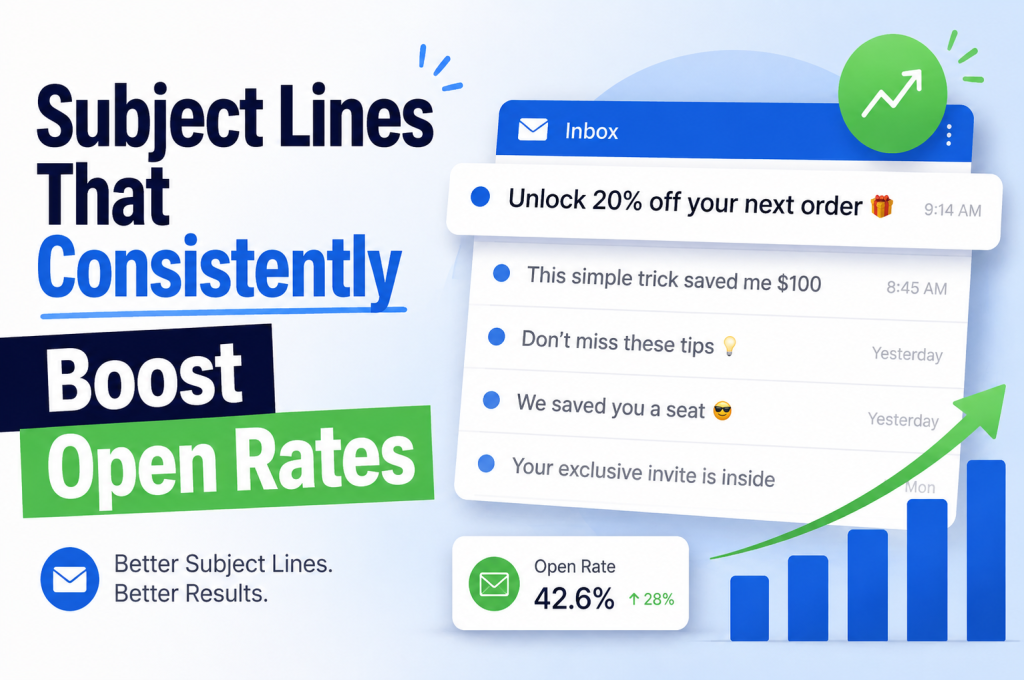
The best email subject lines earn attention by making the next action feel worthwhile. They tend to be concise, relevant and specific, with enough curiosity to encourage an open without becoming vague or misleading. Personalization can help when it reflects something meaningful about the recipient; urgency and scarcity can work when they’re genuine; and benefit-driven language often succeeds because it answers the reader’s unspoken question: What’s in this for me? There is no magic collection of words that guarantees higher email open rates, though. Audience, intent, sender reputation, deliverability and context matter enormously, which is why A/B testing should sit behind almost every subject-line decision.
A great email can fail before anyone reads the first sentence.
Not because the offer is weak. Not because the design is poor. Not even because the call to action misses the mark.
It can fail because of six words sitting in an inbox.
The subject line is a tiny piece of copy carrying an enormous responsibility. It has to interrupt a scan, create enough interest to earn attention and give the recipient a reason to open — often while competing with dozens of other emails doing exactly the same thing.
That makes writing effective subject lines less about finding a clever phrase and more about understanding why somebody opens an email in the first place.
And that distinction matters.
There Isn’t a Magic Subject Line Formula
Search for subject line best practices and you’ll quickly encounter supposed rules.
Use a number. Don’t use a number.
Add the recipient’s first name. Avoid obvious personalization.
Create urgency. Don’t sound pushy.
Keep it short. Add more detail.
Ask a question. Make a statement.
Contradictory? Absolutely.
Useless? Not necessarily.
The problem comes from treating findings from different audiences and different types of email campaigns as though they’re interchangeable.
A cold sales email sent to a company director has a different job from a promotional email sent to an existing customer. A newsletter announcing a useful new resource isn’t operating under the same conditions as an abandoned-basket email. Likewise, a subscriber who knows your brand isn’t assessing your message in the same way as somebody seeing your sender name for the first time.
So rather than searching for one universally perfect formula, think in terms of four questions:
- Who is receiving this email?
- Why would they care about it now?
- What expectation does the subject line create?
- Does the email fulfil that expectation?
That final question is particularly important.
A curiosity gap may increase email opens, but if the message behind it disappoints the reader, you’ve simply moved the problem further down the funnel.
The open isn’t the objective. It’s permission to continue the conversation.
That conversation should eventually produce meaningful email engagement: a reply, a click, an enquiry, a purchase, a booking or another relevant conversion.
This is similar to the distinction between attracting traffic and attracting useful traffic. Good SEO isn’t simply about creating more impressions; it’s about connecting relevant searches with the right destination. Email subject lines operate on much the same principle. Attention matters, but relevant attention matters more.
What Actually Makes Someone Open an Email?
Picture an inbox as a rapid series of micro-decisions.
Delete. Ignore. Maybe. Open.
Recipients don’t normally stop to conduct a detailed linguistic analysis of every subject line. They scan. Sender recognition, timing, previous experience and the few words visible beside the sender all combine to create an almost immediate judgement.
Strong subject lines generally give the brain one or more compelling reasons to stop scanning.
Those reasons tend to revolve around:
- Relevance — This concerns me.
- Benefit — There’s something useful here.
- Curiosity — I want to know what happens next.
- Specificity — I understand what this is about.
- Timeliness — This matters now.
- Recognition — I know and trust this sender.
- Personal context — This appears to relate to something I’ve done, wanted or shown interest in.
The clever part is combining these without trying to cram everything into one line.
Compare:
Newsletter – August Update
with:
Three changes affecting your August campaigns
The second version introduces specificity, relevance and an information gap. What are the three changes? Do they affect me? Is there something I need to do?
Now compare:
Hurry! Don’t miss this AMAZING offer!!!
with:
Your early-access price ends Friday
Both introduce urgency. Only one explains why there is urgency.
That’s the difference between manufactured pressure and useful context.
The same principle appears elsewhere in digital marketing. An effective PPC campaign has to align search intent, ad copy and the destination after the click. If the promise and destination don’t match, the click itself isn’t much of a victory.
Email works similarly.
Subject line → expectation → open → message → action
Break that chain anywhere and performance suffers.
Curiosity Works Best When You Give It Something to Hold Onto
Curiosity is one of the most dependable concepts behind compelling subject lines, but it’s also one of the easiest to misuse.
The principle is simple: reveal enough information to create interest, but leave an unanswered question.
That’s the curiosity gap.
Consider these two imaginary subject lines:
We need to tell you something
and:
The checkout mistake costing stores conversions
Both create an open loop. The difference is that the second provides context.
A retailer, marketer or ecommerce manager immediately understands the territory. There’s an identifiable pain point — lost conversions — and an unresolved piece of information: what is the mistake?
The first line could be about almost anything.
Curiosity without relevance becomes vagueness.
Curiosity with relevance becomes intrigue.
Useful Curiosity Patterns
Some reusable structures include:
- The [mistake/problem] that’s affecting [desired result]
- What most people miss about [topic]
- Before you [action], check this
- We tested [X]. Here’s what happened
- Why [common assumption] isn’t always true
- The unexpected reason your [thing] isn’t working
- One change that made [specific result] easier
Notice that these aren’t finished subject lines to copy blindly.
They’re frameworks.
The details you put inside them determine whether they feel useful, surprising, conversational or painfully generic.
There is also a fine line between an information gap and clickbait. If your subject says “The email mistake destroying your sales” and the message eventually reveals that the devastating mistake is merely forgetting to proofread, the reader has been oversold.
You might win the open and lose trust.
Relevance Beats Cleverness
A beautifully written subject line about something the recipient doesn’t care about is still an irrelevant subject line.
That’s why audience segmentation deserves much more attention than swapping individual words.
Suppose an online shop sends this:
Something special for you
It’s short. There’s intrigue. It sounds personal.
But there’s virtually no information.
Now imagine the same retailer knows a segment of customers previously bought products from a particular category:
New arrivals based on what you’ve been browsing
Suddenly there is contextual relevance.
Go further and behavioural personalization can draw on browsing behaviour, purchase history, lifecycle stage, customer interests or other genuine intent signals. The objective isn’t to demonstrate how much data you possess. It’s to make the message more useful.
That distinction is crucial.
Personalization should feel helpful, not watched.
Dropping somebody’s first name into a subject line isn’t automatically meaningful personalization:
Sarah, don’t miss this!
may actually contain less useful information than:
The service you viewed is available again
The first is technically personalised. The second is contextually personalised.
Context usually has more substance.
This is one reason email shouldn’t be treated as an isolated marketing channel. The experience after the open matters just as much as the inbox impression. If someone clicks through, good website design should continue the same message, intent and expectation rather than forcing the visitor to work out what they’re supposed to do next.
Think of it as message-match.
Inbox promise → email content → landing experience
The tighter that relationship becomes, the more useful the entire campaign becomes.
Benefits Give People a Reason to Care
Features describe.
Benefits answer why it matters.
That distinction can transform a subject line.
Compare:
Introducing our new reporting dashboard
with:
See your campaign results without building another spreadsheet
The first announces something new. The second communicates an outcome.
This doesn’t mean announcements are ineffective. New, introducing, update and similar language can create anticipation, particularly when the recipient already cares about the product or brand. But novelty alone isn’t always enough.
A stronger question is:
What becomes better for the reader because this exists?
Perhaps they’ll:
- save time;
- avoid a common mistake;
- reduce costs;
- discover something useful;
- get earlier access;
- make a better decision;
- solve a persistent problem; or
- achieve a desired result faster.
That gives you the raw material for benefit-driven subject lines.
Instead of:
Our September Email Marketing Guide
you might test:
Write your next campaign in half the time
Instead of:
New Conversion Report Available
try:
See where your customers stop buying
The subject line moves away from describing the thing and towards communicating the value of the thing.
But there’s an important word in that previous sentence: test.
Because even a subject line that looks stronger on paper can behave very differently once it reaches a real inbox.
A/B Testing Turns Opinions Into Evidence
Subject lines are full of opinions masquerading as rules.
Someone says questions increase open rates. Someone else swears by numbers. Another marketer insists that lowercase subject lines feel more conversational. Then a case study appears showing precisely the opposite.
This is where A/B testing becomes useful.
Instead of debating which subject line should perform better, let your audience help answer the question.
A simple subject-line split test takes two variants, sends each to comparable portions of your audience and measures the resulting campaign performance.
For example:
Variant A:
5 ways to improve your email campaigns
Variant B:
Are your email campaigns missing this?
One leads with specificity and a number. The other uses a question and curiosity gap.
Neither is inherently superior.
The useful question is:
Which approach works better for this audience, in this context, for this particular type of email?
That distinction is what makes testing valuable.
Test One Meaningful Variable at a Time
If one subject line says:
5 quick ways to increase conversions
and the alternative says:
Are these mistakes costing your business sales?
you aren’t really testing one thing.
You’ve changed:
- the format;
- the emotional trigger;
- the length;
- the use of a number;
- the language;
- the promise; and
- the psychological mechanism.
If one wins, you won’t know why.
A cleaner test might be:
5 ways to improve your landing page
versus:
Ways to improve your landing page
Now the primary variable is the number.
Or:
Your campaign report is ready
versus:
James, your campaign report is ready
Now you’re testing first-name personalization.
Good testing methodology is deliberately boring. Change one meaningful element, establish a control subject line, compare it with the challenger and record what happens.
Over time, those individual tests become much more valuable than another article telling you that seven words is the perfect length.
They become evidence about your own audience.
Don’t Judge Subject Lines by Open Rate Alone
There’s another complication.
Open-rate tracking isn’t as clean as it once was.
Privacy technologies, most notably Apple Mail Privacy Protection (MPP), can make an email appear to have been opened even when the recipient hasn’t consciously opened and read it. That means a reported open rate shouldn’t automatically be interpreted as a precise count of interested humans.
This doesn’t make email open rates useless.
It makes them directional.
If one campaign suddenly performs very differently from your usual baseline, that’s worth investigating. If repeated A/B tests reveal a consistent pattern across a sufficiently large audience, that’s useful too.
But campaign performance should be viewed more broadly.
Consider:
| Metric | What It Can Help You Understand |
|---|---|
| Open rate | Whether the inbox presentation appears to attract attention |
| Click rate | Whether recipients engage with the content after opening |
| Click-through behaviour | Which offers, links or ideas generate interest |
| Conversion rate | Whether recipients complete the desired action |
| Reply rate | Particularly useful for conversational and sales emails |
| Unsubscribe rate | Whether expectations, frequency or relevance may be wrong |
| Spam complaints | Whether targeting, trust or expectation setting has broken down |
Imagine Subject Line A produces more opens but considerably fewer conversions than Subject Line B.
Which one won?
If the purpose of the email was to generate conversions, probably B.
A high open rate can tell you that you won attention. It cannot, by itself, tell you whether that attention was valuable.
This is why the strongest email analytics connect inbox behaviour with what happens afterwards.
How Long Should an Email Subject Line Be?
Short enough to understand quickly.
Long enough to communicate something worth understanding.
That’s less satisfying than a precise character count, but considerably more useful.
Brevity matters because inboxes are scanned, not studied. It matters even more on mobile devices, where available screen space can truncate longer subject lines.
But aggressively shortening every message can remove the very detail that makes it compelling.
Consider:
A quick question
Short? Yes.
Specific? No.
Now:
A quick question about your September campaign
Longer, but much clearer.
Or compare:
Save time
with:
Save an hour on your weekly reporting
Again, the longer version earns its extra words by adding specificity.
The goal isn’t therefore to achieve the fewest possible characters.
It’s to remove words that aren’t doing any work.
Edit for Density, Not Simply Length
Take this:
We wanted to let you know about some important new changes to our service
It can become:
Important changes to your service
Nothing meaningful has disappeared.
That’s good editing.
The principle is simple:
Every word in a short subject line has to justify the space it occupies.
Remove throat-clearing language. Remove unnecessary adjectives. Remove repetition. Put useful information earlier, particularly when designing for mobile optimization.
And don’t forget the preheader text.
Your Preview Text Is Part of the Subject Line
Technically, the email preview text or preheader isn’t part of the subject line.
Practically, recipients often experience them together.
An inbox might display something like:
Your campaign results are ready
See which channel generated the strongest return…
Those two pieces of copy are working as a pair.
Yet countless campaigns waste the second line by allowing email software to pull in whatever text appears first in the message:
View this email in your browser…
or:
Having trouble viewing this email?…
That is valuable inbox real estate doing absolutely nothing.
A better approach is to treat the subject and preheader as a miniature two-part advertisement.
The subject line creates the reason to stop.
The preview text expands the idea.
Subject + Preheader Combinations
Subject: Your most-viewed products this month
Preheader: Plus the three pages customers left fastest.
Here, the preview adds a second information gap.
Subject: Your early-access window opens today
Preheader: Subscribers can browse the collection before Friday.
Here, the preview explains the exclusivity.
Subject: Still thinking about it?
Preheader: The item you viewed is still available.
Here, behavioural personalization supplies the context that the subject deliberately leaves open.
Avoid simply repeating yourself:
Subject: Our summer sale starts today
Preheader: Our summer sale has now started.
Nothing new has been added.
A better preheader could introduce the strongest benefit, deadline, qualification or supporting detail.
Should You Use Numbers in Subject Lines?
Numbers are interesting because they create specificity almost instantly.
Compare:
Ways to improve your newsletter
with:
7 ways to improve your newsletter
The second creates a clearer expectation. The reader knows they’re opening a finite list rather than an undefined discussion.
Numbers can communicate:
- quantities;
- percentages;
- deadlines;
- time periods;
- prices;
- savings;
- rankings;
- steps;
- results; and
- data.
For example:
3 fixes for an underperforming campaign
Your offer ends in 48 hours
The 5 pages customers visit most
12 ideas for your next newsletter
But context matters.
Research into marketing emails has sometimes found positive results from numerical subject lines, while findings from sales outreach have produced less enthusiastic conclusions. That’s not necessarily a contradiction.
A newsletter subscriber and a cold prospect aren’t making the same decision.
Someone who has deliberately subscribed to educational content might welcome:
9 conversion ideas worth testing
A busy decision-maker receiving an unsolicited sales email might interpret:
7 reasons you need our software
very differently.
Numbers aren’t magic.
They’re a formatting device that can increase specificity when the number itself contributes useful information.
Questions Can Create an Instant Conversation
Questions have another advantage: they invite the reader to answer mentally.
Is your checkout costing you sales?
Your brain immediately searches for an answer.
Maybe.
How would I know?
What could be wrong with it?
That tiny internal response creates engagement before the email has even been opened.
Questions work particularly well when they connect to a recognised pain point, desire, obstacle or unresolved problem.
For example:
Still spending Friday afternoon on reports?
Which page loses the most customers?
Ready for the Christmas rush?
Are people finding you on Google?
The important word here is recognised.
Ask a question the recipient doesn’t care about and nothing happens.
Worse, use a painfully obvious sales question:
Would you like to increase revenue?
and the mechanism becomes transparent.
Of course most businesses would like to increase revenue. The question reveals nothing about why this particular email deserves attention.
Specific questions are usually stronger.
Instead of:
Want more customers?
consider:
Where are customers abandoning your checkout?
Now there’s a problem to investigate.
Questions can also function as open loops. They introduce something unresolved and leave the answer on the other side of the open.
But again, the email has to answer the question.
Personalization Is Bigger Than a First Name
For years, one of the most familiar subject line formulas has been:
[First Name], [message]
Sometimes it works.
Sometimes it looks like mail merge.
The difference usually comes down to contextual relevance.
True personalization can involve:
- Lifecycle stage — new subscriber, repeat customer, dormant customer or active lead.
- Purchase history — products, services or categories previously purchased.
- Browsing behaviour — pages, products or resources someone has shown interest in.
- Geography — genuinely relevant local information.
- Customer interests — topics or categories the subscriber has selected or repeatedly engaged with.
- Previous actions — downloads, registrations, enquiries, abandoned baskets or account activity.
- Relationship — customer, subscriber, prospect, member or existing client.
This creates far more interesting possibilities than adding a name.
Instead of:
David, our new guide is here
you might have:
A follow-up to the guide you downloaded
Instead of:
Emma, we’ve picked these for you
you could use:
More from the collection you viewed
Instead of:
Tom, don’t forget your order
try:
You left something in your basket
Not every version will perform better, of course. That’s precisely why segmentation and split testing matter.
But the broader lesson remains:
Personalization is strongest when the relevance would survive even if you removed the person’s name.
Urgency Works. Fake Urgency Doesn’t.
Ends tonight.
Last chance.
Only 24 hours left.
Final reminder.
These phrases persist because urgency can be a powerful motivator. Humans tend to assign greater importance to opportunities that are disappearing.
Add scarcity and the effect can become stronger:
Only 12 places remaining
Final appointments for August
Subscriber access closes tonight
Now the recipient isn’t merely deciding whether something is desirable. They’re deciding whether postponement could mean losing access to it.
This touches on FOMO, loss aversion and anticipation.
But there’s a catch.
Urgency depends on credibility.
If every promotion is a “last chance”, every Friday brings a “final opportunity” and every countdown mysteriously resets on Monday morning, the audience learns something.
Not that your offers are urgent.
That your deadlines aren’t meaningful.
Genuine Urgency Has a Reason
Strong urgency usually answers why now?
For example:
Registration closes at 5pm Friday
has a concrete deadline.
Book before prices change on Monday
provides a consequence.
Subscriber access ends tonight
combines exclusivity and timing.
Contrast that with:
ACT NOW BEFORE IT’S TOO LATE
There’s plenty of pressure and almost no information.
Scarcity should work the same way.
If only three places genuinely remain, saying so provides useful information. If inventory isn’t actually limited, manufacturing scarcity may create a short-term emotional trigger at the expense of long-term trust.
And trust compounds.
Once recipients believe your subject lines accurately represent what follows, sender recognition itself can become a reason to open.
Exclusivity Makes the Recipient Feel Selected
Urgency says:
You have limited time.
Scarcity says:
There is limited availability.
Exclusivity says:
Not everybody gets this.
That’s a subtly different psychological mechanism.
Words and concepts such as:
early access, subscriber-only, members, invitation, reserved, private, priority and first look
can make an email feel more valuable because access itself becomes part of the benefit.
For example:
Your subscriber preview starts today
An early look before Friday’s launch
Reserved access for existing customers
The strongest versions make the exclusivity genuine.
If the “exclusive” offer is publicly visible to everybody on the website, the word loses its meaning.
Again, expectation setting matters.
A compelling subject line shouldn’t merely generate excitement. It should accurately frame the experience waiting behind the click.
Actionable Language Can Create Momentum
Some subject lines describe.
Others invite movement.
Discover what’s changed
See your results
Compare the two options
Plan your September campaign
Choose your preferred date
These use action verbs to give the recipient something concrete to do.
Actionable language works particularly well when the action itself contains a benefit.
“Click here” isn’t compelling because clicking isn’t the desired outcome.
“See where your traffic comes from” is different.
The action is see.
The reward is understanding where your traffic comes from.
This is a useful way to evaluate almost any action-oriented subject line:
Verb + useful outcome
- Discover + an insight
- Compare + alternatives
- Save + time or money
- Learn + something valuable
- Find + an answer
- See + a result
- Choose + an option
- Claim + a legitimate benefit
- Reserve + something limited
- Avoid + a problem
But even actionable language needs restraint.
Stacking commands can make a subject line sound aggressive:
Hurry! Click now and claim your deal today!
That’s not momentum.
That’s shouting.
A conversational tone usually creates a better balance between action and persuasion.
And that leads to one of the biggest distinctions in subject-line writing: the difference between talking to an audience that knows you and trying to earn attention from somebody who doesn’t.
Marketing Emails and Cold Sales Emails Play by Different Rules
One of the easiest ways to misunderstand subject-line research is to assume every inbox relationship is the same.
It isn’t.
A subscriber who voluntarily joined your mailing list has already given you a small amount of permission. An existing customer may recognise your sender name immediately. Someone who has purchased repeatedly may actively anticipate your emails.
A cold prospect has given you none of those advantages.
That changes the job of the subject line.
A marketing email can sometimes lean comfortably into:
- benefits;
- product announcements;
- exclusivity;
- curiosity;
- seasonal relevance;
- offers;
- scarcity; and
- promotional urgency.
A cold sales email usually has to establish relevance much faster while avoiding the unmistakable smell of a mass sales campaign.
Compare:
Subscriber preview: our new collection has arrived
with:
Exclusive opportunity to transform your business today
The first makes sense within an established brand relationship.
The second sounds like hundreds of other prospecting emails.
This also helps explain why apparently contradictory subject line best practices can both be valid.
Personalization may improve one type of email campaign while producing little benefit in another. Numbers may attract newsletter readers while making cold outreach appear automated. Urgency can motivate an existing customer who already wants a product while creating suspicion when used by a salesperson the recipient has never met.
Context changes the meaning of the technique.
So before copying any supposedly winning subject line, ask where the evidence came from.
Was it:
- ecommerce?
- B2B sales?
- newsletters?
- abandoned baskets?
- promotional campaigns?
- customer retention?
- lead nurturing?
- cold outreach?
The closer the test environment resembles your own campaign, the more useful the finding becomes.
Write Like a Person, Not an Email Marketing Template
Sometimes the most effective way to interrupt an inbox is to sound surprisingly normal.
Not artificially casual.
Not packed with slang.
Just human.
Consider:
A thought about your next campaign
There’s no dramatic promise. No capitalised urgency. No inflated claim.
It simply sounds like one person starting a conversation with another.
A conversational tone can be especially useful when an inbox is crowded with subject lines trying desperately to outperform each other:
MASSIVE SAVINGS — TODAY ONLY
DON’T MISS OUR BIGGEST OFFER EVER
EXCLUSIVE DEAL JUST FOR YOU
Against that backdrop, restraint becomes its own form of pattern interruption.
A small change worth testing
may attract attention precisely because it isn’t screaming for it.
This doesn’t mean every subject line should be understated. A retail promotion and a personal B2B email naturally sound different.
The point is to make tone consistent with the sender, audience and message.
Brand recognition also matters here. If people repeatedly receive useful emails from you, the sender name itself begins doing part of the persuasive work.
That is difficult to manufacture with copy.
It has to be earned.
Announcements Work When the News Actually Matters
There is a reason words such as new, introducing, just launched, update and now available appear so frequently in email campaigns.
Humans notice change.
New information creates a natural information gap:
What’s different?
That makes announcements particularly useful for:
- product launches;
- new services;
- important updates;
- new features;
- research findings;
- events;
- availability changes;
- major company developments; and
- genuinely useful content.
For example:
Introducing a faster way to manage your reports
does more than announce something new. It connects novelty with a benefit.
Likewise:
New: see all your campaign data in one place
combines an announcement with a clear value proposition.
The weaker alternative is novelty without significance:
Exciting news from our team!
Exciting to whom?
The business may be delighted. The subscriber has not yet been given a reason to share that enthusiasm.
A useful editing question is:
Why should this announcement matter to the person receiving it?
Put some version of that answer into the subject line or preview text.
Surprise Can Break the Scanning Pattern
Not all attention comes from urgency or benefit.
Sometimes it comes from encountering something unexpected.
This is where surprise, controversy and status-quo challenges can work.
Examples might include:
Your best-performing campaign might be the problem
Stop trying to maximise every open rate
Why we removed our highest-clicked button
These subject lines create tension because the statement doesn’t immediately fit the reader’s expectation.
That tension creates curiosity.
Why would a successful campaign be a problem?
Why wouldn’t I want more opens?
Why remove something people click?
Used carefully, this can be extremely effective for educational content, thought leadership and newsletters.
Used carelessly, it becomes contrarian clickbait.
“Everything you know about email is WRONG”
might create a pattern interruption, but it also makes an enormous promise.
The email then has to justify it.
The better approach is to challenge a specific assumption and provide evidence for the challenge.
Surprise should lead somewhere useful.
How-To Subject Lines Promise a Solution
“How to” remains one of the simplest subject line formulas because it communicates an immediate exchange.
The reader has a problem or desired outcome.
The email offers help.
How to reduce abandoned baskets
How to write a shorter sales email
How to find your highest-converting pages
There’s very little mystery about what the recipient will receive.
That can be a strength.
Not every email needs a curiosity gap.
Sometimes clarity wins.
How-to subject lines become stronger when the desired outcome is specific:
How to improve your marketing
is broad.
How to find the campaigns wasting your budget
is much more tangible.
You can also remove the literal phrase “how to” while keeping the same psychological structure:
A faster way to plan next month’s emails
The simplest way to compare campaign performance
Three steps to a cleaner checkout
The underlying promise remains:
Open this and you’ll learn how to achieve something useful.
Don’t Forget the Sender Name
Subject-line optimisation often ignores one of the most prominent elements in the inbox:
who the email is from.
Sender recognition can influence whether somebody opens an email before they have properly processed the subject.
A familiar brand with a history of sending valuable messages begins with an advantage.
An unfamiliar or suspicious sender begins with a deficit.
That’s why subject lines cannot compensate indefinitely for poor email practices.
If previous campaigns were irrelevant, excessively frequent or misleading, subscribers remember.
If previous emails were consistently useful, they remember that too.
Brand recognition becomes part of the decision.
This creates a feedback loop:
Useful emails → positive expectations → stronger sender recognition → greater willingness to open future emails
The reverse also applies:
Misleading emails → disappointment → weaker trust → declining engagement → future emails ignored
No subject line formula can permanently escape that cycle.
Deliverability Comes Before Copywriting
There is another obvious requirement for generating opens:
The email has to reach the inbox.
A beautifully crafted subject line buried in spam isn’t doing much work.
Deliverability is influenced by far more than the words in the subject field. Sender reputation, authentication, engagement history, list quality, complaint rates, bounce rates and sending behaviour can all affect inbox placement.
This is why obsessing over lists of supposed spam trigger words can be misleading.
Modern spam filtering is considerably more sophisticated than simply spotting one word and banishing the message.
That doesn’t mean presentation is irrelevant.
Excessive capitalization, misleading claims, strange punctuation and aggressive promotional language can make an email look less trustworthy to recipients even when the technical spam filter lets it through.
Compare:
CLAIM YOUR FREE OFFER NOW!!!!!!
with:
Your complimentary trial is ready
The difference isn’t simply deliverability.
It’s credibility.
The second sounds like a message that might belong in a professional inbox. The first looks like something many recipients have trained themselves to ignore.
Capitalization and Punctuation: Less Is Usually More
Subject lines are small, which means tiny stylistic decisions become conspicuous.
ALL CAPS IS LOUD.
Multiple exclamation marks!!!
Constant Questions???
Odd Capitalization Can Also Feel Artificial.
There are legitimate reasons to test different capitalization styles. Sentence case can feel conversational. Title case may suit certain brands or announcements. A single question mark naturally belongs after a genuine question.
The issue is excess.
Punctuation should support meaning rather than manufacture excitement.
Compare:
Our new service is here!
with:
OUR NEW SERVICE IS HERE!!!!!!!!
The first can communicate enthusiasm.
The second demands it.
Likewise, punctuation can change rhythm:
One question about your campaign
feels different from:
One question about your campaign?
The second creates an explicit invitation to answer.
Small details like these can be included in A/B testing, particularly once larger strategic questions — audience, relevance, offer and value proposition — have already been addressed.
Don’t spend three hours debating a comma while ignoring the fact that the email has nothing interesting to say.
What About Emojis in Subject Lines?
Emoji usage is another area where universal rules aren’t particularly useful.
For some consumer brands, an appropriate symbol may add personality or help a subject stand out visually.
For other audiences, it can feel out of character or overtly promotional.
The important consideration is brand fit.
Ask:
- Would we naturally communicate this way elsewhere?
- Does the symbol add information or merely decoration?
- How will it appear across devices and email clients?
- Does it make the message easier to scan?
- Could it make a professional communication feel less credible?
The fact that something attracts attention doesn’t automatically make that attention beneficial.
That principle applies to almost every subject-line technique in this article.
Specificity Is One of the Safest Improvements You Can Make
When a subject line feels weak, look for vague language.
Words such as:
things, stuff, news, update, opportunity, solution, results and information
aren’t necessarily bad.
They’re simply incomplete.
Compare:
An important update
with:
Your delivery schedule changes Monday
Compare:
Ways to get better results
with:
4 ways to reduce checkout abandonment
Compare:
A new solution for your business
with:
See every campaign cost in one dashboard
Specificity helps because it reduces uncertainty without necessarily removing curiosity.
The reader knows the territory but may still want the detail.
This balance is worth remembering:
Too little information → confusion
Enough information + unanswered detail → curiosity
Too much information → no reason to open
The sweet spot lies somewhere between.
Build the Subject Line Around the Email, Not Afterwards
Subject lines are often written at the end of the campaign.
The email is designed. Copy approved. Links checked.
Then someone asks:
What shall we put in the subject line?
Five minutes later, the campaign goes out.
A better process starts with the core promise of the email.
Try reducing the entire message to one sentence:
After reading this email, the recipient will understand/discover/receive ________.
That blank gives you the foundation.
If the email helps someone identify three costly reporting errors, the subject line might become:
3 reporting errors worth checking today
If it announces early access to a product:
Your early access starts Thursday
If it contains new research:
What 500 campaigns taught us about conversions
The subject line then becomes an accurate compression of the value inside the email.
That creates stronger message-match and better expectation setting.
A Practical Subject-Line Framework
When you’re staring at an empty subject field, don’t begin by searching for a clever adjective.
Start with the recipient.
Work through this sequence:
- Audience: Who exactly is receiving the message?
- Context: What do they already know about you or the topic?
- Purpose: What is the email actually trying to achieve?
- Value: What does the recipient gain from opening?
- Relevance: Why does that value matter to this particular audience?
- Timing: Is there a genuine reason it matters now?
- Mechanism: Would clarity, curiosity, benefit, urgency, scarcity, exclusivity or surprise best communicate the idea?
- Specificity: Can vague language be replaced with something concrete?
- Length: Can unnecessary words disappear without sacrificing meaning?
- Expectation: Does the email genuinely deliver what the subject promises?
- Preview text: Can the preheader add useful information rather than repeat the subject?
- Testing: What meaningful alternative could you compare against it?
That process takes slightly longer than typing “Last chance!” into the subject field.
It also gives you something far more defensible.
Subject Line Formulas Worth Testing
Formulas are useful as starting points, not commandments.
Here are several structures that can be adapted around genuine audience needs.
1. The Specific Benefit
[Achieve outcome] without [common obstacle]
Example:
Plan next month’s campaigns without another spreadsheet
2. The Curiosity Gap
The [thing] most [audience] overlook
Example:
The metric most email reports overlook
3. The Number
[Number] ways to [desired outcome]
Example:
5 ways to make your next newsletter clearer
4. The Question
Are you [experiencing relevant problem]?
Example:
Are customers abandoning the same page?
5. The Genuine Deadline
[Benefit/opportunity] ends [specific time]
Example:
Early access closes Friday at 5pm
6. The Announcement
New: [specific improvement]
Example:
New: compare all campaign results in one view
7. The Status-Quo Challenge
Why [common belief] isn’t always true
Example:
Why a higher open rate isn’t always better
8. The How-To
How to [achieve specific result]
Example:
How to find your weakest landing page
9. The Behavioural Follow-Up
[Context from recipient action] + [useful next step]
Example:
Still comparing options? Here’s the difference
10. The Open Loop
We tested [thing]. Here’s what happened
Example:
We shortened every subject line. Here’s what happened
The formula gets you moving.
Relevance makes it work.
Before You Press Send
A final subject-line check doesn’t need to become a 40-point ritual.
Read it once and ask:
- Is the meaning clear?
- Is there a reason to care?
- Does it suit this audience?
- Is the benefit or point specific enough?
- Have unnecessary words been removed?
- Does any urgency or scarcity reflect reality?
- Is personalization genuinely relevant?
- Does the preview text add something?
- Will the email fulfil the promise?
- Is there a useful alternative worth testing?
Then zoom out.
Look at the sender name, subject line and preview text together.
That’s what the recipient sees.
Not your strategy document.
Not the beautifully designed email underneath.
Not the hours spent writing it.
Just a handful of signals asking for attention.
The Best Subject Line Is the One Your Audience Proves Works
There is no secret vocabulary that guarantees an open.
No perfect character count.
No universal formula involving a first name, number, question mark or carefully positioned action verb.
And that’s good news.
Because it means successful email marketing isn’t reserved for people who know some mysterious copywriting trick.
The strongest subject lines tend to come from something much more practical: understanding the audience, communicating relevant value, creating an appropriate amount of curiosity and then testing what actually happens.
Curiosity can create the open loop.
Specificity can make it credible.
Personalization can increase contextual relevance.
Benefits give the recipient a reason to care.
Urgency and scarcity can make timing matter.
Brevity makes the message easier to process.
Preview text provides another opportunity to persuade.
Sender reputation and deliverability help ensure the message gets the chance to compete at all.
And A/B testing separates assumptions from evidence.
Put those pieces together and the objective changes.
You’re no longer hunting for Subject Lines That Consistently Boost Open Rates as though there is a secret list hidden somewhere.
You’re building a repeatable system for discovering what earns attention from your audience.
That is a much more useful advantage.
Because the ultimate goal isn’t to trick somebody into opening one email.
It’s to become the sender whose next email is worth opening too.
Frequently Asked Questions About Email Subject Lines
1. What is a good email open rate?
A good email open rate varies considerably by industry, audience, email type and how the metric is measured. A newsletter sent to highly engaged subscribers shouldn’t necessarily be benchmarked against a large promotional campaign or cold outreach.
Open rates should therefore be compared primarily against your own historical campaign performance rather than treated as a universal score.
There is another complication: Apple Mail Privacy Protection (MPP) and similar privacy features can inflate reported email opens. For a more complete picture, consider open rate alongside click rate, conversions, replies, unsubscribes and other engagement signals.
2. What is the best time to send an email for higher open rates?
There is no single best send time for every email list. The right time depends on when your particular audience is most likely to notice and engage with the message.
A B2B audience may behave differently from retail customers, while location, working patterns, time zones and the purpose of the email can all influence results.
Rather than relying exclusively on generic recommendations such as “Tuesday morning”, analyse your own email analytics and test different sending windows. Timing can influence performance, but a well-timed irrelevant email is still irrelevant.
3. Does the email sender name affect open rates?
Yes. The sender name is one of the first pieces of information a recipient sees and can strongly influence whether the message feels familiar, trustworthy and worth opening.
For established businesses, brand recognition and sender recognition can become valuable assets. If subscribers associate your sender name with consistently useful emails, they have another reason to pay attention when the next message arrives.
Consistency is generally helpful. Frequently switching between unfamiliar sender names can make recognition harder and may cause legitimate messages to look unexpected.
4. Should I include the company name in an email subject line?
Usually only when it adds useful context.
If your company name is already clearly displayed as the sender, repeating it in every subject line can consume valuable space without adding much information.
There are situations where including a brand or company name makes sense — account notifications, partnerships, event communications or messages where identifying the organisation immediately improves clarity.
Ask a simple question: does including the company name help the recipient understand why this email matters?
If not, that space can probably work harder.
5. Can changing a subject line improve an email campaign that is already underperforming?
Potentially, but first identify where the campaign is actually failing.
If relatively few recipients appear to open the message, the inbox presentation may deserve attention. That includes the subject line, sender name, preview text, timing, audience targeting and deliverability.
If plenty of people open but few click, changing the subject line probably won’t solve the underlying problem. The offer, content, call to action or message-match after the open may need attention instead.
Diagnose the stage of the funnel before changing the copy.
6. Should promotional emails mention discounts in the subject line?
They can, particularly when the discount is genuinely one of the strongest reasons to open.
Specific offers such as:
Save 20% until Sunday
often communicate more useful information than vague alternatives such as:
A special surprise inside
However, constantly leading with discounts can train subscribers to associate your emails — and potentially your products or services — primarily with reduced prices.
The strongest approach depends on the campaign. Sometimes the discount is the story. At other times, newness, exclusivity, product relevance, convenience or another benefit may provide a stronger reason to open.
7. Is it better to reveal the offer in the subject line or create curiosity?
It depends on what makes the email compelling.
If the offer itself is strong — a meaningful saving, important announcement, valuable resource or genuinely limited opportunity — clarity may outperform mystery.
If revealing everything removes the reason to open, a carefully constructed curiosity gap may work better.
The two approaches can also be combined:
Our biggest reporting update yet
creates curiosity.
New: build your report in half the time
reveals the benefit.
Neither approach automatically wins. Test clarity versus curiosity with comparable audience segments and measure what happens beyond the initial open.
8. Should different customer segments receive different subject lines?
Often, yes.
Different segments can have different motivations, pain points, purchase histories, levels of brand familiarity and lifecycle stages. One generic subject line has to compromise between all of them.
For example, a new subscriber may respond to introductory benefits, while an existing customer might care more about an update to something they already use. A dormant customer may require an entirely different reason to re-engage.
This is where audience segmentation and behavioural personalization become especially valuable.
The goal isn’t variation for variation’s sake. Create different subject lines when the differences between recipients give you a meaningful reason to change the message.
9. Can resending an email with a different subject line increase opens?
It can sometimes recover attention from subscribers who didn’t engage with the original campaign, but resending should be handled carefully.
A new subject line may frame the message differently or catch recipients at a more convenient time. However, repeatedly resending essentially the same campaign can also create fatigue.
If you test this approach, consider changing the timing and subject line while excluding people who have already engaged where your email platform allows appropriate segmentation.
More importantly, investigate why the first campaign underperformed. If poor targeting, weak relevance or deliverability caused the problem, another subject line alone may not fix it.
10. How often should I test new email subject line ideas?
Regularly enough to keep learning, but not so aggressively that every campaign becomes an unrelated experiment.
A useful testing programme builds knowledge progressively.
You might test:
curiosity vs clarity → benefit vs announcement → question vs statement → personalised vs non-personalised → short vs descriptive
Keep a record of the control subject line, winning variant, audience segment, campaign type and downstream results.
Over time, you’ll begin identifying patterns specific to your subscribers.
That’s considerably more valuable than accumulating a folder of supposedly high-performing subject lines from other businesses.
The objective isn’t to discover one unbeatable sentence.
It’s to develop a growing body of evidence about what your audience notices, what they value and what motivates meaningful engagement after the open.