
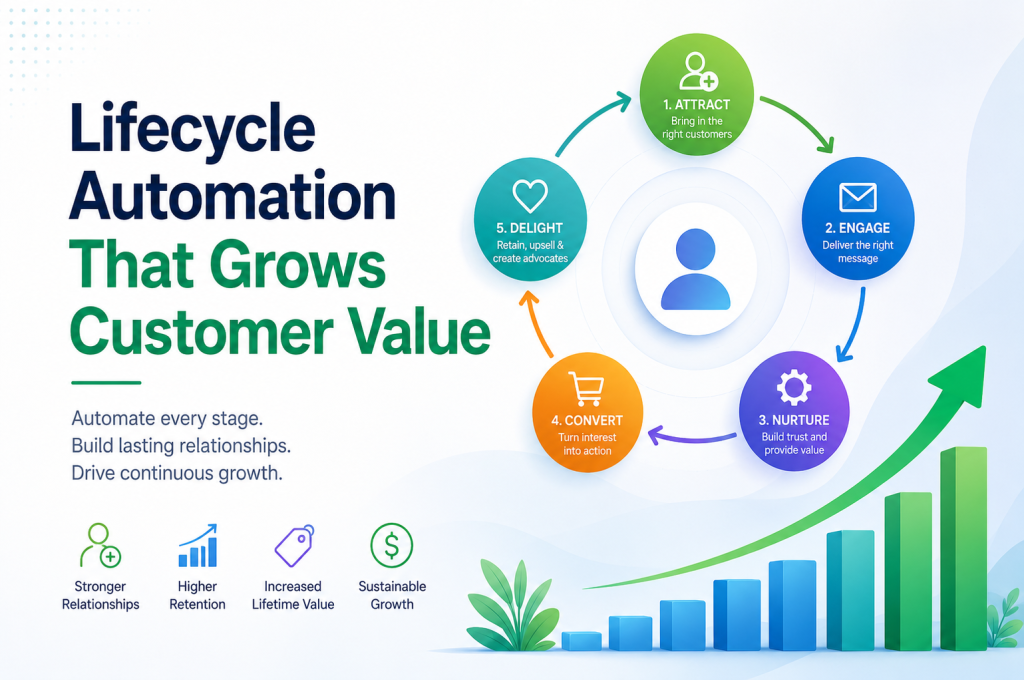
Businesses often focus heavily on acquiring new customers while overlooking the enormous value hidden within their existing audience. Customer lifecycle automation helps brands create meaningful interactions throughout every stage of the customer journey, from initial awareness and lead nurturing to onboarding, retention, repeat purchases, and customer advocacy. By combining marketing automation, customer data, behavioural triggers, personalization, and omnichannel marketing, businesses can increase customer lifetime value (CLV), reduce churn, improve customer satisfaction, and generate sustainable revenue growth. This guide explores how automated customer journeys create stronger relationships, better customer experiences, and long-term profitability.
Why Customer Lifecycle Automation Matters More Than Ever
Modern customers expect relevance.
They expect brands to remember their preferences, anticipate their needs, and communicate at the right moment through the right channel. Businesses that fail to meet these expectations often struggle with declining customer engagement, lower retention rates, and increasing acquisition costs.
Customer lifecycle automation addresses this challenge by delivering personalised experiences throughout every stage of the customer lifecycle.
Instead of relying on manual campaigns and generic communications, businesses can build automated workflows that respond intelligently to customer behaviour.
This shift transforms marketing from a series of disconnected campaigns into a continuous relationship-building process.
The most successful brands don’t simply generate sales; they systematically create value throughout the entire customer journey.
When implemented effectively, lifecycle marketing becomes a powerful engine for:
- Customer retention
- Customer loyalty
- Revenue growth
- Customer profitability
- Customer satisfaction
- Brand advocacy
- Customer value optimisation
Understanding the Customer Lifecycle
Before implementing automation, it’s important to understand the lifecycle stages customers naturally move through.
While individual businesses may define stages differently, most customer lifecycle management strategies include the following phases:
- Awareness
- Consideration
- Acquisition
- Onboarding
- Activation
- Retention
- Expansion
- Advocacy
Each stage represents an opportunity to improve customer experience and increase customer lifetime value.
Awareness Stage
The customer journey begins when a potential customer discovers your business.
This often occurs through channels such as:
- Organic search
- Paid advertising
- Social media
- Referral marketing
- Content marketing
- Industry recommendations
Businesses investing in strong visibility strategies often combine customer acquisition initiatives with ongoing digital marketing activities such as SEO to attract highly relevant prospects at the beginning of the marketing funnel.
At this stage, customer data is limited, making broad audience segmentation essential.
The goal is not immediate conversion.
The objective is generating awareness while beginning the process of lead generation and prospect nurturing.
Consideration Stage
Once awareness has been established, customers enter the consideration phase.
Here they compare solutions, evaluate alternatives, and seek evidence that a business understands their challenges.
This is where customer engagement becomes increasingly important.
Effective lifecycle campaigns during consideration often include:
- Educational content
- Case studies
- Demonstrations
- Customer success stories
- Expert insights
- Comparative resources
Automation can deliver dynamic content based on behavioural data, ensuring prospects receive information relevant to their interests and purchase intent.
The Role of Customer Data in Lifecycle Marketing
Every successful automation strategy is powered by data.
Without customer insights, automation quickly becomes little more than scheduled messaging.
Businesses that consistently grow customer value build systems capable of collecting and analysing:
- Behavioural data
- Purchase behaviour
- Website activity
- Email interactions
- Customer touchpoints
- Product engagement
- Customer intent signals
This information creates a unified customer profile that supports increasingly sophisticated customer journey orchestration.
The result is more meaningful interactions and stronger customer relationships.
Building a Data-Driven Foundation
A robust customer lifecycle automation strategy often relies on several interconnected systems:
| Technology | Purpose |
|---|---|
| CRM | Customer relationship management |
| Marketing Automation Platform | Campaign execution |
| Customer Data Platform (CDP) | Unified customer profiles |
| Analytics Tools | Customer behaviour analytics |
| Email Automation Software | Triggered customer communications |
| SMS Automation Systems | Real-time engagement |
Together, these tools provide the infrastructure necessary for intelligent customer lifecycle management.
Businesses investing in modern digital infrastructure frequently pair automation initiatives with professional website design to ensure customer experiences remain seamless across every interaction.
Segmentation: The Foundation of Personalization
Not all customers are the same.
One of the biggest mistakes businesses make is treating every contact identically.
Segmentation allows marketers to group audiences based on meaningful characteristics, enabling highly relevant messaging.
Common segmentation criteria include:
Demographic Segmentation
- Age
- Location
- Industry
- Company size
Behavioural Segmentation
- Purchase history
- Browsing behaviour
- Engagement levels
- Product usage
Lifecycle Segmentation
- New leads
- Active customers
- Loyal customers
- At-risk customers
- Dormant customers
Value-Based Segmentation
- High-value customers
- Frequent purchasers
- Subscription customers
- Advocacy groups
When combined with personalization, segmentation dramatically improves customer engagement and conversion optimisation.
Rather than sending identical communications to thousands of contacts, businesses can deliver experiences tailored to individual needs and behaviours.
From Personalization to Predictive Personalization
Traditional personalization often relies on simple tactics such as using a customer’s name in an email.
Modern customer lifecycle automation goes much further.
Advanced organisations increasingly use:
- AI-powered personalization
- Predictive analytics
- Customer intelligence
- Predictive customer journeys
- Next best action modelling
- Real-time personalization
These capabilities allow businesses to anticipate customer needs before they are explicitly expressed.
For example, a customer showing repeated interest in a particular service category may automatically receive relevant educational content, recommendations, or consultation offers.
The result is a more natural and valuable customer experience that strengthens trust while increasing conversion opportunities.
Why Behaviour-Based Triggers Outperform Scheduled Campaigns
Traditional marketing relies heavily on fixed schedules.
Lifecycle automation introduces something far more effective: behaviour-based triggers.
Rather than sending messages according to a calendar, triggered campaigns respond to actual customer actions.
Examples include:
- Downloading a guide
- Visiting a pricing page
- Abandoning a checkout process
- Completing a purchase
- Leaving a review
- Becoming inactive
These trigger-based marketing activities create more relevant interactions because they align with real customer intent.
In the next section, we’ll explore how automated workflows, onboarding sequences, customer activation strategies, and retention automation transform these behavioural signals into measurable revenue growth and long-term customer loyalty.
Automated Workflows: The Engine Behind Scalable Customer Relationships
At the heart of every successful customer lifecycle automation strategy lies a carefully designed system of automated workflows.
These workflows allow businesses to deliver the right message, to the right customer, at the right time, without requiring constant manual intervention.
More importantly, they create consistency.
Whether a customer enters your ecosystem today or six months from now, they receive a high-quality experience designed to guide them through the next logical step of their journey.
An effective workflow typically combines:
- Behaviour-based triggers
- Customer segmentation
- Automated messaging
- Personalisation rules
- Conversion objectives
- Reporting and optimisation
When these elements work together, businesses can manage thousands of customer interactions simultaneously while maintaining relevance and engagement.
Creating an Effective Onboarding Experience
Many businesses work hard to acquire customers only to lose momentum immediately after the sale.
This is where onboarding becomes critical.
The period immediately following conversion often determines whether a customer becomes:
- A one-time buyer
- A repeat purchaser
- A loyal advocate
Strong onboarding automation reduces uncertainty, builds confidence, and accelerates activation.
Customers should quickly understand:
- What they purchased
- How to achieve success
- What actions they should take next
- Where to find support
- How to maximise value
An automated welcome series can guide customers through these steps while maintaining consistent communication.
Typical Onboarding Workflow
| Trigger | Automated Response |
|---|---|
| Purchase completed | Welcome email |
| Account created | Setup guidance |
| First login | Educational content |
| Feature usage | Next-step recommendations |
| Inactivity detected | Re-engagement support |
This structured approach improves customer satisfaction while reducing abandonment and confusion.
Activation: The Most Overlooked Lifecycle Stage
Many organisations focus heavily on acquisition and retention while overlooking activation.
Activation occurs when customers experience meaningful value for the first time.
This moment is often referred to as the “aha” moment.
Until activation occurs, customers remain vulnerable to churn.
Businesses that prioritise activation often see improvements in:
- Customer retention
- Product adoption
- Customer health
- Revenue retention
- Long-term engagement
Common Activation Strategies
Successful activation campaigns often include:
- Guided walkthroughs
- Educational content
- Interactive tutorials
- Personalised recommendations
- Customer success outreach
- Milestone-based communications
The faster customers experience value, the more likely they are to continue engaging with your brand.
Omnichannel Marketing Creates Stronger Customer Experiences
Customers rarely interact with businesses through a single channel.
A prospect might:
- Discover a brand through search
- Visit the website
- Subscribe to emails
- Engage on social media
- Receive SMS updates
- Complete a purchase weeks later
Because modern customer journeys are rarely linear, lifecycle marketing must be equally flexible.
Omnichannel marketing ensures customer communications remain consistent regardless of where interactions occur.
Rather than operating channels independently, businesses create connected experiences across:
- SMS
- Websites
- Social media
- Paid advertising
- Customer support
- CRM systems
This cross-channel engagement creates familiarity and trust throughout the customer journey.
Businesses investing in paid acquisition often use highly targeted campaigns through services such as PPC Management to introduce new prospects into automated lifecycle campaigns that continue long after the initial click.
Email Automation Remains the Cornerstone of Lifecycle Marketing
Despite the growth of new communication channels, email automation continues to deliver exceptional results.
The reason is simple.
Email provides a direct line of communication that customers control and expect businesses to use.
Automated email workflows support every lifecycle stage, including:
Lead Nurturing
- Welcome sequences
- Educational content
- Product information
- Case studies
Customer Activation
- Setup instructions
- Training resources
- Best practices
Retention Marketing
- Check-in campaigns
- Product updates
- Success stories
- Loyalty initiatives
Customer Reactivation
- Win-back campaigns
- Special offers
- New product announcements
- Personalised recommendations
Well-designed email automation helps businesses maintain customer engagement without overwhelming recipients.
The goal is relevance, not volume.
The Growing Importance of SMS Automation
While email remains essential, SMS automation has emerged as a highly effective complement.
SMS messages often achieve significantly higher open rates than email because they reach customers instantly and directly.
Common lifecycle applications include:
- Appointment reminders
- Order updates
- Renewal notifications
- Limited-time offers
- Customer support alerts
When integrated carefully into a broader customer journey orchestration strategy, SMS can improve responsiveness and customer satisfaction.
However, businesses should exercise restraint.
Overusing SMS can quickly damage customer trust.
Customer Journey Mapping: Seeing the Entire Experience
One of the most valuable exercises in customer lifecycle management is customer journey mapping.
Journey mapping helps businesses visualise:
- Customer touchpoints
- Decision-making processes
- Pain points
- Opportunities
- Communication gaps
Without this visibility, automation often becomes fragmented and ineffective.
Questions Journey Mapping Should Answer
- Where do customers first discover us?
- What motivates purchase decisions?
- What obstacles delay conversion?
- Where do customers disengage?
- What drives loyalty?
- What creates advocacy?
Answering these questions allows businesses to build lifecycle campaigns that align with actual customer behaviour rather than assumptions.
Using CRM Systems to Power Lifecycle Automation
Customer relationship management platforms act as the central nervous system of modern lifecycle marketing.
Every interaction contributes valuable information that can improve future communications.
CRM systems help businesses track:
- Customer interactions
- Purchase history
- Lead sources
- Support activity
- Customer preferences
- Revenue contribution
This growing collection of first-party data supports increasingly sophisticated audience segmentation and personalisation efforts.
As privacy regulations continue to evolve, first-party customer data is becoming one of the most valuable business assets available.
Customer Journey Orchestration vs Traditional Campaigns
Traditional marketing campaigns are often isolated events.
A campaign launches, generates activity, and eventually ends.
Customer journey orchestration takes a different approach.
Instead of focusing on individual campaigns, businesses design interconnected experiences that adapt continuously based on customer behaviour.
This approach enables:
- Automated customer journeys
- Real-time decision making
- Personalised pathways
- Dynamic content delivery
- Continuous optimisation
The difference is substantial.
Traditional campaigns ask:
“What message should we send?”
Journey orchestration asks:
“What does this customer need next?”
That subtle shift often leads to dramatic improvements in customer experience, customer retention, and lifetime revenue.
Retention Automation: Protecting Revenue Before It Disappears
Acquiring customers is expensive.
Retaining them is usually far more profitable.
Yet many businesses only react when customers have already disengaged.
Retention automation changes this by proactively identifying risk signals and responding before churn occurs.
In the final section, we’ll examine churn prediction, loyalty automation, customer advocacy, customer value optimisation, cross-selling, upselling, predictive analytics, and the metrics businesses should track to maximise customer lifetime value and long-term revenue growth.
Retention Automation: Building Sustainable Revenue Growth
Retention is where the true value of lifecycle marketing becomes visible.
While acquisition often receives the majority of marketing attention, long-term profitability is usually driven by existing customers. Businesses that consistently improve customer retention often outperform competitors even when acquisition budgets are smaller.
This is because loyal customers typically:
- Purchase more frequently
- Spend more per transaction
- Refer new customers
- Require lower acquisition costs
- Generate greater lifetime revenue
Retention automation helps businesses maintain these valuable relationships through timely, relevant, and personalised interactions.
Rather than waiting for customers to disengage, proactive retention strategies identify risk factors early and trigger automated responses designed to strengthen customer relationships.
Churn Prevention Starts with Early Detection
Customers rarely disappear without warning.
Most exhibit behavioural signals before leaving.
These signals may include:
- Reduced engagement
- Lower purchase frequency
- Declining website activity
- Unopened emails
- Cancelled subscriptions
- Reduced product usage
Businesses leveraging customer behaviour analytics and predictive customer analytics can identify these patterns before customer attrition occurs.
Common Churn Indicators
| Behaviour | Potential Risk |
|---|---|
| Long periods of inactivity | Reduced engagement |
| Falling purchase frequency | Customer dissatisfaction |
| Lower product usage | Reduced perceived value |
| Support complaints | Friction points |
| Email disengagement | Communication fatigue |
By combining churn analytics with behaviour-based triggers, businesses can launch customer recovery campaigns before relationships deteriorate further.
Re-Engagement Campaigns That Bring Customers Back
Every business has inactive customers.
The question is whether those customers are permanently lost or simply waiting for a compelling reason to return.
Re-engagement campaigns are specifically designed to reconnect with dormant audiences.
Effective win-back campaigns often include:
- Personalised recommendations
- Exclusive offers
- Educational content
- Product updates
- Customer success stories
- Feedback requests
The most successful customer reactivation strategies focus on restoring value rather than aggressively pushing sales.
Customers respond positively when brands demonstrate an understanding of their needs and circumstances.
Loyalty Automation Creates Customer Stickiness
Customer loyalty is rarely accidental.
It is typically the result of consistent positive experiences delivered over time.
Loyalty automation helps reinforce those experiences by recognising and rewarding customer engagement throughout the customer lifecycle.
Examples include:
- Loyalty programs
- Milestone rewards
- VIP experiences
- Early access opportunities
- Exclusive content
- Personalised incentives
These initiatives contribute to customer stickiness by increasing the perceived value of maintaining a relationship with the brand.
Over time, this strengthens customer equity and improves customer profitability.
The Power of Cross-Selling and Upselling
Many businesses underestimate the value already present within their existing customer base.
Cross-selling and upselling represent two of the most effective methods for increasing customer value without incurring additional acquisition costs.
Cross-Selling
Cross-selling involves recommending complementary products or services.
Examples include:
- Additional service packages
- Related products
- Enhanced support options
- Supplementary solutions
Upselling
Upselling focuses on encouraging customers to upgrade to a higher-value offering.
Examples include:
- Premium services
- Expanded packages
- Higher-tier subscriptions
- Advanced features
When powered by customer insights and predictive personalisation, these recommendations become significantly more relevant and effective.
The result is stronger customer expansion revenue and increased lifetime value.
Customer Advocacy: The Final Stage of the Lifecycle
The ultimate objective of customer lifecycle automation is not simply retention.
It is advocacy.
Advocates actively promote your brand because they genuinely believe in the value it provides.
They often become:
- Referral sources
- Repeat purchasers
- Review contributors
- Social proof generators
- Community participants
Customer advocacy significantly reduces customer acquisition costs while improving brand credibility.
Characteristics of Brand Advocates
Brand advocates typically:
- Trust the company
- Have achieved measurable success
- Feel valued by the business
- Receive consistently positive experiences
- Engage regularly with the brand
Customer advocacy programmes can automate much of this process through referral initiatives, review requests, community engagement opportunities, and customer recognition campaigns.
Advanced Lifecycle Marketing Through Predictive Analytics
Modern customer lifecycle management increasingly relies on predictive analytics rather than reactive decision-making.
Instead of asking:
“What happened?”
Businesses now ask:
“What is likely to happen next?”
Predictive models can identify:
- Purchase probability
- Churn risk
- Customer intent signals
- Product interest
- Expansion opportunities
- Future customer value
These capabilities support predictive customer journeys that adapt dynamically based on anticipated behaviour.
As artificial intelligence continues to evolve, predictive personalisation and next best action recommendations are becoming central components of sophisticated lifecycle marketing strategies.
Revenue Lifecycle Management: Measuring What Matters
Automation should never exist solely for efficiency.
Its purpose is to improve business outcomes.
To understand whether lifecycle initiatives are delivering results, businesses should track key performance indicators throughout the customer journey.
Essential Metrics
Customer Lifetime Value (CLV)
Measures the total revenue generated by a customer throughout their relationship with the business.
Customer Retention Rate
Tracks the percentage of customers retained over a specific period.
Revenue Retention
Measures recurring revenue maintained from existing customers.
Net Revenue Retention (NRR)
Evaluates growth from existing customers after accounting for expansion, churn, and contraction.
Customer Acquisition Cost (CAC)
Measures the cost of acquiring new customers.
Customer Satisfaction
Provides insight into customer experience quality.
Customer Engagement
Evaluates interaction levels across communication channels.
Together, these metrics provide a clear picture of customer value optimisation and long-term business health.
Common Lifecycle Automation Mistakes to Avoid
Despite the advantages of automation, many businesses struggle to achieve meaningful results due to avoidable mistakes.
Over-Automation
Automation should enhance relationships, not replace them.
Customers still expect authentic human interaction when appropriate.
Poor Segmentation
Generic messaging reduces relevance and weakens engagement.
Ignoring Customer Feedback Loops
Customer insights should continuously inform optimisation efforts.
Focusing Only on Acquisition
Sustainable growth requires equal attention to retention and expansion.
Neglecting Data Quality
Incomplete or inaccurate customer data undermines automation effectiveness.
Avoiding these pitfalls allows businesses to create customer-centric marketing systems that genuinely improve customer experiences.
The Future of Lifecycle Automation
Customer expectations continue to evolve.
As technology advances, businesses will increasingly rely on:
- AI-powered personalisation
- Real-time personalisation
- Customer intelligence platforms
- Unified customer profiles
- Multi-channel automation
- Automated customer journeys
- Predictive customer analytics
The organisations that succeed will be those that balance technology with genuine customer understanding.
Automation alone does not create loyalty.
Relevant experiences do.
Conclusion
Customer lifecycle automation is no longer a competitive advantage reserved for large enterprises.
It has become an essential component of sustainable business growth.
By combining customer data, segmentation, personalisation, automated workflows, customer journey mapping, predictive analytics, and retention strategies, businesses can create meaningful experiences across every stage of the customer lifecycle.
The outcome extends far beyond operational efficiency.
Businesses gain stronger customer relationships, higher customer retention, increased customer lifetime value, improved customer profitability, and greater revenue growth.
Most importantly, they transform individual transactions into long-term relationships built on trust, relevance, and consistent value.
In an increasingly competitive marketplace, organisations that invest in customer journey orchestration and customer value optimisation are best positioned to create loyal customers, passionate advocates, and lasting commercial success.
Frequently Asked Questions About Lifecycle Automation That Grows Customer Value
1. How long does it take to see results from customer lifecycle automation?
The timeline varies depending on the complexity of your automation strategy, customer journey length, and industry. Some businesses see improvements in customer engagement and lead conversion within weeks, while significant gains in customer lifetime value (CLV), customer retention, and revenue growth often become evident after several months of optimisation and data collection.
2. Is lifecycle automation only suitable for large businesses?
No. Businesses of all sizes can benefit from customer lifecycle automation. Small and medium-sized businesses often see substantial improvements because automation allows them to deliver personalised customer experiences without requiring large marketing teams. Even basic automated workflows can improve customer communications, onboarding, and retention.
3. What is the difference between lifecycle automation and marketing automation?
Marketing automation typically focuses on automating specific marketing activities such as email campaigns, lead nurturing, and customer communications.
Lifecycle automation takes a broader approach by managing interactions across the entire customer lifecycle, including acquisition, onboarding, activation, retention, customer expansion, and advocacy. Marketing automation is often one component within a larger lifecycle strategy.
4. Which industries benefit most from customer lifecycle automation?
Almost every industry can benefit from lifecycle marketing. However, it is particularly valuable for:
- E-commerce businesses
- SaaS companies
- Professional service providers
- Subscription-based businesses
- Financial services
- Healthcare providers
- Education providers
- Hospitality brands
Any organisation focused on customer retention and long-term customer relationships can benefit from lifecycle journey automation.
5. Can lifecycle automation improve customer service as well as marketing?
Yes. Customer lifecycle automation can enhance customer service by providing timely support resources, automated follow-ups, feedback requests, onboarding assistance, and proactive issue resolution. This improves customer satisfaction while reducing pressure on support teams.
6. What role does artificial intelligence play in lifecycle automation?
Artificial intelligence increasingly supports advanced automation strategies through:
- Predictive analytics
- Predictive personalisation
- Customer intent analysis
- Churn prediction
- Customer behaviour analytics
- Next best action recommendations
AI helps businesses make smarter decisions based on customer data and behavioural patterns, creating more relevant customer experiences.
7. How important is first-party data in lifecycle marketing?
First-party data has become one of the most valuable assets in customer lifecycle management. Because it comes directly from customer interactions, purchases, website behaviour, and communications, it provides accurate insights that support personalisation, audience segmentation, customer intelligence, and predictive customer journeys.
8. What are the biggest barriers to successful lifecycle automation?
Some of the most common challenges include:
- Poor-quality customer data
- Lack of clear customer journey mapping
- Inadequate segmentation
- Disconnected technology systems
- Overly complex workflows
- Limited internal resources
- Failure to measure performance
Addressing these issues early significantly improves automation effectiveness.
9. How often should automated workflows be reviewed and updated?
Customer behaviours, market conditions, and business objectives change over time. As a result, automated workflows should be reviewed regularly.
Many businesses conduct quarterly reviews of:
- Customer engagement metrics
- Conversion performance
- Retention rates
- Churn indicators
- Customer feedback
- Revenue contribution
Continuous optimisation helps ensure lifecycle campaigns remain effective and relevant.
10. What is the ultimate goal of lifecycle automation?
The ultimate goal is to maximise customer value by delivering relevant, personalised experiences throughout every stage of the customer journey.
Successful customer lifecycle automation helps businesses:
- Increase customer lifetime value
- Improve customer retention
- Enhance customer loyalty
- Strengthen customer relationships
- Generate repeat purchases
- Create customer advocates
- Drive sustainable revenue growth
Rather than focusing on individual transactions, lifecycle automation helps build long-term relationships that benefit both the customer and the business.