
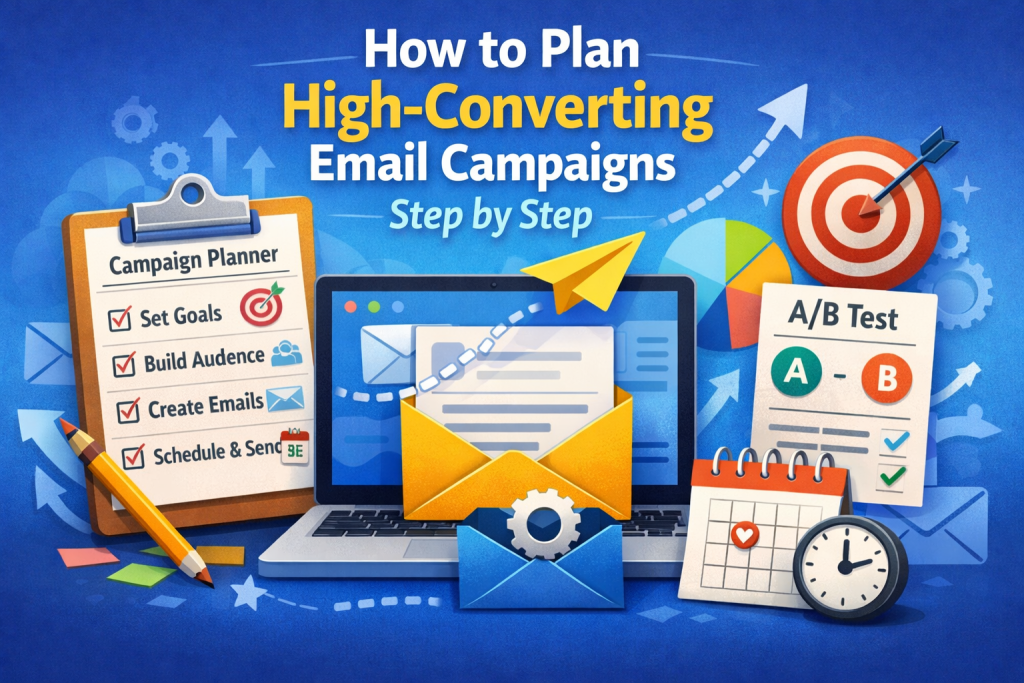
Planning a high-converting email campaign isn’t just about sending an email—it’s about crafting a focused, strategic, and customer-centric journey. In this article, you’ll learn:
- How to develop a strategy framework that aligns with your business goals
- How to segment and target your email list with precision
- What makes your content persuasive, from subject lines to CTAs
- The types of email sequences that drive conversions
- How to track key metrics like open rate, CTR, and ROI
- How to use automation and personalization at scale
- Real-world tools and creative practices to elevate your campaigns
- Plus: useful links to explore SEO strategies and digital design foundations
This is part one of a full guide to email campaign planning and conversion. By the end of this first section, you’ll have the foundation for a structured campaign plan that delivers measurable results.
Step 1: Build Your Email Marketing Strategy on Solid Ground
Before a single email is written, your campaign must rest on a well-defined foundation.
“A high-performing campaign starts with clarity—on audience, intent, and action.”
Define Your Campaign Goals
Setting SMART goals (Specific, Measurable, Achievable, Relevant, Time-bound) gives your campaign its spine. Consider objectives like:
- Increase sales by 15% from a specific product launch
- Reactivate 1,000 dormant subscribers
- Improve click-through rate on monthly newsletters by 20%
Each goal should be tied to a clear conversion event—whether it’s a product purchase, form fill, or lead qualification.
Craft Your Strategy Framework
With goals defined, construct your strategy framework:
- Audience insight: Who are you speaking to?
- Offer clarity: What’s the value you bring?
- Messaging tone: How should it feel to the reader?
- Channel and timing: Where and when does this land?
You’re not just sending a message—you’re designing an experience.
Explore how thoughtful website design aligns with your campaign strategy to ensure visual and UX consistency across touchpoints.
Step 2: Master List Management and Audience Segmentation
Not all subscribers are equal. Targeting everyone with the same message is a fast route to disengagement—and unsubscribes.
Create a Quality Email List
- Use gated content, loyalty programs, and opt-in forms
- Avoid bought lists—they damage deliverability and reputation
- Keep your list clean with regular verification tools
Segment Your Audience
Audience segmentation enables dynamic and data-informed messaging. Use criteria like:
- Purchase history
- Engagement level
- Browsing behavior
- Geography or interests
For example, build a lead nurturing sequence tailored to new subscribers vs. long-term buyers.
Tip: Use subscriber behavior data to define micro-segments, like VIP customers or recent abandoners, and automate targeted flows.
If you’re running PPC campaigns, link those leads into tailored onboarding emails to keep messaging consistent and intentional.
Step 3: Develop an Actionable Content Plan
Now that your goals and audience are clear, it’s time to build the campaign itself.
Email Types That Drive Conversions
High-performing campaigns typically combine multiple touchpoints. Consider using:
- Welcome emails to set tone and expectation
- Promotional campaigns tied to offers or launches
- Transactional emails with cross-sell/upsell opportunities
- Reengagement emails for lapsed users
- Triggered sequences based on user behavior
Each email serves a purpose in the buyer’s journey.
Message Crafting: Beyond the Words
Great content is engineered, not just written.
- Start with compelling subject lines—short, clear, and curiosity-driven
- Write with crisp, persuasive copywriting focused on benefits
- Add calls-to-action (CTAs) that are visible, actionable, and value-oriented
- Use email design elements that support scannability and engagement
The right email templates can streamline your design process while maintaining consistency. Just remember to optimize for mobile and accessibility.
Step 4: Optimize Campaign Performance With Testing and Iteration
Once your emails are live, the real work begins. Testing and refining isn’t a luxury—it’s a core part of email campaign planning that turns good results into great ones.
Test What Matters
Effective A/B testing starts with a hypothesis. What’s the question you’re trying to answer?
- Does a button-style CTA outperform a text link?
- Does personalizing the subject line increase open rates?
- Do product images lead to higher engagement than text-only layouts?
Test one element at a time to isolate performance differences. Run tests on:
- Subject lines
- Preview text
- Send times
- Email layouts
- CTA positioning
And don’t forget to test email variants across devices—responsive design is no longer optional.
Track and Improve Key Metrics
Your analytics dashboard should surface meaningful insight quickly. Focus on key metrics:
- Open rate – Do subject lines earn attention?
- Click-through rate (CTR) – Are readers engaging with your offer?
- Conversion rate – Are they completing your desired action?
- Bounce rate – Is your list clean and your email authenticated?
- Unsubscribe rate – Are you over-emailing or off-message?
- ROI (return on investment) – Are your campaigns justifying cost?
If you’re seeing low open rates, revisit your content calendar and subscriber segmentation. High unsubscribes? Consider tone, frequency, or relevance.
Pro Tip: Use performance trends analysis across several campaigns to inform your strategy long-term—not just campaign-by-campaign.
Step 5: Activate Automation and Personalization at Scale
If you’ve made it this far manually, it’s time to bring in the tech. Automation allows for personalization and scale without sacrificing message quality.
Use Smart Tools and Triggers
Adopt an email marketing platform (ESP) that allows for:
- Automated workflows triggered by user behavior
- Conditional flows based on lifecycle stage
- Send-time optimization
- Dynamic content blocks that adapt to the reader
These tools help implement lifecycle marketing tactics, where every subscriber gets a journey tailored to their needs and stage of awareness.
For example, someone who just made a purchase might enter a post-sale sequence with personalized recommendations, while a cold lead might receive a reengagement email.
Scale With Precision
Too much automation can feel robotic. The solution is intelligent segmentation paired with personalization at scale.
Pull in:
- First names for personalization
- Last browsed product
- Geographical relevance
- Past purchases or engagement level
This makes your message feel handcrafted—even at scale.
Well-timed automation enhances the buyer journey. Poorly timed automation ends it.
Step 6: Ensure Compliance and Best Practice
Your beautiful campaign is worthless if it’s flagged as spam or violates data protection laws.
Stay Compliant
- Use preference centers for subscriber control
- Honor opt-outs immediately
- Comply with GDPR and CAN-SPAM
- Maintain clean list management to avoid blacklists
These aren’t just legal steps—they’re trust signals that boost inbox placement and long-term deliverability.
Step 7: Align Email with Your Broader Digital Strategy
A high-performing email campaign isn’t an island. The most successful marketers treat email as a channel within a larger strategy framework—one that spans web, search, social, and even offline touchpoints.
Cross-Channel Consistency
Ensure your email marketing strategy reinforces your core messaging across other customer touchpoints. This means:
- Visual and tone consistency with your website
- Offers and campaigns synchronized across email, PPC, and social
- Seamless transitions from email to landing page
If your campaign promotes a seasonal product or service, make sure your SEO content reflects the same theme, keywords, and language. This kind of cross-functional planning builds trust and recognition.
Sync With Buyer Journey Stages
Consider how email fits into each stage of the funnel:
- Awareness: Educational newsletters, helpful guides, blog updates
- Consideration: Product comparisons, testimonials, feature breakdowns
- Decision: Promo codes, limited-time offers, trust signals
- Retention: Loyalty rewards, feedback requests, post-sale tips
- Reactivation: “We miss you” campaigns, dynamic discounts
Use buyer journey segmentation to tailor your triggered email sequences and keep each recipient moving forward.
Reminder: No channel should feel disconnected. Your campaign emails should echo the brand voice and structure of your home base—your website.
Step 8: Retain, Reactivate, and Refine
Even the best campaigns lose steam without ongoing optimization and retention strategies.
Build for Long-Term Engagement
Your campaign isn’t done when a conversion happens. Think beyond the sale:
- Set up an onboarding sequence for new customers
- Create educational follow-ups for complex products
- Ask for reviews and user-generated content
- Offer exclusive loyalty deals to long-time subscribers
Use retention marketing to increase subscriber engagement scores and overall lifetime value.
Run Reactivation Campaigns
Lapsed subscribers aren’t lost forever. Use reengagement emails that offer:
- A gentle reminder of value
- Exclusive win-back incentives
- Preference center updates
- Options to pause (rather than unsubscribe)
These campaigns are perfect opportunities to apply multivariate testing and experiment with bold new offers or design styles.
Step 9: Bring It All Together
Planning a truly effective email campaign means combining:
- A strong strategic foundation
- Clean, segmented audience lists
- Well-crafted, conversion-focused content
- Automation and personalization that scale
- Ongoing testing and optimization
- Alignment across your full digital ecosystem
It’s not about doing everything. It’s about doing the right things with intentionality.
Here’s a quick checklist for your next campaign:
- Goals are SMART and aligned with business objectives
- Audience is segmented by relevant criteria
- Content is personalized, mobile-optimized, and action-driven
- Email types match lifecycle stages
- Testing and measurement are built into the plan
- Automation tools are in place to scale delivery
- Compliance is enforced to protect your list and brand
- Email campaigns align with website and marketing channels
“A campaign isn’t just a sequence of emails. It’s a conversation, an experience, and—at its best—a conversion engine.”
By applying the principles above and tailoring them to your audience, you’ll be well on your way to building campaigns that do more than reach inboxes—they drive results.
If you’d like help implementing your strategy or want a hand aligning your content with paid ads, explore our PPC services.
FAQs: How to Plan High-Converting Email Campaigns Step by Step
1. How often should I send marketing emails?
There’s no universal frequency, but consistency is key. Weekly or bi-weekly emails work well for many brands. Monitor engagement metrics and let your audience behavior guide your cadence. Over-emailing can lead to unsubscribes.
2. What’s the best time of day to send emails?
The “best time” depends on your audience. B2B emails tend to perform better in the morning, while B2C emails often get more engagement in the evening or weekends. Use send-time optimization tools or test different times to see what works.
3. Should I send plain text or HTML emails?
Both have their place. HTML emails allow for rich visuals and branding, while plain text can feel more personal and perform better in deliverability. A hybrid approach (HTML styled to look like text) is often effective.
4. How can I reduce my unsubscribe rate?
Ensure your emails are relevant, spaced appropriately, and valuable. Offer a preference center so subscribers can control frequency or topics instead of opting out entirely. Personalization also plays a key role in retention.
5. How do I write subject lines that actually get opened?
Use curiosity, urgency, or clear value in a concise format. Avoid spammy words and test with A/B testing. Including the subscriber’s name or referencing recent actions can boost open rates.
6. What tools do I need to run an email campaign?
At minimum, you’ll need:
- An email marketing platform (ESP) like Mailchimp or Klaviyo
- Automation tools for workflows
- A template editor or designer for mobile-optimized emails
- An analytics dashboard to track performance
7. Can I use email marketing for cold leads?
Not ethically or legally without permission. Cold emailing can violate laws like GDPR and CAN-SPAM unless you’re compliant. It’s best to build a permission-based email list through opt-ins and lead magnets.
8. How do I make my emails mobile-friendly?
Use a responsive design, large tappable buttons, and short paragraphs. Avoid heavy images and ensure your CTAs are prominent. Always preview emails on mobile before sending.
9. How do I clean my email list?
Regularly remove:
- Inactive subscribers
- Bounced emails
- Spam traps or invalid addresses
Use list hygiene tools and segment those who haven’t engaged for reactivation or removal.
10. What’s the difference between drip campaigns and automated workflows?
Drip campaigns are pre-scheduled email sequences sent over time. Automated workflows are triggered by specific actions (like abandoning a cart). Workflows are more dynamic and behavior-based.