
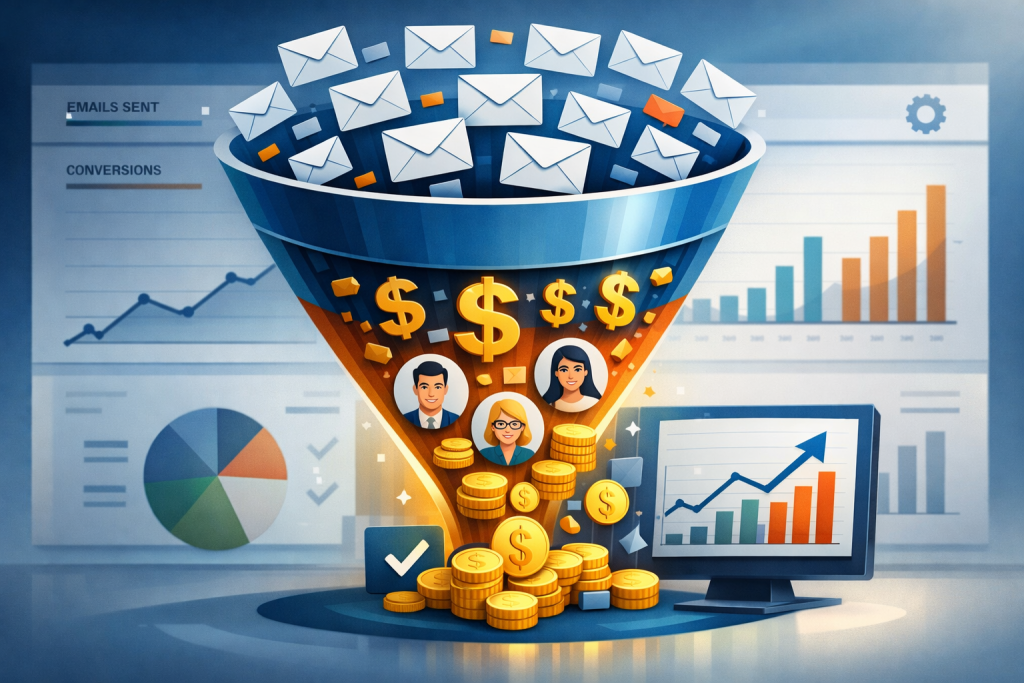
In this article, we’ll unravel the complete anatomy of a high-performing email funnel—from capturing attention in the awareness stage to cultivating loyalty and reactivating dormant subscribers. Learn how to use smart segmentation, engaging content, and conversion-focused flows to drive consistent performance. You’ll also find guidance on using lead magnets, email automation, and how to align your funnel strategy with your overall customer journey. This guide ties directly into strategic elements like SEO, paid acquisition, and website optimization to help you drive meaningful and measurable ROI from every subscriber interaction.
The Real Purpose of an Email Funnel
You might think an email funnel is just a sequence of sales emails, but that’s only part of the story. A true email marketing funnel is an evolving dialogue with your audience, one that mirrors the entire subscriber lifecycle—from curious newcomer to raving fan.
Unlike social channels that depend on algorithms or pay-to-play models, email gives you a direct, owned line to your prospects. It’s your space to educate, convert, nurture, and re-engage on your terms.
“A well-structured email funnel doesn’t just convert once—it creates a system that converts consistently.”
Funnel Foundations: Structure and Strategy
Every high-converting funnel shares a similar skeleton, broken into five strategic stages:
- Awareness – where attention is captured
- Engagement – where curiosity turns into interest
- Consideration – where interest becomes intent
- Conversion – where action is taken
- Retention / Loyalty – where the relationship deepens
While the flow may look linear, in practice, it’s dynamic. Different users enter and move through the funnel at different speeds, making segmentation, behavioral targeting, and email automation essential for staying relevant.
For instance, let’s say someone found your business through a PPC campaign. They’re at the top of the funnel—aware but unconvinced. This is the time to offer a compelling lead magnet, such as an exclusive download, free training, or discount in exchange for their email address.
Lead Magnets That Actually Work
If you’ve ever slapped a “10% off” coupon on a popup and hoped for leads, you’ve met the underwhelming lead magnet. Today’s consumers expect more than generic offers—they want personalised content, educational value, or first-party data exchanges that feel genuinely worthwhile.
Examples of Effective Lead Magnets:
- A case study that solves a common pain point
- A detailed buying guide (e.g., “How to Pick the Right Digital Strategy”)
- A drip campaign mini-course with actionable insights
Once they opt-in, your welcome email needs to do more than just say “hello.” It should prime them for what’s next in the customer journey, spark interest, and invite deeper engagement with content like your Website Design services.
Content That Moves: From Passive to Purchase
The content of your emails is what carries people through each funnel stage. That’s why you need both educational content and promotional offers—but more importantly, you need to know when to send what.
Here’s a high-level overview of content by stage:
- Awareness: Story-based emails, pain-point driven messaging, top blog posts
- Engagement: Mini-trainings, free resources, interactive emails (click-through rate is key here)
- Consideration: Product comparisons, social proof, product demos
- Conversion: Time-limited offers, clear call-to-action (CTA), testimonials
- Retention: Loyalty rewards, behind-the-scenes updates, referral incentives
- Win-Back: Re-engagement surveys, tailored discount offers, value-driven reminders
Every email should be crafted with A/B testing in mind—from subject lines to CTA placement. Tracking engagement metrics like open rate, bounce rate, and conversion rate helps you continually refine your funnel performance.
Personalisation Is More Than Using a First Name
In today’s inbox, personalisation goes far beyond {{first_name}}. Real personalisation relies on segmentation, triggered emails, and behavioural data to deliver content that feels custom-built for each subscriber. This is where zero-party data and first-party data collection becomes pivotal.
For example, if a user downloads a lead magnet focused on increasing web traffic, you can place them in a segment that prioritises your SEO services in future emails. Their actions—not assumptions—shape the conversation.
Key ways to personalise your funnel:
- Dynamic content based on previous clicks or preferences
- Triggered flows that respond to specific actions (e.g., abandoned cart, page visit)
- Subscriber segmentation strategies using interest, behaviour, or lifecycle stage
These tactics make your emails feel timely, relevant, and valuable—raising open rates, boosting click-through rates (CTR), and dramatically improving conversion rates over time.
Win-Back Campaigns That Don’t Feel Desperate
Even the best email funnels experience decay. Subscribers go cold. Emails go unopened. Engagement drops. That’s when a reactivation or win-back strategy comes into play.
Rather than blasting a generic “We miss you” email, your approach should tap into value, curiosity, or exclusivity.
Effective Win-Back Approaches:
- A surprise offer tied to previous activity
- A “choose your journey” re-engagement survey
- Showcasing recent educational content they may have missed
- A countdown-driven incentive to create urgency
Remember, the goal is to reignite relevance, not push for a hard sell. Testing different content types during win-back campaigns using email automation can help identify what reconnects best with each segment.
Optimising for Conversions Without Guesswork
A conversion-focused funnel requires more than clever copy and compelling offers—it depends on a process of constant learning and testing.
“Your email funnel should be a living system—one you evolve based on insight, not assumption.”
Here’s how to apply an optimisation mindset:
- Run A/B tests on subject lines, CTAs, layout, and even send times
- Monitor engagement metrics regularly (open rate, CTR, bounce rate)
- Use content mapping to align every email with the recipient’s stage and goal
- Experiment with marketing automation tools to refine timing and triggers
- Calculate and track ROI (Return on Investment) per funnel stage to gauge profitability
Analytics doesn’t mean analysis paralysis. Start simple, focus on one test at a time, and iterate.
Email, but Not in Isolation
It’s easy to treat email as a silo—but your funnel works best when it’s part of an integrated ecosystem. Email traffic should complement organic visibility from your SEO strategy, paid media funnels like PPC, and an optimised user experience via smart website design.
By syncing your funnel with other channels, you ensure a seamless customer journey across touchpoints. Someone might discover you on Google, join your list via a gated content download, receive nurturing emails for a few weeks, and finally convert during a time-limited promo.
That’s lifecycle marketing in action—where every piece of content, every email, and every click is part of a larger strategic arc.
Beyond the Sale: Retention and Loyalty That Pays Back
Once someone converts, your work isn’t done—it’s only just beginning. The most profitable part of your email marketing funnel often lives after the first sale, in what’s called the retention stage.
Returning customers are cheaper to convert, spend more over time, and are more likely to become brand advocates. That’s why building a loyalty loop into your funnel isn’t optional—it’s essential.
Post-Purchase Emails That Build Loyalty
- Order follow-up with care tips, usage guides, or FAQs
- Exclusive access to product launches or behind-the-scenes content
- Loyalty incentives (referral codes, early-bird discounts)
- Review requests to collect social proof and improve SEO
- User-generated content invites, deepening the emotional tie
When you nurture the post-sale phase intentionally, you open doors to upsells, repeat business, and word-of-mouth amplification. Pair these flows with strong subscriber segmentation strategies to tailor experiences even more.
Avoiding Funnel Fatigue
Even the best-planned funnels can stall. The inbox is a noisy place, and if your strategy stays static, performance will slowly erode. Funnel fatigue is real—but it’s preventable.
Here’s how to keep your funnel fresh and consistently converting:
- Refresh content regularly – Repurpose blog content, testimonials, and seasonal updates
- Monitor audience signals – High bounce rates or declining open rates are early warnings
- Introduce new lead magnets – Keep opt-in forms feeling relevant and irresistible
- Survey your audience – Ask what they want more (or less) of
- Re-audit your flows quarterly – Are all CTAs still compelling? Are links still accurate? Do the emails still align with your brand tone?
You’re not just managing a funnel. You’re curating an evolving experience across the entire subscriber lifecycle.
The Big Picture: Integrating Funnels Into Your Business Engine
Your email funnel isn’t just a marketing tactic—it’s a strategic asset. When done right, it operates as a scalable sales funnel integration machine that reduces acquisition costs, increases customer value, and boosts brand equity.
To truly maximise it, integrate it with:
- Your content calendar and blog strategy (for timely educational vs sales content)
- Your paid ad flows (like PPC campaigns) to catch leads who don’t convert right away
- Your website design to ensure consistent messaging and UX
- Your SEO strategy to organically feed top-of-funnel subscribers
“An email funnel that converts consistently doesn’t start with a discount code—it starts with a deep understanding of your audience’s journey.”
Final Thoughts
Building a high-converting email funnel isn’t about sending more emails. It’s about sending the right messages at the right time to the right people.
Use data, personalisation, and automated intelligence to guide people from curiosity to loyalty—with value at every step.
Whether you’re capturing leads through smart opt-in forms, nurturing them with targeted drip campaigns, or turning one-time buyers into lifelong fans, remember: your email funnel is your most controllable, ownable marketing channel.
Frequently Asked Questions (FAQ)
1. What’s the ideal length for an email funnel?
There’s no one-size-fits-all answer. Some funnels are 5–7 emails long, others span several months. It depends on your sales cycle, offer complexity, and audience intent. Aim for a balance between nurturing and prompting action without overwhelming the subscriber.
2. Should I use a single funnel for all subscribers?
No. A single, static funnel is unlikely to convert consistently. Segment your funnel based on where subscribers came from (e.g., blog opt-in vs. PPC), their behaviour, or their lifecycle stage. Tailored experiences convert better.
3. How do I write subject lines that get opened?
Focus on clarity, curiosity, or value. Subject lines should reflect the email’s content but also evoke a reason to open. Try A/B testing emotional vs. practical angles. Avoid spammy tactics—your reputation matters.
4. Is it better to send emails daily or weekly in a funnel?
It depends on your industry and the funnel’s goal. For product launches or time-sensitive offers, daily emails may work. For educational sequences, 2–3 times a week is usually optimal. Monitor unsubscribes and engagement to adjust timing.
5. What email service provider (ESP) should I use for funnels?
Look for an ESP that supports automation, segmentation, and A/B testing. Examples include Mailchimp, Klaviyo, ActiveCampaign, and ConvertKit. Choose one that integrates well with your website and offers clear analytics.
6. How do I measure the success of my email funnel?
Key metrics include:
- Open rate (measures subject line effectiveness)
- Click-through rate (CTR) (measures engagement)
- Conversion rate (measures funnel effectiveness)
- Unsubscribe rate (measures content relevance)
Also track ROI and list growth over time.
7. What’s the difference between a drip campaign and a funnel?
A drip campaign is a series of scheduled emails sent at specific intervals. A funnel is a broader concept, mapping the subscriber’s journey through various stages using content, automation, and segmentation. A funnel often contains multiple drip campaigns.
8. Can I use the same funnel for B2B and B2C audiences?
Rarely. B2B funnels tend to be longer, more informative, and focused on decision-making processes. B2C funnels often use emotional appeals, faster pacing, and more direct offers. Always tailor your approach to your audience.
9. How can I reduce unsubscribes during a funnel sequence?
- Set clear expectations from the beginning
- Deliver consistent value in every email
- Avoid overwhelming frequency
- Personalise based on actions and interests
- Provide easy, visible options to update preferences
10. What tools can help me build and optimise my funnel?
- Email marketing platforms (Klaviyo, Mailchimp, ActiveCampaign)
- Landing page builders (Unbounce, Leadpages)
- Analytics tools (Google Analytics, ESP dashboards)
- Heatmaps & behaviour tools (Hotjar, Crazy Egg)
- A/B testing frameworks (most modern ESPs include this)