
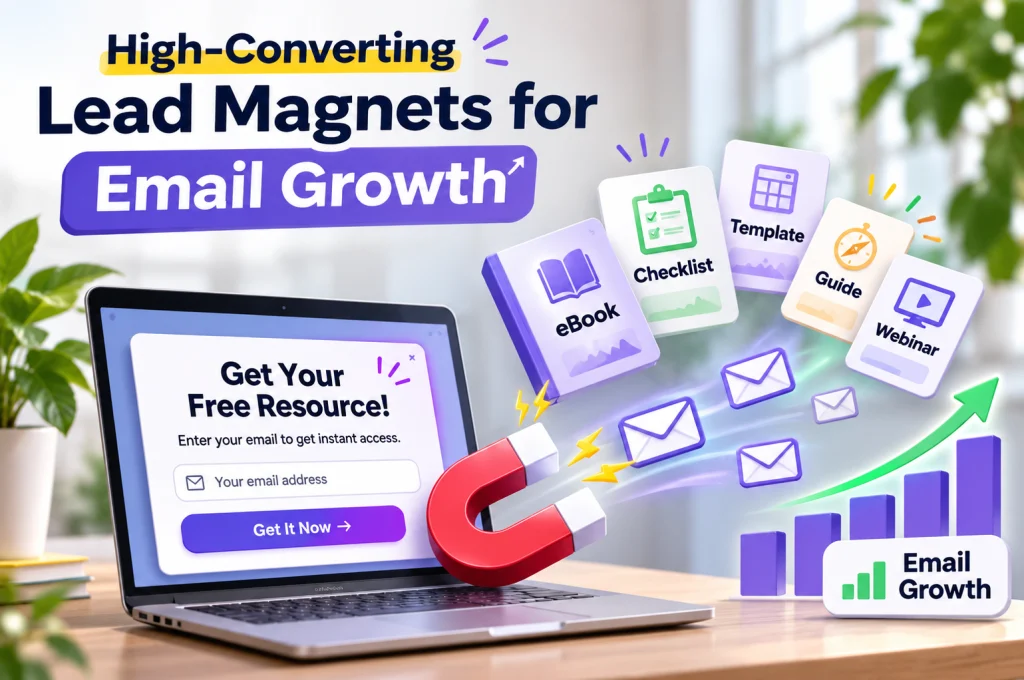
The Quick Take: How to Turn Website Visitors Into Email Subscribers
Want more email subscribers without constantly increasing your advertising budget? The secret isn’t simply asking people to join your mailing list. It’s giving them something genuinely useful in return.
A well-crafted lead magnet transforms a casual website visitor into someone who actively wants to hear from your business. Whether that’s a downloadable checklist, a practical template, an interactive quiz or a free assessment, the right offer can make email list building considerably more effective.
Here’s what you need to know:
- Lead magnets exchange value for contact information. Visitors receive a useful resource, while your business gains an opportunity to build a relationship.
- Specificity beats size. A five-minute checklist solving one urgent problem can outperform a lengthy eBook that tries to cover everything.
- The best lead magnets attract the right people. A thousand uninterested subscribers aren’t necessarily as valuable as a hundred genuinely qualified prospects.
- Different audiences need different incentives. A small business owner might appreciate a marketing audit, while an eCommerce shopper could prefer a buying guide or exclusive offer.
- Your landing page matters. Clear headlines, persuasive calls to action and friction-free signup forms help turn interest into subscriptions.
- Email follow-up completes the process. A download alone doesn’t create a customer. Relevant welcome emails and lead nurturing sequences help develop that initial interest.
- Measure what happens after the signup. Opt-in rates matter, but lead quality, engagement and eventual revenue tell you whether your strategy is working.
The bottom line: Effective lead magnets solve a meaningful problem, deliver an immediate benefit and provide a natural introduction to your products or services.
Now, let’s explore how to make that happen.
1. What Is a Lead Magnet and How Does It Grow Your Email List?
Imagine walking into a shop and being asked for your email address before you’ve even looked around.
Would you hand it over?
Probably not.
Now imagine the shop offers you a free, genuinely helpful buying guide that explains exactly how to choose the right product for your needs. Suddenly, sharing your email feels like a reasonable exchange.
That’s the principle behind a lead magnet.
A lead magnet is a valuable resource, incentive or experience offered to potential customers in exchange for their contact information, usually an email address.
It could be something simple, such as a printable checklist, or something more sophisticated, such as an interactive calculator providing personalised recommendations.
The format matters less than the outcome.
A successful lead magnet gives visitors a compelling reason to take action while introducing them to your brand’s expertise.
How the lead generation funnel works
A typical lead generation funnel follows five stages:
- Attract: Someone discovers your website through search engines, social media, referrals or paid advertising.
- Engage: They encounter content that addresses a question, challenge or interest.
- Convert: A relevant lead magnet encourages them to submit their email address through an opt-in form.
- Nurture: An automated email sequence delivers the resource and provides additional helpful information.
- Develop the relationship: Subscribers become more familiar with your business and may eventually make an enquiry or purchase.
Consider a local business owner searching for ways to generate more enquiries.
They discover an article explaining why their website isn’t converting visitors into customers. Halfway through, they see an offer:
Free Website Conversion Checklist
Discover 15 common website mistakes that could be costing your business valuable enquiries, plus practical ways to fix them.
That’s far more persuasive than a generic invitation to “Subscribe to our newsletter”.
Why?
Because the visitor understands precisely what they’re getting and why it’s useful.
The resource addresses an existing concern, promises a tangible benefit and requires relatively little effort to obtain.
This is where thoughtful lead capture strategies begin to make a difference.
Why email list building still matters
Social media platforms are excellent for reaching new audiences. Search engines help potential customers discover your business. Paid advertising can generate targeted traffic.
But these channels don’t guarantee an ongoing relationship.
Algorithms change. Advertising costs fluctuate. Organic reach can rise or fall without warning.
An email list provides a more direct way to communicate with people who have chosen to hear from you.
With a permission-based email marketing strategy, you can:
- Share educational content and practical advice.
- Introduce new products, services or offers.
- Build familiarity and trust over time.
- Segment subscribers according to their interests.
- Reconnect with prospects who aren’t ready to buy immediately.
- Measure engagement and understand which messages generate enquiries.
For example, a business investing in search engine optimisation might attract visitors researching a particular problem long before they’re ready to purchase.
A relevant downloadable resource gives those visitors a reason to stay connected after leaving the website.
Instead of relying on them to remember your brand and return independently, you can continue providing useful information through email.
That doesn’t mean every subscriber will become a customer.
It means your business has created an opportunity to build a relationship that might otherwise have ended after a single website visit.
Lead magnets vs content upgrades: What’s the difference?
These terms are closely related, but they aren’t quite interchangeable.
| Lead Magnet | Content Upgrade |
|---|---|
| A resource offered to attract email subscribers. | A resource designed to complement a specific piece of content. |
| Can appear across multiple website pages. | Usually appears within a relevant blog post or article. |
| Examples include eBooks, quizzes, webinars and templates. | Examples include downloadable worksheets, checklists and expanded guides. |
| Often targets a broader audience segment. | Typically addresses the immediate interests of the reader. |
For example, a general “Small Business Marketing Toolkit” could be promoted throughout a marketing website.
A downloadable “10-Step Email Signup Form Checklist” placed within an article about improving email conversions would be a content upgrade.
Both can support email subscriber growth.
However, content upgrades have a particular advantage: they’re closely aligned with what the visitor is already reading.
That relevance can make the offer feel like a natural next step rather than an interruption.
2. What Makes a Lead Magnet High Converting?
Here’s something many businesses overlook.
A lead magnet doesn’t need to be expensive, elaborate or packed with information to convert.
It needs to be desirable to the right person at the right moment.
A beautifully designed 60-page eBook can generate disappointing results if its subject is too broad.
Meanwhile, a simple spreadsheet that helps someone calculate their marketing budget might attract highly relevant subscribers because it solves an immediate problem.
High-converting lead magnets tend to share several characteristics.
2.1. They solve one specific problem
Broad promises are easy to ignore.
“Improve Your Marketing” sounds helpful, but it doesn’t explain what someone will achieve.
“Find Out Why Your Website Isn’t Generating Enquiries” is much more specific.
It identifies a recognisable problem and creates curiosity about the solution.
Compare these examples:
| Generic Lead Magnet | More Compelling Alternative |
|---|---|
| Free Marketing Guide | 7 Marketing Mistakes That Could Be Costing Your Business Leads |
| Social Media eBook | 30 Ready-to-Use Social Media Post Ideas |
| SEO Checklist | 20 SEO Checks to Make Before Publishing a Blog Post |
| Email Marketing Guide | 10 Welcome Emails You Can Adapt for Your Business |
| Website Tips | The 15-Minute Website Conversion Audit |
The second column communicates a clearer benefit.
It also helps potential subscribers decide whether the resource is relevant to them.
Practical tip: Before creating a lead magnet, complete this sentence:
After using this resource, my ideal customer will be able to ________.
If you can’t describe the outcome clearly, the offer probably needs refining.
2.2. They deliver an immediate win
People are busy.
They don’t necessarily want another lengthy document sitting unread in their downloads folder.
They want something that helps them make progress.
That’s why quick-win resources can be so appealing.
Think:
- A checklist that identifies overlooked mistakes.
- A calculator that produces an instant estimate.
- A template that eliminates repetitive work.
- A quiz that reveals a useful recommendation.
- A short tutorial demonstrating how to complete a task.
The quicker someone experiences value, the more positive their initial impression of your business may be.
This doesn’t mean long-form resources are ineffective.
A detailed buyer’s guide or research report can be extremely valuable when the audience is making a complex decision.
The important thing is matching the depth of the resource to the problem being solved.
2.3. They attract qualified leads, not just email addresses
It’s tempting to judge lead generation strategies by the number of subscribers they produce.
More signups must mean better results, right?
Not necessarily.
Imagine two campaigns.
Campaign A: A generic competition attracts 1,000 subscribers, but very few are interested in the company’s services.
Campaign B: A specialist website audit attracts 150 subscribers, many of whom are actively considering improving their online presence.
Campaign A produces more email addresses.
Campaign B may produce more commercially valuable opportunities.
The distinction is lead quality.
Effective lead magnets attract people whose interests, challenges and goals align with what your business actually offers.
For example, someone downloading a website conversion checklist may be more relevant to a digital marketing agency than someone entering a general prize draw.
The best lead magnet strategy therefore considers both subscriber acquisition and buyer intent.
Ask yourself:
- Who is this resource designed for?
- What problem are they trying to solve?
- Why would they want this information now?
- How does the resource relate to our expertise?
- What useful next step could we offer afterwards?
A lead magnet should create a natural connection between the visitor’s immediate need and the value your business can provide.
2.4. They communicate value before asking for information
A visitor shouldn’t have to guess what’s behind your signup form.
Your headline, description and call to action should make the offer immediately understandable.
A strong lead magnet landing page typically explains:
- What the resource contains.
- Who it’s designed to help.
- Which problem it addresses.
- What someone will gain from using it.
- How they can access it.
For instance:
Headline: Get Your Free Website Conversion Checklist
Supporting copy: Discover 15 practical checks to help identify confusing navigation, weak calls to action and other issues that may discourage enquiries.
Call to action: Download My Free Checklist
Notice how the message focuses on the visitor’s benefit rather than the company’s desire to collect contact details.
That distinction matters.
People don’t usually sign up because a business wants to grow its email list.
They sign up because the offer promises something worthwhile.
2.5. They make signing up feel effortless
Even a compelling resource can struggle if the signup process is frustrating.
Long forms, confusing instructions and poorly designed mobile layouts introduce unnecessary friction.
For an introductory downloadable resource, requesting an email address may be sufficient.
A first name can be useful for personalisation, but additional fields should have a clear purpose.
For more commercially focused resources, such as a detailed B2B assessment, asking for a company name or relevant business information might be reasonable.
The key is balancing lead qualification with ease of completion.
Good website design plays an important role here.
An effective landing page should have:
- A clear visual hierarchy.
- A prominent, descriptive call-to-action button.
- Readable text and sufficient contrast.
- A mobile-friendly signup form.
- Minimal distractions.
- Clear privacy information.
- A straightforward confirmation and delivery process.
Remember that visitors may encounter your lead magnet on a smartphone while travelling, browsing social media or taking a short break.
If they need to zoom in, navigate multiple pages or complete an unnecessarily complicated form, some will abandon the process.
The easier you make it to receive genuine value, the fewer unnecessary barriers you place between interest and action.
2.6. They build trust rather than relying on exaggerated promises
There is a difference between an attractive offer and an unrealistic one.
“Double Your Revenue Overnight” might grab attention, but it also risks undermining credibility.
“Identify Five Opportunities to Improve Your Website’s Conversion Rate” is more measured and believable.
Trust is particularly important when asking people to share personal information.
Support your offer with clear explanations, realistic benefits and relevant evidence where available.
If you’re presenting a case study, explain what actually happened.
If you’re providing a calculator, describe its assumptions.
If you’re offering a checklist, make sure the advice is practical and accurate.
A lead magnet that delivers on its promise helps establish authority.
One that disappoints can damage the relationship before it has properly begun.
2.7. They lead naturally into useful email follow-up
The download isn’t the finish line.
It’s the beginning of a conversation.
Once someone receives your resource, what happens next?
A well-planned welcome email sequence might:
- Deliver the promised resource immediately.
- Explain how to get the most from it.
- Share another practical insight related to the same problem.
- Introduce a relevant example or case study.
- Offer an appropriate next step when the subscriber is ready.
For example, someone downloading a marketing budget planner might later appreciate advice on allocating spend across different channels.
Someone completing a website self-assessment might benefit from an explanation of how to prioritise improvements.
This approach makes lead nurturing feel like a continuation of the original value exchange.
It also supports a healthier email marketing strategy: one based on relevance, trust and permission rather than constant sales messages.
For UK businesses, it’s important to distinguish delivering a requested resource from obtaining permission to send ongoing promotional emails. Consent and other applicable marketing requirements should be addressed clearly when collecting subscriber information.
3. 25+ High-Converting Lead Magnet Ideas and Examples
So, which lead magnets actually deserve your time?
There’s no universal winner.
The best lead magnets depend on your audience, your offer and where potential customers are in their decision-making journey.
A business selling a straightforward consumer product may benefit from a useful buying guide or an exclusive subscriber incentive.
A consultancy might achieve better results with an assessment, calculator or specialist report.
And a digital marketing business could use practical templates, audit tools or educational resources to demonstrate its expertise.
Below are lead magnet examples worth considering, starting with some of the most versatile options.
3.1. Downloadable checklists
Best for: Busy professionals, small business owners, beginners and people completing repeatable tasks.
Checklists are deceptively powerful.
They take a complicated process and break it into manageable steps.
Rather than asking someone to read a lengthy explanation, they provide a practical reference that can be used immediately.
Examples include:
- The 20-Point Website Launch Checklist.
- The Small Business SEO Essentials Checklist.
- The Email Campaign Pre-Send Checklist.
- The eCommerce Product Page Optimisation Checklist.
- The Monthly Marketing Performance Checklist.
Why they can convert: Checklists promise clarity, convenience and reduced uncertainty.
They also work particularly well as content upgrades.
For instance, an article explaining common email marketing mistakes could offer a downloadable checklist that readers can use before sending their next campaign.
The resource extends the article’s usefulness without simply repeating it.
Creation tip: Keep each item actionable. Replace vague instructions such as “Improve your website” with specific checks such as “Confirm every important service page includes a clear next-step CTA”.
3.2. Plug-and-play templates
Best for: Business owners, marketers, freelancers and professionals who want to save time.
Templates remove the frustration of starting from scratch.
They provide a useful structure that someone can adapt to their own situation.
Popular lead magnet templates include:
- Email welcome sequence templates.
- Marketing campaign planning spreadsheets.
- Social media content calendars.
- Customer persona worksheets.
- Landing page copy templates.
- Marketing budget planners.
A particularly useful example would be a Five-Email Welcome Sequence Template.
Instead of simply explaining why welcome emails matter, it could provide editable examples covering resource delivery, brand introduction, educational follow-up, social proof and a relevant next step.
That makes the resource immediately practical.
Why they can convert: Templates offer a shortcut to a specific outcome. They reduce the effort needed to complete a task, which gives the visitor a clear reason to download them.
The more time a template can realistically save, the more attractive it may become.
3.3. Interactive quizzes and personalised assessments
Best for: Businesses offering multiple solutions, consultative services or products requiring careful selection.
Interactive lead magnets turn a passive download into an experience.
Instead of simply receiving information, visitors answer questions and get recommendations based on their responses.
For example:
What’s Holding Back Your Website’s Lead Generation?
A short assessment might ask about:
- Monthly website traffic.
- Current enquiry volume.
- Landing page structure.
- Call-to-action placement.
- Mobile usability.
- Conversion tracking.
The visitor could then receive a personalised summary highlighting potential improvement areas.
This approach can create value for both sides.
The visitor receives guidance tailored to their answers, while the business may gain useful insight into the prospect’s interests and challenges, provided the information is collected and used appropriately.
Why they can convert: Personalised results feel more relevant than generic advice.
However, quizzes should deliver genuinely useful outcomes rather than using vague questions simply to collect email addresses.
A short, focused assessment is often preferable to an unnecessarily lengthy questionnaire.
3.4. ROI calculators and interactive tools
Best for: B2B companies, service providers and businesses whose customers make financially significant decisions.
Calculators help turn abstract questions into more tangible estimates.
A prospective customer may be interested in improving their marketing performance but unsure what an improvement could mean financially.
An interactive calculator can help them explore different scenarios.
Examples include:
- Marketing return-on-investment calculators.
- Website conversion opportunity calculators.
- Customer acquisition cost calculators.
- Email campaign revenue estimators.
- Advertising budget planners.
- Potential lead value calculators.
Imagine a business receives 2,000 website visits per month and currently converts 2% of those visitors into enquiries.
That’s 40 enquiries.
If its conversion rate increased to 3%, the same traffic would generate 60 enquiries.
That’s 20 additional enquiries without increasing website traffic.
The calculation is straightforward, but it helps illustrate why conversion optimisation matters.
Of course, an estimate isn’t a guarantee. Actual performance depends on traffic quality, audience intent, the offer and numerous other factors.
Why they can convert: Interactive calculators provide personalised, decision-supporting information that visitors may find difficult to obtain from a generic article.
They can also attract prospects who are actively evaluating the financial implications of a potential investment.
3.5. Free eBooks and in-depth guides
Best for: Businesses targeting customers who need education, reassurance or detailed information before making a decision.
eBooks have been a staple of email marketing lead magnets for years. And despite the rise of interactive tools, they still have a place.
The catch?
Nobody wants another generic 50-page PDF filled with information they could find through a quick Google search.
A successful eBook needs a clear purpose, a defined audience and practical advice that goes beyond surface-level explanations.
Consider the difference between these two offers:
- Generic: The Complete Guide to Digital Marketing.
- Specific: How to Generate Your First 100 Website Enquiries: A Practical Guide for Small Businesses.
The second immediately communicates who it’s for and what readers can expect to learn.
Other examples include:
- The Small Business Guide to Building an Email List.
- How to Improve Your Website Without a Complete Redesign.
- A Beginner’s Guide to Understanding Marketing Analytics.
- The Essential Guide to Choosing the Right Digital Marketing Channels.
- How to Create a Customer Acquisition Strategy on a Limited Budget.
Why they can convert: Comprehensive guides help people understand complicated subjects, compare options and make more informed decisions.
They’re particularly useful when the audience is still researching a problem rather than actively looking for a supplier.
Creation tip: Structure your eBook around outcomes, not word count. Include examples, actionable exercises, illustrations and concise summaries that help readers apply what they’ve learned.
A 12-page guide packed with useful information can be more valuable than a 70-page document full of filler.
3.6. Free webinars and educational workshops
Best for: Consultants, agencies, educators, software providers and businesses offering specialist expertise.
Some subjects are easier to understand when someone explains them.
That’s where webinars shine.
A well-planned educational session allows your business to demonstrate expertise while helping potential customers solve a meaningful problem.
Possible topics include:
- How to Build an Email List From Scratch.
- Five Website Changes That Could Improve Your Enquiry Rate.
- How to Create Your First Lead Generation Funnel.
- Understanding Google Analytics for Small Businesses.
- How to Plan a Marketing Budget That Supports Business Growth.
Webinars can be delivered live or made available as on-demand recordings.
Live sessions encourage participation and give attendees opportunities to ask questions.
Recorded sessions offer convenience and can continue generating leads long after the original presentation.
Why they can convert: A webinar offers access to structured learning and specialist knowledge. For complex subjects, that can feel more valuable than another downloadable document.
However, the presentation must deliver on its promise.
If you advertise a practical workshop, attendees should leave with something they can use, not simply a prolonged sales pitch.
A useful webinar teaches first and sells second. The more confidently your audience can take action afterwards, the stronger the impression your expertise is likely to leave.
3.7. Case studies and success stories
Best for: Service businesses, agencies, B2B companies and organisations selling solutions with measurable outcomes.
Potential customers often have one question in mind:
Will this actually work for a business like mine?
Case studies help answer it.
Instead of making broad claims, they explain how a particular challenge was approached, which actions were taken and what results followed.
A compelling case study usually includes:
- The challenge: What problem was the customer experiencing?
- The starting point: What did the situation look like before the work began?
- The approach: Which strategies or changes were implemented?
- The outcome: What measurable improvements occurred?
- The lessons: What can another business learn from the experience?
For example, a case study could examine how improving a website’s landing page structure contributed to more enquiries.
It might explore changes to headlines, page layout, calls to action and form design.
Where reliable performance data exists, it should be presented accurately and with appropriate context.
Why they can convert: Case studies provide evidence and reduce uncertainty.
They’re particularly relevant to visitors who already understand their problem and are comparing potential solutions.
Creation tip: Use genuine customer examples with permission. Never invent testimonials, performance figures or client outcomes to make a lead magnet appear more impressive.
3.8. Free audits and diagnostic scorecards
Best for: Digital marketing agencies, consultants, professional service providers and businesses offering performance improvements.
A free audit gives potential customers an opportunity to understand what’s working, what’s underperforming and where improvements might be possible.
Unlike a broad educational guide, an audit focuses on the visitor’s specific situation.
Examples include:
- Website Conversion Audit.
- SEO Health Check.
- Email Marketing Performance Review.
- Landing Page Effectiveness Scorecard.
- Social Media Content Assessment.
- Digital Marketing Readiness Audit.
Audits can be delivered through automated questionnaires, downloadable self-assessment worksheets or manually reviewed submissions.
Each approach offers different advantages.
An automated assessment can provide instant feedback at scale.
A personalised review may deliver deeper insight but requires more time and resources.
Why they can convert: Audits appeal to people who suspect something could be improved but aren’t sure where to begin.
They also create a natural connection between identifying a problem and exploring possible solutions.
For instance, a business struggling to generate enquiries might discover that its landing pages have weak calls to action, confusing navigation or unclear messaging.
An audit can help prioritise which issues deserve attention.
The important distinction is between providing genuine diagnostic value and using an audit merely as an excuse to recommend paid services.
3.9. Swipe files and ready-to-use examples
Best for: Marketers, copywriters, business owners, content creators and professionals who regularly produce similar materials.
A swipe file is a curated collection of examples, prompts or proven structures that people can adapt.
It removes the need to start with a blank page.
Useful examples include:
- 25 Email Subject Line Formulas.
- 50 Call-to-Action Examples for Business Websites.
- 30 Social Media Caption Templates.
- 15 Landing Page Headline Structures.
- 20 Customer Follow-Up Email Examples.
Imagine a small business owner struggling to write persuasive emails.
A swipe file containing subject line formulas, opening paragraphs and call-to-action examples could help them produce their next campaign much faster.
Why they can convert: Swipe files offer immediate inspiration and reduce creative effort.
They can also encourage repeat engagement because subscribers may return to the resource whenever they need another example.
Creation tip: Include short explanations showing when and why each example might be useful. Encourage readers to adapt the wording to their audience rather than copying it blindly.
3.10. Free email courses
Best for: Businesses covering subjects that require several stages of learning.
Not every lead magnet needs to arrive as a single download.
An email course delivers educational content over a series of messages, helping subscribers make progress gradually.
For example:
The Five-Day Email List Growth Challenge
- Day 1: Identify your ideal subscribers.
- Day 2: Choose a compelling lead magnet.
- Day 3: Create a conversion-focused signup page.
- Day 4: Set up your welcome email sequence.
- Day 5: Launch and measure your first campaign.
Each email introduces a manageable task.
By the end, subscribers have worked towards a practical outcome rather than simply consumed information.
Why they can convert: Email courses combine lead magnet delivery with ongoing engagement.
They introduce subscribers to your communication style while creating multiple opportunities to demonstrate expertise.
They can also support email list hygiene by helping identify subscribers who actively engage with your content.
The key is maintaining a clear learning progression.
Each lesson should build on the previous one without overwhelming readers.
3.11. Industry reports and original research
Best for: B2B companies, specialist consultancies, professional services and businesses serving research-driven audiences.
Original research can be an especially compelling lead magnet because it offers information that may not be readily available elsewhere.
Examples include:
- Small Business Digital Marketing Trends Report.
- Email Marketing Challenges Survey.
- Local Business Website Performance Study.
- Customer Acquisition Trends by Industry.
- Marketing Budget Benchmark Report.
These resources might include survey findings, anonymised performance data, industry comparisons or analysis of emerging trends.
Why they can convert: Original research offers distinctive insights and can help establish credibility.
It may also attract journalists, industry professionals and decision-makers looking for reliable information.
However, research-based lead magnet creation requires care.
Explain how the data was collected, the size and characteristics of the sample, and any important limitations.
If you’re presenting industry benchmarks, distinguish your own findings from external research.
A report doesn’t become authoritative simply because it contains charts.
Its credibility depends on the quality and transparency of the underlying evidence.
3.12. Buyer’s guides and comparison worksheets
Best for: eCommerce businesses, specialist retailers, B2B suppliers and companies selling products or services that require careful consideration.
Some customers know they need a solution but aren’t sure which option is right.
A buyer’s guide helps them make that decision.
For example:
- How to Choose the Right Website Platform.
- The Small Business Guide to Selecting Marketing Software.
- Email Marketing Platform Comparison Checklist.
- Questions to Ask Before Hiring a Digital Marketing Agency.
- How to Compare Marketing Proposals.
A good buyer’s guide should explain important evaluation criteria, potential trade-offs and common purchasing mistakes.
Why they can convert: These resources attract people who may be closer to making a decision.
They also demonstrate that your business understands the buying process, not just the product or service being sold.
The strongest guides provide balanced advice rather than automatically presenting one solution as suitable for everyone.
3.13. Resource libraries and exclusive toolkits
Best for: Businesses with several complementary resources that solve related problems.
Why offer one template when you could provide a coordinated collection?
A resource toolkit combines multiple assets into a single useful package.
For example, a Small Business Lead Generation Toolkit might contain:
- A customer persona worksheet.
- A lead magnet planning template.
- A landing page checklist.
- A welcome email sequence.
- A simple conversion tracking spreadsheet.
Each resource addresses a different stage of the same overall challenge.
Why they can convert: Toolkits communicate substantial practical value and can appeal to people who want a complete starting point.
However, more isn’t automatically better.
A collection of unrelated documents may feel overwhelming.
The resources should work together towards a clear objective.
3.14. Free trials and product demonstrations
Best for: Software companies, subscription businesses and organisations offering products that benefit from hands-on evaluation.
Sometimes the most persuasive lead magnet isn’t educational content.
It’s the opportunity to experience the product.
A free trial or interactive demonstration can help potential customers understand how a solution works before committing to a purchase.
Examples include:
- A limited-access software trial.
- A guided product demonstration.
- A free sample of a digital tool.
- An interactive feature preview.
- A short trial of a subscription-based service.
Why they can convert: Product experiences reduce uncertainty and allow visitors to evaluate practical benefits directly.
These offers often attract people with stronger purchase intent than those downloading general educational resources.
However, the signup experience should clearly explain any restrictions, trial duration, payment requirements and cancellation terms.
Transparency is essential.
3.15. Exclusive subscriber offers and discount incentives
Best for: eCommerce brands, online retailers and businesses selling products with a relatively straightforward purchase decision.
Not every visitor wants a guide, checklist or webinar.
Sometimes they already know what they want.
They simply need a compelling reason to take the next step.
An exclusive subscriber offer could include:
- A first-order discount.
- Early access to a new product.
- A subscriber-only promotion.
- Free delivery on an eligible purchase.
- Access to a limited collection or special release.
Why they can convert: These incentives provide an immediate, easily understood benefit.
They’re especially relevant when visitors are already browsing products and considering a purchase.
However, discount-led email acquisition has a potential drawback.
Some subscribers may only be interested in the incentive rather than developing an ongoing relationship with the brand.
That’s why subscriber engagement and eventual customer value matter just as much as the initial signup rate.
For a business focused on long-term customer relationships, a useful buying guide or exclusive educational resource may sometimes attract a more engaged audience than a generic discount.
4. How to Choose the Right Lead Magnet for Your Audience
With so many lead magnet ideas available, choosing one can feel surprisingly difficult.
Should you create a checklist?
Launch a quiz?
Build an interactive calculator?
Or spend the next month developing an extensive downloadable guide?
The answer depends on your audience and the action you want them to take.
The most effective lead magnet isn’t necessarily the most sophisticated. It’s the one that offers the clearest value to the people you’re trying to reach.
Start with your ideal customer
Before opening a design tool or writing a single page, identify who the resource is for.
Think beyond basic demographic information.
What does your ideal customer actually need?
What are they struggling with?
What questions are they asking?
What would make their working day easier?
Consider three different audiences:
| Target Audience | Main Challenge | Suitable Lead Magnet |
|---|---|---|
| Small business owner | Website traffic isn’t generating enough enquiries. | Website Conversion Checklist |
| Marketing manager | Campaign performance is difficult to evaluate. | Marketing ROI Calculator |
| eCommerce business owner | Visitors browse products but don’t subscribe or purchase. | Email List Growth Toolkit |
Each audience has different priorities.
A generic marketing eBook might appeal to all three, but a focused resource addressing their specific challenge is likely to feel more relevant.
This is why audience segmentation should influence your lead magnet strategy from the beginning.
Match your lead magnet to buyer intent
Not every visitor is ready to purchase.
Some are discovering a problem for the first time.
Others are comparing possible solutions.
A smaller group may already be evaluating suppliers.
Your lead magnet should reflect these different stages of the customer journey.
| Customer Journey Stage | Visitor’s Mindset | Recommended Lead Magnet |
|---|---|---|
| Awareness | “I think I have a problem.” | Checklists, introductory guides, quizzes |
| Consideration | “I’m exploring ways to solve it.” | Templates, webinars, calculators, detailed guides |
| Decision | “I’m comparing solutions or suppliers.” | Case studies, buyer’s guides, assessments, demonstrations |
For example, someone searching “Why isn’t my website generating leads?” may appreciate an educational checklist.
Someone searching “How much should I spend on lead generation?” might prefer an interactive budget calculator.
And someone comparing digital marketing providers could find a detailed buyer’s guide particularly useful.
The underlying principle is simple:
Offer the next useful step, not the biggest possible resource.
Consider the time and resources required
An interactive calculator may sound impressive, but it isn’t always the right starting point.
Some lead generation tools require development work, ongoing maintenance and careful testing.
A downloadable checklist or editable template can often be created much faster.
Before committing, consider:
- Production time: How long will the resource take to create?
- Technical requirements: Does it need specialist software or development?
- Maintenance: Will the information need frequent updates?
- Delivery: Can it be distributed automatically?
- Relevance: Does it address a genuine audience need?
- Measurement: Can you track its performance and resulting leads?
A simple resource that launches this week and solves a real problem may deliver more value than an ambitious project that never gets finished.
Choose a format that supports your wider business goals
Your lead magnet shouldn’t exist in isolation.
It should complement your products, services and broader content marketing strategy.
For example, a business offering pay-per-click advertising services could develop a downloadable advertising budget planner.
That resource would help potential customers understand how to approach campaign spending before considering professional support.
The connection feels natural because the resource and the service address related challenges.
Similarly, an email marketing consultant might create a welcome sequence template, while an eCommerce business could offer a product selection guide.
In each case, the lead magnet provides genuine value while attracting people who may have a relevant future need.
Use a simple scoring system to evaluate your ideas
When several lead magnet concepts seem promising, score them against the same criteria.
Give each idea a rating from 1 to 5 for:
- Audience relevance.
- Strength of the problem being solved.
- Perceived value.
- Ease of creation.
- Connection to your business offering.
- Potential for useful email follow-up.
For example:
| Lead Magnet Idea | Relevance | Value | Ease | Business Fit | Follow-Up Potential | Total |
|---|---|---|---|---|---|---|
| Website checklist | 5 | 4 | 5 | 5 | 5 | 24 |
| General marketing eBook | 3 | 3 | 3 | 3 | 3 | 15 |
| Interactive ROI calculator | 5 | 5 | 2 | 5 | 5 | 22 |
Illustrative scores only; actual ratings should reflect your audience and business.
The scoring system isn’t a scientific prediction of conversion performance.
It’s a practical way to make the decision more objective.
It can also help prevent a common mistake: choosing a lead magnet because it looks impressive rather than because people genuinely need it.
Validate your idea before investing heavily
You don’t always need to create the entire resource before testing demand.
Start by looking for evidence that your audience cares about the problem.
Useful sources include:
- Questions customers regularly ask.
- Popular pages on your website.
- Search queries bringing visitors to your content.
- Comments and discussions within relevant communities.
- Customer support enquiries.
- Feedback from existing email subscribers.
You could also test interest with a simple landing page describing the proposed resource, provided you’re transparent about when it will be available.
If people consistently respond to a particular problem, that’s a useful signal.
Then build the smallest version of the resource capable of delivering a meaningful outcome.
Improve it as you learn more about what subscribers find valuable.
This approach reduces unnecessary production work and keeps your lead magnet creation focused on actual customer needs.
5. How to Create a High-Converting Lead Magnet Step by Step
You’ve chosen your audience. You’ve identified a problem worth solving. And you’ve settled on a lead magnet idea that makes sense for your business.
Now comes the interesting part.
Actually creating it.
The good news? You don’t need an enormous marketing budget, a professional design team or weeks of development time to produce something valuable.
What you do need is a clear plan.
Let’s break the lead magnet creation process into manageable steps.
Step 1: Identify one problem your audience wants solved
Start with the problem, not the format.
Too many businesses decide they want to create an eBook before considering whether their customers actually need one.
Instead, ask:
What’s one frustrating, time-consuming or expensive problem my ideal customer would love to solve?
For a small business owner, that might be:
- Struggling to generate enquiries from their website.
- Not knowing which marketing channels deserve investment.
- Finding it difficult to write engaging emails.
- Spending too much time planning social media content.
- Feeling overwhelmed by website performance data.
Choose one challenge.
Then narrow it down further.
“Help businesses improve their marketing” is too broad.
“Help small business owners identify why visitors aren’t completing their contact forms” is much more actionable.
The narrower your focus, the easier it becomes to communicate value.
Step 2: Define the result before creating the content
A lead magnet should promise a useful outcome.
That doesn’t mean guaranteeing revenue, rankings or conversions.
It means explaining what someone will be able to understand, identify or accomplish after using the resource.
For example:
| Problem | Lead Magnet | Intended Outcome |
|---|---|---|
| Low website enquiries | Website Conversion Checklist | Identify potential barriers to enquiries |
| Inconsistent email marketing | Welcome Email Templates | Draft a structured welcome sequence |
| Unclear marketing spending | Budget Planning Spreadsheet | Organise and evaluate marketing costs |
| Poor campaign visibility | Marketing Performance Dashboard | Track important campaign metrics |
| Difficulty choosing a service | Buyer’s Comparison Guide | Compare options more confidently |
Notice how each resource has a practical purpose.
That purpose should guide everything from the headline to the final page.
If a section doesn’t help the reader achieve the intended outcome, question whether it needs to be included.
Step 3: Choose the simplest effective format
A lead magnet’s format should make the information easier to use.
Not harder.
If your audience needs to complete a sequence of checks, create a checklist.
If they need to calculate figures, provide a spreadsheet or calculator.
If they need to understand a complicated process, consider a guide or short video tutorial.
And if they need personalised recommendations, an assessment or quiz might be appropriate.
Avoid adding complexity simply to make the resource look more impressive.
A thoughtfully designed two-page worksheet can be more useful than an elaborate interactive tool that takes several minutes to load.
The goal is to remove effort from your audience’s life, not create more of it.
Step 4: Create genuinely useful content
This is where your lead magnet either earns its place in someone’s inbox or becomes another forgotten download.
Make every section count.
A strong resource should be:
- Specific: Focused on a clearly defined challenge.
- Practical: Filled with information the reader can apply.
- Accessible: Written in language appropriate for the audience.
- Accurate: Based on reliable information and realistic expectations.
- Easy to navigate: Organised with clear headings and logical sections.
- Consistent: Aligned with your brand’s expertise and communication style.
For example, a website conversion checklist shouldn’t simply say:
“Make sure your website is user-friendly.”
That’s too vague to be useful.
Instead, it could include:
- Can visitors understand what your business offers within a few seconds?
- Is the primary call to action visible without excessive scrolling?
- Are contact forms easy to complete on mobile devices?
- Do important pages explain the next step clearly?
- Are testimonials or other relevant trust signals easy to find?
Now the reader has something they can actually evaluate.
This is the difference between content that sounds helpful and content that is helpful.
Step 5: Design the resource for usability
Good design supports understanding.
It doesn’t need to be extravagant, but it should make your resource pleasant and straightforward to use.
Consider:
- Clear headings and subheadings.
- Short paragraphs and readable typography.
- Sufficient spacing between sections.
- Consistent branding and colours.
- Tables, diagrams or examples where they clarify information.
- A layout that works on mobile devices.
- Accessible contrast and descriptive links.
For downloadable resources, check that text remains readable when viewed on a smartphone.
If you’re creating a worksheet, leave enough space for people to complete it.
If you’re providing a spreadsheet, label fields clearly and protect important formulas where appropriate.
And if you’re designing an interactive quiz, make sure users understand how to progress and receive their results.
A beautiful resource that frustrates its users isn’t a successful one.
Step 6: Create a compelling title
Your lead magnet title has one job:
Make the benefit immediately clear.
It should help visitors understand what they’re getting and why they might want it.
Compare:
Weak: Free Marketing PDF
Stronger: The Small Business Marketing Checklist: 20 Things to Review Before Your Next Campaign
Or:
Weak: Email Guide
Stronger: Five Welcome Email Templates to Help You Engage New Subscribers
Effective titles often combine three elements:
A specific audience + a useful outcome + a clear format
You don’t need all three in every title, but the underlying promise should be obvious.
Avoid exaggerated claims or artificial urgency.
A trustworthy, relevant offer can be persuasive without promising impossible results.
Step 7: Set up delivery and email automation
Once someone submits their details, the promised resource should be easy to access.
For downloadable lead magnets, an automated delivery email is usually a practical option.
A simple delivery sequence could work like this:
- The visitor completes the signup form.
- The system records the submission and applicable marketing preferences.
- A confirmation or delivery email is triggered.
- The subscriber receives a working download link.
- Any separately authorised marketing sequence begins according to the subscriber’s preferences.
Test the entire process before launching.
Check the signup form, confirmation messages, download links and mobile experience.
If you’re using double opt-in for marketing subscriptions, make sure the confirmation process is clear.
Also remember that requesting a free resource doesn’t automatically give your business unrestricted permission to send promotional emails.
For UK businesses, lead capture should account for applicable UK GDPR and PECR requirements, including appropriate transparency and a valid basis for subsequent marketing communications.
Step 8: Test the complete experience
Before promoting your resource, approach it as a first-time visitor.
Ask yourself:
- Is the offer understandable?
- Does the landing page explain the benefit?
- Is the signup form easy to complete?
- Does everything work on mobile?
- Is the resource delivered correctly?
- Does the content match the original promise?
- Are privacy and marketing preferences clear?
- Is the next step relevant and helpful?
You can also ask someone unfamiliar with the project to test it.
Fresh eyes often spot confusing instructions or unnecessary steps that the creator has overlooked.
Once everything works, you’re ready to start attracting subscribers.
6. How to Build a Lead Magnet Landing Page That Converts
Picture this.
You’ve spent hours creating an excellent downloadable guide.
The information is practical. The design looks professional. The resource addresses a genuine customer problem.
Then you publish it behind a signup form.
And hardly anyone downloads it.
Frustrating?
Absolutely.
But the problem might not be the lead magnet.
It could be the landing page.
A lead magnet landing page bridges the gap between someone being interested in your offer and deciding to exchange their email address for it.
Every element should help visitors understand the value and take the next step with confidence.
6.1. Write a headline that communicates the benefit
Your headline is often the first thing visitors notice.
Make it specific.
Rather than:
“Download Our Free Resource”
Try:
“Discover 15 Website Mistakes That Could Be Costing You Enquiries”
The second headline gives visitors a reason to pay attention.
It identifies a problem, suggests a practical benefit and creates a clear expectation.
You can strengthen it with a supporting sentence:
“Get our free checklist and learn how to identify common website issues that may be discouraging potential customers from contacting your business.”
The combination communicates both the problem and the value of the resource.
6.2. Focus on benefits rather than features
Features describe what a resource contains.
Benefits explain why someone should care.
For example:
| Feature | Benefit |
|---|---|
| 20-point checklist | Review important website elements without starting from scratch |
| Editable spreadsheet | Organise your marketing budget more easily |
| Five email templates | Draft welcome emails with less effort |
| Interactive assessment | Identify areas that may need attention |
| Downloadable buyer’s guide | Compare purchasing options more confidently |
Both matter, but benefits usually provide the stronger motivation.
Your landing page should help visitors picture how the resource will make their task easier, clearer or more manageable.
6.3. Use a clear and specific call to action
Generic calls to action aren’t always the most persuasive.
“Submit” explains what a button does.
“Download My Free Checklist” explains what the visitor receives.
Other useful examples include:
- Get the Free Template.
- Download the Planning Guide.
- Start My Free Assessment.
- Access the Resource Toolkit.
- Send Me the Checklist.
The wording should reflect the offer and the action.
Avoid misleading button labels or promising instant access if the resource requires additional steps.
6.4. Keep your email capture form simple
Every additional form field introduces another decision.
That doesn’t mean all extra fields are harmful, but each should serve a purpose.
For a straightforward downloadable checklist, an email address may be enough.
For a detailed business assessment, asking about company size or industry could help personalise the results.
The appropriate form depends on the value of the resource and the information genuinely required.
A practical starting point is:
Essential information first. Optional information only when useful.
Also consider mobile usability.
Fields should be large enough to interact with comfortably, labels should be clear, and error messages should explain how to fix a problem.
A confusing form can undermine an otherwise compelling offer.
6.5. Show visitors what they’re getting
People are often more comfortable signing up when they can see what the resource looks like.
Consider including:
- A preview of the guide’s cover.
- A screenshot of the template.
- An example checklist page.
- A sample calculator result.
- A short demonstration of an interactive tool.
These visuals help make the offer tangible.
For example, showing part of a marketing planning spreadsheet can communicate its usefulness more quickly than several paragraphs of explanation.
However, avoid decorative images that distract from the actual offer.
The visual should reinforce the value proposition.
6.6. Add relevant trust signals
Visitors may hesitate to share their email address with an unfamiliar business.
Trust signals can help address that uncertainty.
Depending on the resource and your business, these might include:
- Genuine customer testimonials.
- Relevant professional credentials.
- Examples of your expertise.
- A clear privacy notice.
- Transparent information about future communications.
- Evidence supporting claims made on the page.
Only use testimonials and performance claims that you can substantiate.
A fabricated endorsement may create the appearance of credibility, but it damages the trust you’re trying to build.
6.7. Remove unnecessary distractions
A dedicated lead magnet landing page should have a clear purpose.
If visitors are presented with several competing offers, excessive navigation options and unrelated promotional messages, they may lose focus.
Consider simplifying the layout.
Keep the primary headline, benefits, signup form and supporting information easy to find.
That doesn’t mean removing every other link or hiding important legal information.
It means creating a logical path towards the intended action.
6.8. Optimise for mobile visitors
Your landing page might look excellent on a desktop monitor.
But what happens when someone opens it on their phone?
Check that:
- Headlines remain readable.
- Forms fit the screen.
- Buttons are easy to tap.
- Images don’t obscure important content.
- The page loads efficiently.
- The call to action is easy to locate.
- Privacy information remains accessible.
Mobile optimisation is particularly important when promoting lead magnets through social media or mobile advertising.
A strong offer can lose potential subscribers if the page is difficult to use.
6.9. Test different landing page elements
There isn’t one universal landing page design that works best for every audience.
That’s why A/B testing can be valuable.
You might compare:
- Two different headlines.
- A short page against a longer explanation.
- Different call-to-action wording.
- A static resource preview against a short demonstration.
- One form layout against another.
- Different ways of presenting the benefits.
Change one major element at a time when you want to understand its individual effect.
And avoid declaring a winner after only a handful of signups.
Reliable conclusions require enough relevant data and a sensible testing approach.
The goal of lead magnet optimisation isn’t simply to make the page look different.
It’s to discover which changes genuinely improve the experience and produce more valuable conversions.
7. How to Promote Your Lead Magnet and Attract Email Subscribers
Creating a valuable lead magnet is only half the challenge.
The other half?
Getting it in front of people who actually want it.
Even the best lead magnets won’t produce meaningful email subscriber growth if nobody discovers them.
A successful promotion strategy combines relevant traffic sources with well-placed signup opportunities.
The key is matching your offer to the visitor’s interests and the context in which they encounter it.
7.1. Promote lead magnets within relevant blog content
Your blog can be one of the most natural places to introduce downloadable resources.
Someone reading an article has already demonstrated interest in its subject.
That creates an opportunity to offer something that helps them take the next step.
For example:
Blog topic: How to Improve Your Website’s Conversion Rate
Relevant lead magnet: Free Website Conversion Checklist
Or:
Blog topic: How to Create an Email Welcome Sequence
Relevant lead magnet: Five Editable Welcome Email Templates
These offers feel like useful extensions of the original content.
Place them where they make sense rather than interrupting the reader unnecessarily.
You could include a relevant call to action after explaining a process, near an actionable example or towards the end of an article.
This approach is particularly effective when the resource provides something the article cannot easily deliver, such as an editable template or printable worksheet.
7.2. Use search engine optimisation to attract relevant visitors
Search engine optimisation can help your lead magnet reach people actively researching the problem it solves.
Start by identifying relevant search queries.
For example, someone searching for “how to improve email opt-in rates” may be interested in a signup form checklist.
Someone searching for “marketing budget template” may want a downloadable spreadsheet.
Create useful, search-focused content around these topics.
Then introduce your lead magnet as a relevant next step.
A simple organic lead generation journey might look like this:
- A visitor searches for an answer.
- They discover a helpful article.
- The article explains the problem and possible solutions.
- A related resource offers additional practical value.
- The visitor chooses whether to subscribe.
This strategy can support email list growth without requiring payment for every individual visit.
However, organic traffic usually takes time to develop, and search visibility is never guaranteed.
The strongest approach focuses on genuinely helpful content that satisfies search intent.
7.3. Promote your resource through social media
Social media can introduce your lead magnet to people who haven’t encountered your website before.
But simply posting “Download our free guide” repeatedly is unlikely to be particularly engaging.
Instead, share useful insights from the resource.
For example, if you’re promoting a website conversion checklist, you might publish a post explaining three common mistakes that discourage enquiries.
Then invite interested readers to access the full checklist.
Other approaches include:
- Sharing a short educational video.
- Publishing a practical tip from the resource.
- Creating a carousel explaining common mistakes.
- Demonstrating how a template works.
- Discussing a problem that your resource helps solve.
- Answering relevant questions within appropriate communities.
Choose platforms based on where your intended audience spends time.
A B2B resource may be suitable for LinkedIn, while a visual planning template might lend itself to Pinterest or Instagram.
The platform matters less than the relevance of the message.
7.4. Use paid advertising to reach targeted audiences
Paid advertising can help introduce a lead magnet to people beyond your existing audience.
For example, a business might promote a free marketing planning template to small business owners interested in improving their campaigns.
The advert could lead to a dedicated landing page explaining the resource and inviting visitors to subscribe.
A simple paid lead generation funnel might follow this sequence:
Targeted advert → Lead magnet landing page → Signup → Resource delivery → Relevant email follow-up
Paid campaigns can generate traffic quickly, but traffic alone doesn’t guarantee a worthwhile return.
You need to consider:
- Advertising costs.
- Landing page conversion rates.
- Cost per lead.
- Lead quality.
- Subscriber engagement.
- Eventual customer acquisition and revenue.
A campaign producing inexpensive email addresses isn’t necessarily successful if those subscribers have little interest in your business.
Likewise, a higher cost per lead may be acceptable when the leads are relevant and commercially valuable.
The objective is sustainable customer acquisition, not simply collecting the largest possible list.
7.5. Add contextual signup opportunities throughout your website
Not every visitor arrives through a dedicated landing page.
Some discover your homepage.
Others browse service pages, read articles or explore products.
Relevant signup opportunities can help capture interest across these journeys.
Possible placements include:
- Within related blog posts.
- Near the end of educational articles.
- On relevant service pages.
- In a website footer.
- Within a resource library.
- In a carefully designed popup.
- On a dedicated free resources page.
The offer should fit the context.
A visitor reading about website design might appreciate a usability checklist.
Someone exploring email marketing content might prefer a welcome sequence template.
Avoid displaying the same generic offer indiscriminately across every page.
Contextual relevance can make the invitation more useful and less intrusive.
7.6. Experiment with exit-intent and behavioural popups
Popups can attract attention, but they can also frustrate visitors.
The difference often comes down to timing, relevance and usability.
An exit-intent popup might offer a helpful resource when someone appears ready to leave a desktop page.
A behaviour-based offer might appear after a visitor has engaged with a relevant article.
For example:
Before You Go: Want a Practical Website Checklist?
Get a free resource to help you review common issues that may be affecting your website’s ability to generate enquiries.
That message provides a clear reason to consider the offer.
However, avoid aggressive tactics such as repeated interruptions, difficult-to-close overlays or misleading button wording.
Mobile users deserve particular consideration, as intrusive overlays can interfere with reading and navigation.
Test whether popups genuinely improve overall results rather than focusing solely on the number of email addresses they collect.
7.7. Explore partnerships and newsletter cross-promotion
You don’t always need to build an audience entirely on your own.
Relevant partnerships can introduce your resources to people who may benefit from them.
For example, two businesses serving complementary audiences could collaborate on a useful educational resource.
A website development business and an email marketing specialist might create a joint guide explaining how to turn website visitors into engaged subscribers.
Other opportunities include:
- Guest articles.
- Joint webinars.
- Co-created downloadable resources.
- Relevant newsletter mentions.
- Industry community collaborations.
- Educational partnerships.
The important word is relevant.
A large but poorly matched audience may generate less value than a smaller community genuinely interested in your subject.
Partnerships should also respect privacy and marketing permissions. Sharing promotional content with another organisation’s audience is different from transferring subscriber data.
7.8. Repurpose one lead magnet into multiple promotional assets
A useful lead magnet can support much more than a single landing page.
Imagine you’ve created a detailed email list growth toolkit.
You could turn parts of it into:
- A blog article explaining common list-building mistakes.
- Several short social media posts.
- A practical email newsletter.
- A short educational video.
- An infographic.
- A webinar topic.
- A downloadable checklist preview.
Each piece can introduce the broader resource from a different angle.
This makes your content marketing more efficient while reinforcing a consistent message.
Rather than continually creating unrelated resources, you develop a connected collection of useful content around one audience problem.
And that consistency can help build familiarity and trust over time.
8. How to Automate Lead Magnet Delivery and Email Follow-Up
Someone has downloaded your resource.
Excellent.
But what happens next?
If the answer is “nothing”, you’re missing an important opportunity.
A lead magnet creates an introduction. Email marketing automation helps you continue the conversation.
The goal isn’t to overwhelm new subscribers with promotional messages.
It’s to deliver what you’ve promised, provide relevant additional value and help interested people move forward at their own pace.
8.1. Deliver the promised resource promptly
Your first priority is simple.
Give people what they requested.
For downloadable resources, that usually means sending a clear delivery email containing an accessible link.
Keep the message straightforward.
Example delivery email:
Subject: Your Free Website Conversion Checklist Is Ready
Hi,
Thanks for requesting our Website Conversion Checklist.
You can access your copy using the link below:
Download Your Checklist
Inside, you’ll find practical checks to help identify potential improvements to your website’s navigation, messaging, calls to action and enquiry process.
We hope you find it useful.
The Red Frog Media Team
The email doesn’t need an elaborate sales pitch.
Its main purpose is to fulfil the original promise and create a positive first experience.
8.2. Build a welcome email sequence around the subscriber’s interests
Where the subscriber has appropriately opted into ongoing marketing, a welcome sequence can provide a structured introduction to your business.
A simple sequence might look like this:
| Purpose | Example Content | |
|---|---|---|
| 1. Delivery | Provide the resource | Download link and brief instructions |
| 2. Getting started | Help subscribers use it | Practical tips and common mistakes |
| 3. Education | Explore the problem further | Additional guidance or examples |
| 4. Trust building | Demonstrate relevant expertise | Genuine case study or useful insight |
| 5. Next step | Offer further help | Relevant service information or invitation |
The timing should reflect the resource and the audience.
Someone completing a five-day educational challenge might expect daily messages.
Someone downloading a detailed research report may prefer a less frequent follow-up schedule.
Avoid treating every subscriber identically simply because automation makes it possible.
8.3. Segment subscribers according to their interests
Audience segmentation allows you to make email communications more relevant.
Rather than sending every message to everyone, you can group subscribers based on meaningful characteristics.
For example:
- The lead magnet they downloaded.
- Topics they’ve expressed interest in.
- Their stage in the customer journey.
- Their business type, where voluntarily provided.
- Their communication preferences.
- Their previous interactions with your content.
Someone who downloads a website conversion checklist may appreciate guidance about landing pages and user experience.
Someone who requests an email planning template may prefer content about subscriber engagement and campaign automation.
These are different needs.
Relevant segmentation can help reduce unnecessary messages while making the content subscribers receive more useful.
8.4. Avoid turning every follow-up into a sales pitch
Imagine downloading a useful checklist and immediately receiving five emails urging you to book a consultation.
Not exactly a welcoming experience.
Effective lead nurturing should balance educational content with appropriate commercial opportunities.
A helpful follow-up might explain how to apply one section of the checklist.
Another could address a common mistake.
A later email might introduce an optional service for readers who want professional support.
The progression should feel logical.
Help first. Establish relevance. Make the next step available without forcing it.
8.5. Maintain a healthy, permission-based email list
Email subscriber growth is valuable only when the list remains useful, engaged and appropriately managed.
Good email list hygiene includes:
- Respecting subscriber preferences.
- Providing a straightforward unsubscribe process.
- Removing invalid email addresses.
- Monitoring delivery failures.
- Avoiding purchased or improperly obtained lists.
- Reviewing engagement patterns.
- Keeping personal data accurate and secure.
- Applying appropriate retention practices.
Double opt-in can help confirm that an email address belongs to someone who actively wishes to subscribe, although it isn’t universally mandatory.
For UK businesses, review the requirements of UK GDPR and the Privacy and Electronic Communications Regulations (PECR), including the rules governing consent and electronic direct marketing.
The Information Commissioner’s Office provides guidance on these obligations.
A smaller list of interested, permission-based subscribers is generally more useful than a large database of people who never wanted your emails in the first place.