
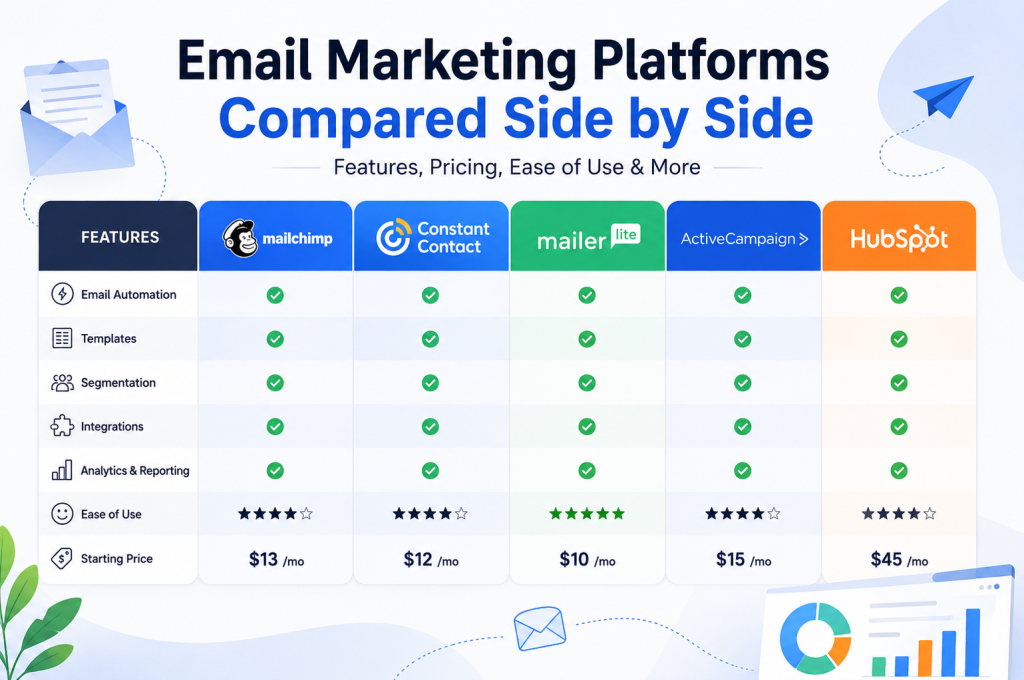
Email marketing continues to deliver one of the highest returns on investment of any digital marketing channel, but choosing the right platform has become increasingly challenging. Modern email marketing software offers far more than newsletters—it now includes marketing automation, customer journey mapping, CRM integration, AI-powered content generation, ecommerce automation, detailed analytics dashboards and sophisticated audience segmentation.
In this guide, we’ll compare today’s leading email marketing platforms, examine the key features that matter most, explain how different providers suit different business sizes and industries, and help you understand what to look for before making a decision. Whether you’re a startup building your first mailing list, an ecommerce retailer automating abandoned cart emails, or an established business looking for enterprise email marketing software, this comparison will help you make an informed choice.
Why Your Choice of Email Marketing Platform Matters
Email has evolved from a simple communication channel into the centre of modern digital marketing.
Today’s businesses expect their email service provider (ESP) to manage:
- Email campaigns
- Marketing automation
- Subscriber management
- Contact management
- Customer lifecycle automation
- Behavioural automation
- Personalisation
- CRM integration
- Ecommerce integration
- SMS marketing
- Campaign reporting
- Revenue attribution
The right platform doesn’t simply send emails—it helps build long-term customer relationships while improving efficiency across your marketing activities.
For many businesses, email also complements SEO, paid advertising and website optimisation. Businesses investing in professional digital marketing often combine strong email automation with an effective organic search strategy such as our SEO services to maximise long-term audience growth and lead generation.
The best email marketing software isn’t necessarily the platform with the most features. It’s the one that fits your business processes, customer journey and future growth plans.
What Makes a Great Email Marketing Platform?
When comparing providers side by side, it helps to evaluate each platform using consistent selection criteria rather than focusing solely on pricing.
Ease of Use
A beginner-friendly platform should include:
- Drag-and-drop email builder
- Responsive email templates
- Intuitive email editor
- Visual workflow builder
- Template library
- Simple contact importing
- Guided campaign creation
Small businesses often prioritise ease of use over advanced functionality, whereas larger organisations may require sophisticated automation workflows and custom integrations.
Email Automation Capabilities
Automation is one of the biggest differences between providers.
Modern email automation software can trigger messages based on:
- User behaviour
- Purchase history
- Website visits
- Product views
- Signup forms
- Event triggers
- Customer lifecycle stages
- Segmentation rules
- Conditional logic
Examples include:
- Welcome emails
- Drip campaigns
- Lead nurturing sequences
- Win-back campaigns
- Promotional emails
- Transactional emails
- Order confirmation emails
- Cart recovery automation
The more advanced platforms also include branching workflows, multistep automation and behaviour-based automation that adapts to customer actions in real time.
Audience Segmentation and Personalisation
Sending every subscriber the same message is rarely effective.
Instead, successful businesses rely on audience segmentation using factors such as:
| Segmentation Method | Example |
|---|---|
| Purchase history | Previous customers receive product recommendations |
| Engagement metrics | Active subscribers receive exclusive offers |
| Location | Region-specific campaigns |
| Customer value | VIP loyalty campaigns |
| Behaviour | Browse abandonment emails |
| Interests | Personalised product categories |
Combined with dynamic content and AI features, these segmentation capabilities significantly improve email engagement and increase conversions.
The Features Every Business Should Compare
Although every provider advertises similar capabilities, the quality of implementation varies considerably.
Before choosing an email marketing platform, compare the following areas carefully.
Deliverability
Excellent email deliverability often separates the best providers from average ones.
Consider:
- Inbox placement rates
- Sender reputation
- Spam testing
- Bounce rate management
- Email authentication
- SPF
- DKIM
- DMARC
- Suppression lists
- Dedicated IP availability
- Shared IP options
- Email warm-up support
Even beautifully designed campaigns produce little value if they consistently land in spam folders.
Reporting and Analytics
Reliable email analytics provide the data needed for continual optimisation.
Useful reporting should include:
- Open rates
- Click-through rate
- Click tracking
- Conversion tracking
- Campaign performance
- Revenue tracking
- Campaign attribution
- Attribution reporting
- Customer lifetime value
- Unsubscribe rate
- Email heatmaps
- Marketing ROI
These insights allow marketers to perform meaningful A/B testing and optimise future campaigns based on real customer behaviour.
Integrations
Businesses increasingly rely on connected software ecosystems.
Strong integrations may include:
- Shopify integration
- WooCommerce integration
- BigCommerce integration
- Salesforce integration
- WordPress integration
- Zapier integration
- API access
- Webhooks
- CRM synchronisation
- Ecommerce plugins
If your website acts as the primary lead generation tool, ensuring seamless integration between your website and email marketing software becomes particularly important. Businesses launching a new online presence should also consider how their email platform connects with a professionally developed website design solution from the outset, avoiding unnecessary migration work later.
Understanding Different Types of Email Marketing Platforms
Not every platform targets the same audience.
Some prioritise simplicity and affordability.
Others focus on enterprise marketing automation or ecommerce email marketing.
Before comparing individual providers, it’s worth understanding the broad categories each platform typically falls into.
Side-by-Side Comparison of the Leading Email Marketing Platforms
With dozens of email marketing services available, narrowing down the right solution can feel overwhelming. While many platforms advertise similar capabilities, there are meaningful differences in automation, scalability, pricing, integrations and the industries they serve best.
Rather than declaring a single winner, it’s more useful to compare each platform according to its strengths, weaknesses and ideal use cases.
ActiveCampaign
ActiveCampaign is widely regarded as one of the strongest all-round marketing automation platforms available.
Its advanced automation builder allows businesses to create highly personalised customer journeys using behavioural automation, lead scoring, event-based workflows and conditional logic.
Best for:
- Growing businesses
- B2B email marketing
- SaaS companies
- Advanced sales automation
- Customer lifecycle automation
Key strengths
- Powerful workflow builder
- Excellent CRM integration
- Advanced audience segmentation
- AI features
- Predictive sending
- Predictive segmentation
- Strong campaign reporting
Potential drawbacks
- Steeper learning curve
- Higher pricing than beginner-focused platforms
Businesses planning sophisticated lead nurturing strategies often find ActiveCampaign offers exceptional long-term value for money.
Mailchimp
Mailchimp remains one of the most recognised names in email marketing software.
Its popularity largely comes from its ease of use, polished interface and generous ecosystem of integrations.
It works particularly well for organisations sending newsletters, promotional emails and straightforward automation workflows.
Best for:
- Beginners
- Small businesses
- Content creators
- Newsletter publishing
Key strengths
- Beginner-friendly interface
- Excellent template library
- Drag-and-drop email builder
- Landing pages
- Signup forms
- AI email writing assistance
- Large integration marketplace
Potential drawbacks
- Automation features become expensive
- Advanced segmentation is limited on lower-tier plans
For businesses just beginning to grow an email list, Mailchimp continues to be one of the easiest platforms to adopt.
Brevo
Formerly known as Sendinblue, Brevo has evolved into a comprehensive omnichannel marketing platform.
Alongside email campaigns, it supports SMS marketing, live chat and CRM functionality, making it attractive for businesses wanting multiple communication channels under one roof.
Best for:
- Small and medium-sized businesses
- Service businesses
- Companies wanting omnichannel marketing
Key strengths
- Competitive pricing
- SMS marketing included
- CRM integration
- Transactional emails
- Marketing automation
- Good deliverability
Potential drawbacks
- Reporting isn’t as detailed as some competitors
- Fewer advanced ecommerce tools
MailerLite
MailerLite has become increasingly popular thanks to its clean interface and affordable pricing.
Despite its simplicity, it still includes automation workflows, responsive templates, landing pages and subscriber management tools that satisfy most small businesses.
Best for:
- Bloggers
- Startups
- Freelancers
- Small businesses
Key strengths
- Affordable email marketing software
- Easy-to-use email editor
- Strong free plan
- Good email templates
- Website builder
- Landing pages
Potential drawbacks
- Limited enterprise functionality
- Fewer AI features
For organisations looking for excellent value without unnecessary complexity, MailerLite deserves serious consideration.
HubSpot
HubSpot approaches email marketing as part of a much larger CRM ecosystem.
Rather than functioning solely as a newsletter platform, it combines email automation, sales pipelines, customer support and marketing analytics into one unified system.
Best for:
- Growing companies
- Enterprise email marketing
- Sales-focused organisations
Key strengths
- Exceptional CRM integration
- Deep customer journey visibility
- Advanced reporting
- Revenue attribution
- Marketing automation
- Campaign attribution
Potential drawbacks
- Premium pricing
- Significant feature set may be overwhelming for smaller teams
Businesses already invested in CRM-driven marketing frequently find HubSpot difficult to beat.
Klaviyo
Klaviyo has established itself as one of the leading platforms for ecommerce email marketing.
Its strength lies in behavioural automation powered by real-time customer data.
Retailers can trigger campaigns based on browsing behaviour, purchase history, abandoned carts and customer lifetime value.
Best for:
- Shopify stores
- WooCommerce businesses
- Ecommerce brands
- Online retailers
Key strengths
- Excellent Shopify integration
- Product recommendations
- Browse abandonment automation
- Cart recovery
- Dynamic content
- Detailed revenue tracking
Potential drawbacks
- Better suited to ecommerce than service businesses
- Costs rise alongside subscriber growth
Omnisend
Like Klaviyo, Omnisend focuses heavily on ecommerce businesses.
However, it distinguishes itself through its balance between advanced automation and accessibility.
Its visual automation builder enables retailers to launch sophisticated workflows without extensive technical knowledge.
Common automation templates include:
- Welcome emails
- Cart recovery
- Browse abandonment
- Product recommendations
- Repeat purchase reminders
- Win-back campaigns
- Order confirmation emails
For many ecommerce businesses, Omnisend represents an excellent balance between functionality and simplicity.
GetResponse
GetResponse has expanded well beyond email campaigns to include webinars, landing pages and sales funnels.
This broader marketing toolkit appeals to businesses wanting an all-in-one platform.
Best for:
- Digital marketers
- Coaches
- Online educators
- Businesses selling digital products
Key strengths
- Conversion funnels
- Webinar hosting
- Marketing automation
- Landing pages
- AI workflow builder
- Email scheduling
Potential drawbacks
- Interface can feel busy
- Some advanced features require higher-tier subscriptions
Constant Contact
Constant Contact has traditionally focused on reliability and ease of use.
Although it doesn’t offer the deepest automation capabilities, it provides dependable tools for organisations wanting straightforward email campaigns without unnecessary complexity.
It remains popular among:
- Local businesses
- Charities
- Community organisations
- Nonprofit email marketing
- Event organisers
Its customer support also receives consistently positive feedback, making it attractive to less technical users.
Comparison Table
| Platform | Best For | Automation | Ecommerce | CRM | Ease of Use |
|---|---|---|---|---|---|
| ActiveCampaign | Advanced automation | Excellent | Very Good | Excellent | Moderate |
| Mailchimp | Beginners | Good | Good | Good | Excellent |
| Brevo | Omnichannel marketing | Good | Good | Good | Excellent |
| MailerLite | Budget-conscious businesses | Good | Moderate | Moderate | Excellent |
| HubSpot | Enterprise businesses | Excellent | Good | Outstanding | Moderate |
| Klaviyo | Ecommerce retailers | Excellent | Outstanding | Good | Good |
| Omnisend | Online stores | Excellent | Outstanding | Moderate | Excellent |
| GetResponse | Digital marketing | Very Good | Good | Moderate | Good |
| Constant Contact | Small organisations | Moderate | Basic | Basic | Excellent |
Is a Free Plan Enough?
Many providers offer a free plan or free trial, making it easier to evaluate their software before committing financially.
A free plan is often suitable when you:
- Have a small mailing list
- Send newsletters occasionally
- Need basic email templates
- Want to learn the platform
- Are testing different providers
However, businesses experiencing rapid subscriber growth typically outgrow free plans quickly.
Premium subscriptions usually unlock:
- Advanced automation
- A/B testing
- AI subject line generator
- Advanced segmentation
- Behaviour-based automation
- Conversion optimisation tools
- Enhanced customer support
- Dedicated IP options
- More detailed analytics dashboards
The cheapest email marketing platform isn’t always the most affordable over the long term. A solution with better automation and stronger email deliverability can generate significantly greater marketing ROI, making a higher monthly subscription worthwhile.
Pricing: Looking Beyond the Monthly Subscription
Pricing comparison is often the first thing businesses look at, but it shouldn’t be the deciding factor.
Two platforms may appear similarly priced, yet deliver completely different levels of functionality, automation and long-term value.
When comparing costs, consider factors such as:
- Number of subscribers
- Monthly email sending limits
- Automation capabilities
- AI features
- Customer support
- Reporting and analytics
- API access
- CRM synchronisation
- Ecommerce integrations
- Scalability
As your mailing list grows, pricing structures can change dramatically. Some providers charge primarily by subscriber count, while others base costs on email volume or feature access.
The best approach is to estimate where your business will be in 12 to 24 months rather than choosing software that only fits today’s requirements.
Security, Compliance and Deliverability
Even the most sophisticated email campaign will struggle if recipients never receive it.
Modern email marketing platforms invest heavily in deliverability, but businesses also play an important role in maintaining a healthy sender reputation.
Key considerations include:
GDPR Compliance
Businesses operating within the UK and Europe should ensure their chosen platform supports:
- GDPR compliance
- Consent management
- Double opt-in
- Easy unsubscribe management
- Secure data storage
- Data privacy controls
Maintaining compliant subscriber records helps protect your business while improving trust with customers.
Email Authentication
Authentication standards help email providers verify legitimate senders.
Look for support for:
- SPF
- DKIM
- DMARC
Correctly configured authentication improves inbox placement while reducing the likelihood of messages being flagged as spam.
Maintaining Strong Deliverability
Good email deliverability depends on far more than the platform itself.
Best practices include:
- Regularly cleaning inactive subscribers.
- Monitoring bounce rate trends.
- Removing invalid email addresses.
- Avoiding purchased mailing lists.
- Building subscribers organically.
- Monitoring spam score reports.
- Following consistent sending schedules.
- Warming up new domains carefully.
These practices improve sender reputation and help maximise campaign performance over time.
Common Mistakes When Choosing Email Marketing Software
Many businesses focus exclusively on feature lists while overlooking practical considerations that affect day-to-day marketing.
Some of the most common mistakes include:
Choosing Based Solely on Price
Affordable email marketing software can be an excellent option, but low subscription fees may come at the expense of automation, reporting or scalability.
Think about future requirements rather than today’s budget alone.
Ignoring Integration Requirements
Your email platform rarely works in isolation.
Consider how it connects with your:
- CRM
- Ecommerce platform
- Website
- Sales software
- Analytics tools
- Customer support systems
Strong integrations reduce manual work and improve data accuracy across your business.
Overlooking Automation
Many organisations only send newsletters despite investing in sophisticated software.
Automation workflows such as:
- Welcome sequences
- Lead nurturing
- Customer lifecycle automation
- Event-based workflows
- Trigger-based campaigns
- Behaviour-based automation
can generate substantially more revenue than one-off promotional emails.
Forgetting About Scalability
Software that works perfectly for 500 subscribers may become restrictive at 50,000.
Evaluate:
- Subscriber limits
- Contact management
- Automation complexity
- Reporting depth
- Team collaboration
- API capabilities
Selecting a scalable platform today can save considerable time and expense later.
Which Email Marketing Platform Is Best?
There isn’t a universal winner because every organisation has different objectives.
As a general guide:
| Business Type | Recommended Focus |
|---|---|
| Startups | Ease of use, free plan and affordable pricing |
| Small businesses | Simplicity, automation and strong customer support |
| Ecommerce retailers | Behavioural automation, product recommendations and Shopify or WooCommerce integration |
| B2B organisations | CRM integration, lead nurturing and advanced automation |
| Enterprise businesses | Scalability, analytics, APIs and customer journey management |
| Content creators | Newsletter software, landing pages and audience growth tools |
The right decision depends on your marketing strategy, sales process and long-term ambitions rather than simply selecting the platform with the largest number of features.
Maximising Results Beyond Your Email Platform
Choosing excellent email marketing software is only one part of building an effective digital marketing strategy.
For the strongest results, email should work alongside:
- Search engine optimisation
- Paid advertising
- High-converting landing pages
- Fast, user-friendly websites
- Conversion optimisation
- Analytics and performance tracking
When these channels support one another, businesses are better positioned to generate consistent lead generation, improve customer retention and increase conversions.
If you’re investing in email marketing to drive more enquiries or sales, it’s also worth ensuring your wider digital strategy supports those efforts. Combining automation with professionally managed PPC campaigns can accelerate traffic acquisition while your organic channels continue to grow.
Final Thoughts
Choosing between today’s leading email marketing platforms isn’t about finding the platform with the longest feature list—it’s about finding the solution that aligns with your business goals.
Whether your priority is sophisticated marketing automation, ecommerce email marketing, AI-powered personalisation, detailed analytics dashboards or simply a beginner-friendly platform that helps you grow your mailing list, there is a solution designed for your needs.
Before making your final decision, compare each provider against consistent selection criteria:
- Features
- Pricing
- Deliverability
- Automation capabilities
- Integrations
- Customer support
- Scalability
- Security
- Compliance
- Long-term value
A thoughtful comparison today can save countless hours of migration, training and redevelopment in the future.
Ultimately, the best email marketing software is the one that enables you to build stronger customer relationships, deliver relevant and timely communications, improve engagement and achieve measurable marketing ROI as your business continues to grow.
Frequently Asked Questions
1. Can I switch from one email marketing platform to another without losing my subscribers?
Yes. Most email marketing platforms allow you to export your subscriber list, custom fields and audience segments before importing them into a new platform. While contacts can usually be transferred easily, automation workflows, templates and reporting history often need to be recreated manually. Before migrating, it’s worth checking whether your new provider offers a migration service to simplify the process.
2. How often should I send marketing emails?
The ideal frequency depends on your audience and industry rather than following a universal schedule. Some businesses achieve excellent results with weekly newsletters, while ecommerce brands may send multiple promotional emails each week. Monitoring engagement metrics such as open rates, click-through rates and unsubscribe rates will help determine the right balance without overwhelming subscribers.
3. What’s the difference between a newsletter and an email campaign?
A newsletter is typically a recurring email designed to keep subscribers informed with company updates, news or educational content. An email campaign is broader and can include promotional emails, product launches, seasonal offers, automated sequences or lead nurturing workflows designed to achieve a specific marketing objective.
4. Can small businesses benefit from AI-powered email marketing?
Absolutely. AI features are becoming increasingly accessible, even on lower-priced plans. Businesses can use AI email writing, subject line suggestions, content recommendations and send-time optimisation to improve productivity while creating more engaging campaigns. These tools save time without replacing the need for a well-planned marketing strategy.
5. How important are mobile-friendly email templates?
Very important. A significant proportion of marketing emails are opened on smartphones and tablets. Responsive templates automatically adjust to different screen sizes, making emails easier to read and interact with. Mobile optimisation can improve user experience, click-through rates and overall campaign performance.
6. Should I remove inactive subscribers from my mailing list?
Yes. Regularly removing or re-engaging inactive subscribers helps maintain a healthier mailing list. Sending emails to people who rarely open your messages can negatively affect engagement rates and sender reputation. Many businesses run dedicated re-engagement campaigns before removing inactive contacts permanently.
7. What is email list hygiene, and why does it matter?
Email list hygiene refers to the ongoing process of keeping your subscriber database accurate and up to date. This includes removing invalid addresses, correcting duplicate records, managing bounced emails and ensuring subscribers have given appropriate consent. A clean mailing list improves deliverability, reporting accuracy and overall campaign effectiveness.
8. Can one email marketing platform manage multiple brands or businesses?
Many providers support multiple brands, domains or business units within a single account, although the available features vary between platforms. Larger organisations often benefit from separate workspaces, user permissions and brand-specific templates, allowing marketing teams to manage multiple audiences while maintaining consistent branding.
9. What metrics should I monitor after sending an email campaign?
Rather than focusing on a single metric, review campaign performance as a whole. Important indicators include delivery rate, open rate, click-through rate, click-to-open rate, conversion rate, unsubscribe rate, bounce rate and overall revenue generated. Tracking these metrics over time provides a clearer picture of long-term performance than analysing individual campaigns in isolation.
10. How long does it take to see results from email marketing?
Some campaigns, such as promotional offers or abandoned cart emails, can generate results within hours. Longer-term strategies focused on lead nurturing, customer retention and audience growth may take several weeks or months to demonstrate their full value. Consistency, high-quality content and ongoing optimisation are usually the biggest factors influencing long-term success.