
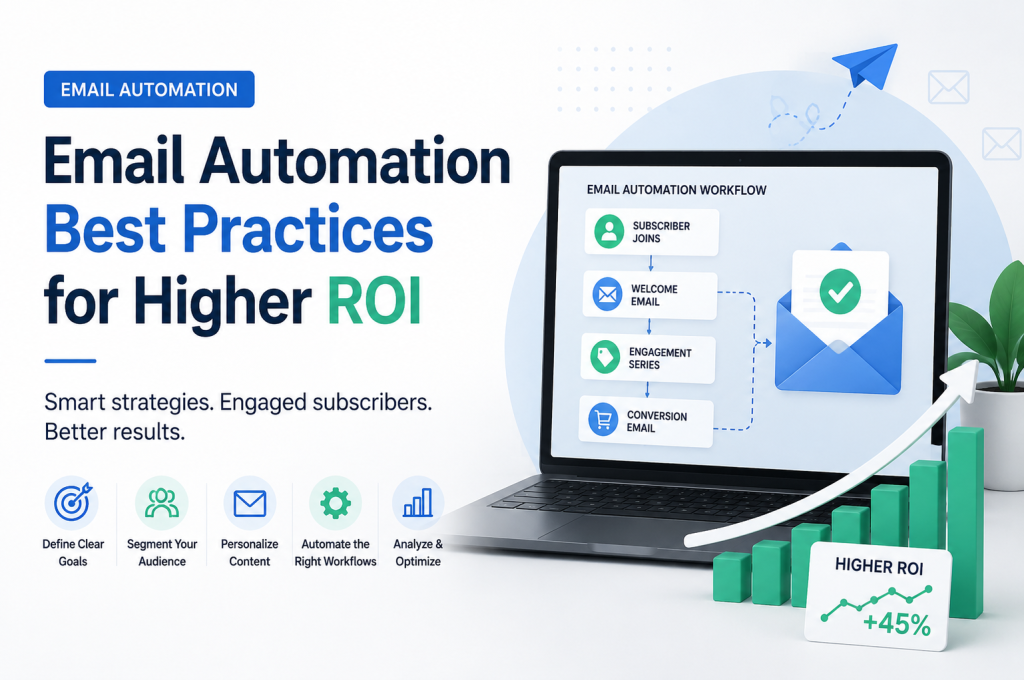
Email marketing still delivers one of the highest returns in digital marketing — but only when automation is executed strategically. Modern brands are no longer blasting generic newsletters to entire lists. Instead, they’re building personalized email campaigns powered by behavioral triggers, audience segmentation, predictive analytics, and automated customer journeys.
In this guide, we’ll explore how businesses can improve customer engagement, increase conversion rates, strengthen email deliverability, and maximise revenue per email (RPE) through smarter automation workflows. You’ll learn how AI-powered automation, lifecycle marketing, dynamic content, and conversion-focused email copy work together to create scalable campaigns that feel genuinely personal.
Whether you’re building onboarding email flows, abandoned cart emails, re-engagement campaigns, or advanced drip campaigns, the goal is the same: deliver the right message to the right customer at the right time.
Email Automation Is No Longer Optional
The days of one-size-fits-all email campaigns are gone.
Today’s customers expect contextual messaging, personalized recommendations, and seamless experiences across every touchpoint. If your campaigns still rely on static mailing lists and manually scheduled broadcasts, your competitors are already ahead.
Businesses investing in email marketing automation are seeing improvements in:
- Customer retention
- Click-through rate (CTR)
- Customer acquisition
- Conversion optimization
- Lead nurturing
- Marketing automation ROI
- Automated upselling opportunities
The real advantage comes from building systems that respond to subscriber behavior automatically.
A visitor downloads a guide? Triggered emails begin nurturing them through the sales funnel.
A shopper abandons a basket? Automated follow-up emails recover lost revenue.
A customer stops engaging? Re-engagement campaigns activate before churn becomes permanent.
This is where automation transforms from a convenience into a revenue engine.
The Foundation of High-Performing Email Automation
Before diving into advanced workflows, businesses need a strong strategic foundation.
Many brands rush into automation software without defining:
- Customer intent
- Segmentation strategy
- Campaign performance metrics
- Lifecycle stages
- Email marketing KPIs
Without these fundamentals, even sophisticated tools produce mediocre results.
The Core Components of Effective Automation
| Component | Purpose |
|---|---|
| Audience segmentation | Deliver relevant messaging |
| Behavioral segmentation | React to customer actions |
| Dynamic content | Personalize emails at scale |
| Automated workflows | Reduce manual campaign management |
| Email analytics | Measure engagement metrics |
| A/B testing | Improve conversion rates |
| Send-time optimization | Increase email open rates |
| List hygiene | Protect sender reputation |
| AI-driven personalization | Improve customer experience personalization |
Successful brands treat automation as part of a broader digital ecosystem — not an isolated tactic.
For example, a company investing in strong landing pages through professional website design creates a smoother path between email engagement and conversion-focused actions.
Why Audience Segmentation Drives Better ROI
One of the biggest mistakes businesses make is emailing everyone the same content.
Consumers interact differently depending on:
- Purchase history
- Browsing behavior
- Customer lifecycle stage
- Interests
- Device usage
- Geographic location
- Engagement scoring
- Subscriber preferences
Segmentation allows businesses to tailor messaging for each group instead of relying on generic campaigns.
Types of Email List Segmentation That Matter Most
Demographic Segmentation
Useful for broad targeting based on:
- Age
- Industry
- Role
- Location
Behavioral Segmentation
This is where modern automation becomes powerful.
Behavior-based automation uses actions such as:
- Product views
- Cart abandonment
- Link clicks
- Download activity
- Previous purchases
- Email engagement
These signals create highly targeted automated customer journeys.
Engagement-Based Segmentation
Not all subscribers deserve the same email cadence.
Some customers engage daily. Others haven’t opened an email in six months.
Segmenting based on engagement prevents list fatigue while improving inbox placement and spam prevention.
The more relevant your email targeting becomes, the stronger your click-to-open rate (CTOR) and conversion rates become.
Building Automated Email Workflows That Actually Convert
Most businesses create automation sequences that feel robotic.
The problem usually isn’t the technology.
It’s the lack of customer psychology.
High-performing automated workflows mirror natural conversations instead of aggressive sales funnels.
Essential Email Sequences Every Business Should Have
1. Welcome Email Series
First impressions shape long-term customer loyalty.
An effective welcome series should:
- Introduce the brand
- Set expectations
- Deliver immediate value
- Gather zero-party data
- Encourage micro-conversions
Strong onboarding email flows also improve long-term retention marketing efforts.
2. Abandoned Cart Emails
Abandoned cart automation remains one of the highest-converting forms of ecommerce email automation.
Effective sequences typically include:
- Reminder email
- Social proof
- Incentive offer
- Urgency-focused follow-up
Timing matters significantly here.
Using predictive email marketing and send-time optimization can dramatically improve recovery rates.
3. Lead Nurturing Campaigns
Most leads are not ready to buy immediately.
Automated lead nurturing helps businesses build trust over time through:
- Educational content
- Case studies
- Product comparisons
- FAQs
- Customer success stories
Brands combining automation with long-term SEO strategies often see stronger conversion-driven automation because organic traffic enters the funnel with higher intent.
Personalization Is Now Expected
Modern consumers can instantly detect generic campaigns.
True personalization goes beyond using a first name in the subject line.
Today’s high-performing campaigns rely on:
- Customer behavior analytics
- AI-powered automation
- Smart product recommendations
- Real-time personalization
- Dynamic content blocks
- Personalized workflows
- Customer intent data
This creates experiences that feel individually crafted.
Hyper-Personalization and AI Email Marketing
AI email marketing platforms now use machine learning optimization to predict:
- Best send times
- Product interests
- Purchase likelihood
- Churn probability
- Engagement patterns
This level of predictive analytics improves both customer engagement and revenue per email.
Businesses integrating automation with broader acquisition channels like targeted PPC campaigns can also create stronger omnichannel marketing experiences by aligning messaging across ads, landing pages, and email sequences.
The Role of Dynamic Content in Modern Campaigns
Dynamic content allows a single email to display different messaging depending on the subscriber.
For example:
| Subscriber Type | Dynamic Email Content |
|---|---|
| Returning customer | Loyalty offer |
| First-time visitor | Educational guide |
| High-value customer | VIP promotion |
| Inactive subscriber | Re-engagement incentive |
This improves:
- Email engagement
- Conversion tracking
- Customer retention
- Automated customer retention
- Engagement-based automation
Instead of creating dozens of separate campaigns manually, marketers can scale personalization through intelligent automation logic.
Why Email Deliverability Can Make or Break ROI
Even exceptional campaigns fail if emails never reach the inbox.
Email deliverability is one of the most overlooked aspects of campaign automation.
Poor sender reputation damages:
- Open rates
- CTR
- Inbox placement
- Revenue opportunities
Best Practices for Better Deliverability
Maintain List Hygiene
Regularly remove:
- Invalid emails
- Inactive subscribers
- Spam traps
- Fake sign-ups
Use Double Opt-In Strategies
This improves:
- Subscriber quality
- GDPR compliance
- CAN-SPAM compliance
- Engagement metrics
Avoid Spam Triggers
Excessive:
- Capital letters
- Promotional language
- Broken HTML
- Misleading subject lines
can damage deliverability.
Monitor Engagement Metrics
Mailbox providers increasingly prioritise subscriber behavior signals such as:
- Opens
- Replies
- Clicks
- Deletions
- Spam complaints
This means personalization and relevance directly impact inbox placement.
Measuring What Matters in Email Marketing Automation
One of the biggest misconceptions in email marketing is assuming success begins and ends with open rates.
It doesn’t.
Modern campaign automation relies on deeper performance indicators that reveal how subscribers actually behave throughout the customer journey.
Without accurate email analytics, businesses struggle to improve conversion optimization or identify weaknesses in their automated workflows.
The Most Important Email Marketing KPIs
The strongest automation strategies monitor a combination of engagement metrics, revenue metrics, and customer lifecycle indicators.
| KPI | Why It Matters |
|---|---|
| Click-through rate (CTR) | Measures engagement quality |
| Click-to-open rate (CTOR) | Evaluates content relevance |
| Revenue per email (RPE) | Tracks campaign profitability |
| Conversion rate | Measures completed actions |
| Bounce rate | Indicates list quality |
| Unsubscribe rate | Signals audience fatigue |
| Spam complaints | Impacts sender reputation |
| Customer retention rate | Measures lifecycle effectiveness |
| Engagement scoring | Identifies high-value subscribers |
Looking at metrics in isolation often leads to misleading conclusions.
For example, a campaign with a lower open rate but significantly higher conversions may outperform a campaign with inflated vanity metrics.
Why A/B Testing Should Never Stop
The highest-performing brands continuously refine campaigns through structured experimentation.
A/B testing allows marketers to optimise:
- Subject lines
- Preview text
- Email cadence
- CTA placement
- Dynamic content blocks
- Personalized recommendations
- Responsive email templates
- Send-time optimization
Even minor improvements can produce substantial gains when scaled across thousands of subscribers.
Elements Worth Testing Frequently
Subject Lines
Different emotional triggers influence customer engagement differently.
Examples include:
- Curiosity-driven
- Benefit-led
- Urgency-focused
- Question-based
- Data-oriented
CTA Positioning
The placement of buttons and links affects conversion rates dramatically.
Email Timing
AI-driven segmentation and predictive analytics can identify optimal delivery windows based on subscriber behavior.
Content Length
Some audiences prefer concise messaging while others engage more deeply with long-form educational content.
High-performing email campaign optimization is rarely about massive redesigns. It’s usually the result of consistent incremental improvements over time.
The Rise of AI-Powered Automation
Artificial intelligence is rapidly transforming how businesses approach campaign automation.
Instead of manually building every workflow, marketers now use AI-powered automation to analyse customer data, predict intent, and automate personalization at scale.
This shift is redefining how brands handle:
- Customer lifecycle automation
- Lead scoring
- Smart automation workflows
- Predictive personalization
- Automated segmentation
- Email timing optimization
How AI Improves Customer Engagement
AI email optimization tools can process huge volumes of customer behavior analytics in real time.
This allows campaigns to adapt dynamically based on:
- Browsing activity
- Purchase history
- Engagement frequency
- Device preferences
- Content interests
- Customer intent data
The result is smarter messaging with far greater contextual relevance.
Examples of AI-Driven Personalization
| AI Capability | Practical Use |
|---|---|
| Predictive analytics | Forecast likely purchases |
| Engagement scoring | Prioritise active subscribers |
| Smart product recommendations | Increase upselling opportunities |
| Behavioral triggers | Automate real-time responses |
| Churn prediction | Launch retention automation |
| Send-time optimization | Improve inbox visibility |
AI marketing tools are particularly valuable for businesses managing large subscriber databases where manual personalization becomes impossible.
Behavioral Triggers Create More Natural Customer Journeys
Traditional email blasts interrupt people.
Behavior-based automation responds to what users are already doing.
That difference matters enormously.
Triggered emails consistently outperform generic campaigns because they align with real customer intent.
Common Behavioral Triggers Businesses Should Use
Browse Abandonment
If a visitor repeatedly views a product or service without converting, automated outreach can encourage them back into the funnel.
Purchase Follow-Ups
Transactional emails can evolve into:
- Product education
- Cross-selling opportunities
- Review requests
- Customer loyalty incentives
Inactivity Detection
Re-engagement campaigns help reduce churn before subscribers disappear permanently.
Content Consumption
Downloading a guide or reading a blog article can initiate automated lead nurturing sequences tailored to subscriber interests.
This type of customer journey automation creates smoother experiences that feel timely rather than intrusive.
Omnichannel Marketing and Email Automation
Email rarely works in isolation anymore.
Modern customer journeys span:
- Paid advertising
- Organic search
- Social media
- SMS
- Retargeting
- Website interactions
Brands that integrate email automation with broader multichannel automation strategies typically see stronger long-term performance.
Why Consistency Across Channels Matters
When users encounter conflicting messaging between:
- Ads
- Emails
- Landing pages
- Product pages
trust declines quickly.
Consistency improves:
- Customer experience personalization
- Conversion tracking
- Audience targeting
- Brand authority
- Customer acquisition efficiency
This is why businesses increasingly integrate automation platforms with CRM systems and customer data platforms (CDPs).
The more unified the customer data becomes, the more intelligent campaign automation becomes.
Email Compliance Is a Competitive Advantage
Many businesses view GDPR compliance and CAN-SPAM compliance as frustrating obligations.
In reality, ethical email practices improve performance.
Subscribers who actively choose to engage with a brand generate:
- Higher CTR
- Better inbox placement
- Improved sender reputation
- Stronger customer loyalty
Compliance Best Practices
Prioritise First-Party Data
Collect customer information directly through:
- Forms
- Surveys
- Preference centres
- Purchases
This creates cleaner segmentation data while reducing dependency on third-party tracking.
Make Unsubscribing Easy
Complicated unsubscribe processes increase spam complaints.
Be Transparent
Clearly explain:
- Data collection
- Communication frequency
- Subscriber preferences
- Personalization practices
Trust directly influences engagement.
Responsive Email Templates and Mobile-First Design
A significant percentage of email opens now happen on mobile devices.
Yet many businesses still design campaigns primarily for desktop viewing.
That creates friction immediately.
Mobile-First Email Design Principles
Keep Layouts Simple
Clean structures improve readability across devices.
Use Clear CTA Buttons
Small or cluttered buttons reduce click-through rate.
Optimise Image Sizes
Large files slow loading speeds and hurt engagement.
Write Scannable Copy
Subscribers often skim emails rapidly.
Short paragraphs, subheadings, and spacing improve readability significantly.
Responsive email templates are not simply a design preference anymore — they directly impact conversion optimization and customer retention.
Customer Retention Often Delivers Better ROI Than Acquisition
Many businesses obsess over acquiring new leads while ignoring existing customers.
That’s expensive.
Retention automation often produces significantly stronger marketing automation ROI because existing customers already trust the brand.
Effective Retention Campaign Types
- Loyalty rewards
- VIP access
- Customer reactivation campaigns
- Educational nurture sequences
- Product replenishment reminders
- Personalized workflows
- Automated upselling campaigns
Well-structured retention marketing increases:
- Lifetime customer value
- Revenue consistency
- Brand advocacy
- Repeat purchases
It also reduces dependency on increasingly expensive paid acquisition channels.
Automation Without Strategy Creates Noise
Automation tools are powerful.
But technology alone doesn’t create successful campaigns.
Poorly planned automation often leads to:
- Generic messaging
- Over-emailing
- Audience fatigue
- Lower engagement
- Deliverability problems
The businesses seeing the strongest results approach automation strategically.
They combine:
- Behavioral segmentation
- Customer intent analysis
- Conversion-focused email copy
- AI-driven personalization
- Smart automation workflows
- Continuous campaign analytics
into one cohesive system.
That’s where sustainable growth happens.
Creating an Email Automation Strategy That Scales
Many businesses begin with a handful of automated campaigns and quickly hit a wall.
Why?
Because disconnected workflows become difficult to manage as subscriber lists grow, customer journeys become more complex, and personalization expectations increase.
A scalable email automation strategy requires structure from the beginning.
The Best Automation Systems Are Built Around the Customer Journey
Instead of focusing purely on campaigns, successful brands map automation around customer lifecycle stages.
| Lifecycle Stage | Automation Goal |
|---|---|
| Awareness | Customer acquisition |
| Consideration | Lead nurturing |
| Conversion | Conversion optimization |
| Retention | Customer loyalty |
| Advocacy | Referrals and repeat sales |
This approach creates automated customer journeys that feel cohesive rather than fragmented.
Each touchpoint should move subscribers naturally toward the next stage.
How Customer Data Improves Automation Performance
The quality of your automation depends entirely on the quality of your customer data.
Weak data creates weak segmentation.
Strong data creates highly targeted campaigns that improve:
- Email engagement
- Customer retention
- Revenue per email
- Audience targeting
- Personalized recommendations
The Shift Toward Zero-Party and First-Party Data
As privacy regulations evolve, businesses are relying more heavily on information customers intentionally share.
This includes:
- Preferences
- Survey responses
- Product interests
- Communication settings
- Purchase intentions
Zero-party data improves personalization while strengthening trust.
Unlike third-party tracking, it creates transparent customer relationships that support long-term retention marketing.
Using Behavioral Data More Effectively
Customer behavior analytics provide critical signals for automation decisions.
These signals include:
- Time spent on pages
- Product interaction frequency
- Previous email engagement
- Purchase intervals
- Content consumption patterns
This enables:
- AI-driven segmentation
- Predictive email marketing
- Smart email targeting
- Automated sales funnels
- Churn reduction emails
The more relevant campaigns become, the stronger the overall marketing automation ROI.
The future of automation belongs to brands that understand customer intent better than their competitors.
Why Timing Is Everything in Email Automation
Even highly personalized campaigns can fail if they arrive at the wrong moment.
Timing directly influences:
- Open rates
- CTR
- Customer engagement
- Inbox placement
- Conversion rates
Send-Time Optimization and Predictive Delivery
Modern automation platforms increasingly use machine learning optimization to determine when subscribers are most likely to engage.
Instead of blasting emails simultaneously, campaigns adapt to:
- Time zones
- Historical engagement patterns
- Device usage
- Purchase timing
- Browsing activity
This improves:
- Email timing optimization
- Customer experience personalization
- Engagement scoring
- Conversion tracking
Businesses using predictive personalization often see stronger results because campaigns feel naturally timed rather than forced.
Drip Campaigns vs Triggered Emails
These two automation models are often confused, but they serve different purposes.
Drip Campaigns
Drip campaigns follow predefined timelines.
For example:
- Welcome email
- Educational follow-up
- Product introduction
- Offer email
These sequences are useful for:
- Onboarding email flows
- Automated lead nurturing
- Educational funnels
- SaaS email automation
Triggered Emails
Triggered emails respond instantly to subscriber behavior.
Examples include:
- Cart abandonment
- Product views
- Form submissions
- Purchases
- Re-engagement activity
Behavior-based automation typically produces higher engagement because messaging aligns with immediate customer actions.
The most effective automation strategies combine both systems.
Common Email Automation Mistakes Businesses Still Make
Despite advances in automation software, many brands continue making preventable mistakes that reduce campaign performance.
1. Over-Automating Communication
Too many automated campaigns create:
- Subscriber fatigue
- Increased unsubscribes
- Lower engagement metrics
- Spam complaints
Automation should improve customer experiences — not overwhelm them.
2. Ignoring Segmentation
Generic broadcasts reduce relevance dramatically.
Without proper email list segmentation, even strong offers underperform.
3. Focusing Only on Sales Emails
Constant promotional messaging damages trust.
Balanced campaigns include:
- Education
- Entertainment
- Problem-solving
- Customer support
- Value-driven insights
4. Neglecting Re-Engagement Campaigns
Inactive subscribers damage sender reputation over time.
Customer reactivation campaigns help maintain:
- List hygiene
- Deliverability
- Engagement quality
5. Weak Conversion-Focused Email Copy
Even sophisticated automation fails with poor messaging.
Strong email copy optimization focuses on:
- Clarity
- Emotional relevance
- Simplicity
- Strong CTAs
- Reader intent
The Growing Role of Ecommerce Email Automation
Ecommerce brands are among the biggest beneficiaries of advanced automation.
With large product catalogues and repeat purchasing opportunities, automation enables highly scalable personalization.
High-Converting Ecommerce Automation Flows
Cart Recovery Sequences
Recover lost revenue through:
- Reminder emails
- Incentive offers
- Urgency messaging
Product Recommendation Campaigns
AI-powered automation can generate personalized recommendations based on browsing and purchasing behavior.
Post-Purchase Automation
These campaigns improve:
- Customer satisfaction
- Repeat purchases
- Upselling opportunities
- Customer loyalty
Replenishment Campaigns
Ideal for consumable products with predictable repurchase timelines.
This type of ecommerce automation strengthens long-term customer retention while increasing lifetime value.
AI and Predictive Analytics Will Continue Reshaping Email Marketing
The next generation of email marketing automation will become even more adaptive.
Instead of static workflows, future systems will increasingly rely on:
- Predictive personalization
- Intent-based marketing
- Real-time personalization
- Customer intent forecasting
- Automated decision-making
What This Means for Businesses
Brands that fail to evolve beyond basic campaigns may struggle with:
- Lower engagement
- Rising acquisition costs
- Reduced inbox visibility
- Weak customer loyalty
Meanwhile, businesses embracing AI-powered automation will gain advantages through:
- Smarter segmentation strategy
- Faster optimization
- Better customer lifecycle automation
- More efficient campaign automation
- Improved conversion-driven automation
Automation is no longer just about saving time.
It’s about delivering experiences customers genuinely value.
Final Thoughts
Successful email automation is not built around sending more emails.
It’s built around sending better ones.
The strongest campaigns combine:
- Personalization
- Behavioral triggers
- Audience segmentation
- Predictive analytics
- Customer intent analysis
- Conversion optimization
- AI-driven personalization
into systems that feel natural, timely, and relevant.
Businesses that focus on customer experience rather than volume consistently achieve:
- Higher conversion rates
- Better customer retention
- Stronger engagement metrics
- Improved inbox placement
- Greater email marketing ROI
As automation technology continues evolving, the brands that win will be the ones using data intelligently while still communicating like humans.
Because ultimately, the goal of automation is not to remove the human element from marketing.
It’s to make meaningful communication scalable.
Additional FAQs About Email Automation and ROI
How often should automated emails be sent to subscribers?
The ideal email cadence depends on your audience, industry, and customer lifecycle stage. Sending too frequently can increase unsubscribes and spam complaints, while sending too infrequently can reduce brand awareness and customer engagement. Monitoring engagement metrics such as open rates, CTR, and unsubscribe rates helps determine the right balance.
What is the difference between email automation and traditional email marketing?
Traditional email marketing often relies on manually scheduled campaigns sent to large groups. Email automation uses behavioral triggers, customer data, and automated workflows to send highly targeted messages based on subscriber actions, preferences, or engagement patterns.
Which industries benefit the most from email automation?
Almost every industry can benefit from automation, but it is particularly effective for:
- Ecommerce businesses
- SaaS companies
- B2B service providers
- Subscription-based brands
- Online education platforms
- Financial services
- Healthcare providers
Any business with repeat customer interactions or lead nurturing opportunities can improve marketing automation ROI through smarter workflows.
What are the best email automation tools for businesses?
Popular email automation software platforms include:
- HubSpot
- Mailchimp
- ActiveCampaign
- Klaviyo
- Twilio SendGrid
The best platform depends on:
- Business size
- CRM integration requirements
- AI email marketing capabilities
- Workflow complexity
- Ecommerce automation needs
- Reporting and analytics features
How long does it take to see ROI from email automation?
Some campaigns, such as abandoned cart emails and welcome email series, can generate results almost immediately. More advanced customer lifecycle automation and retention marketing strategies may take several months to optimise fully. Consistent A/B testing and campaign analytics are critical for improving long-term performance.
Can small businesses benefit from automated email workflows?
Yes. Small businesses often benefit significantly because automation reduces manual workload while improving customer communication consistency. Even basic automated follow-up emails and onboarding sequences can improve customer retention and conversion rates without requiring large marketing teams.
What role does CRM integration play in email automation?
CRM integration allows businesses to sync customer data, track interactions, and personalise campaigns more effectively. This improves:
- Audience segmentation
- Lead scoring
- Customer lifecycle automation
- Predictive personalization
- Sales funnel automation
Integrated systems create a more unified customer experience across multiple channels.
How can businesses reduce email unsubscribe rates?
To reduce unsubscribes, businesses should focus on:
- Sending relevant content
- Improving segmentation strategy
- Avoiding excessive email frequency
- Using personalized workflows
- Offering subscriber preference controls
- Delivering genuine value instead of constant promotions
Better relevance usually leads to stronger customer loyalty and engagement.
What are transactional emails and why are they important?
Transactional emails are triggered by customer actions such as:
- Order confirmations
- Password resets
- Shipping updates
- Account notifications
These emails often achieve extremely high open rates because they are directly tied to customer intent. Businesses can also use transactional emails strategically to improve customer experience personalization and encourage future engagement.
How do automated customer journeys improve conversion rates?
Automated customer journeys guide subscribers through personalised pathways based on behavior, interests, and lifecycle stage. Instead of generic campaigns, customers receive contextual messaging tailored to their needs and actions. This improves:
- Customer engagement
- Lead nurturing
- Conversion optimization
- Customer retention
- Revenue per email
The result is a more relevant and efficient marketing experience for both businesses and subscribers.