
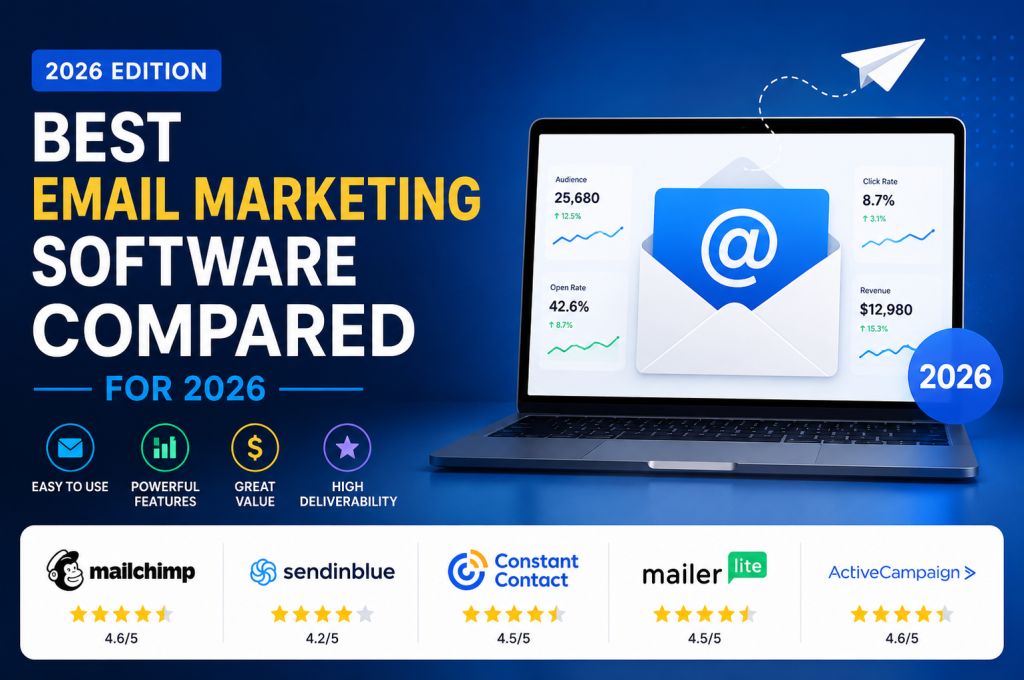
Choosing the right email marketing software in 2026 involves far more than simply sending newsletters. Today’s leading platforms combine AI email marketing, advanced workflow automation, CRM integration, audience segmentation, email deliverability tools, ecommerce email automation, and omnichannel marketing capabilities into a single ecosystem.
The best platforms help businesses automate customer journeys, recover abandoned carts, improve customer retention, personalise campaigns at scale, and measure marketing ROI with sophisticated analytics. Whether you’re a startup, ecommerce brand, creator, agency, nonprofit, or enterprise organisation, understanding how features such as AI subject line generators, predictive email marketing, SMS marketing integration, lead scoring, and deliverability monitoring differ between providers can save significant time and budget.
This guide compares the leading email marketing platforms for 2026, examines the features that matter most, and explains how businesses can choose software that aligns with their growth objectives.
The Evolution of Email Marketing in 2026
Email remains one of the highest-performing digital marketing channels available. Despite the growth of social media, messaging apps, and emerging AI-powered communication channels, email continues to generate exceptional engagement, conversion rates, and long-term customer value.
What has changed dramatically is the technology behind modern email marketing platforms.
Today’s solutions are no longer simple bulk email tools. They function as comprehensive customer engagement platforms capable of coordinating:
- Email automation
- SMS marketing
- Push notification marketing
- CRM-driven email marketing
- Customer lifecycle marketing
- Behavioral targeting
- Revenue attribution
- Cross-channel campaigns
Businesses increasingly expect a single platform to manage communication across multiple touchpoints while providing detailed campaign reporting and conversion tracking.
For organisations investing heavily in digital acquisition channels such as PPC advertising, sophisticated email automation has become essential for converting leads generated through paid campaigns into long-term customers.
The most successful businesses in 2026 are not sending more emails. They are sending smarter emails powered by data, automation, and AI-driven personalisation.
What Makes Great Email Marketing Software?
When comparing providers, it is easy to become distracted by long feature lists. However, the most effective platforms excel in several core areas.
1. Email Deliverability
Even the most beautifully designed campaign is worthless if it never reaches the inbox.
Modern platforms invest heavily in:
- Email authentication
- Inbox placement optimisation
- Email sender score monitoring
- Deliverability monitoring
- Domain reputation management
- DMARC compliance
- GDPR-compliant email marketing
Deliverability has become particularly important as mailbox providers continue introducing stricter anti-spam requirements.
Businesses should prioritise platforms that actively support privacy-first marketing practices and consent management frameworks.
Deliverability Features Worth Looking For
| Feature | Why It Matters |
|---|---|
| SPF & DKIM Setup | Improves sender trust |
| DMARC Compliance | Protects brand reputation |
| Dedicated IP Options | Greater sending control |
| Deliverability Reports | Identifies performance issues |
| Reputation Monitoring | Prevents inbox placement problems |
2. Marketing Automation Capabilities
The difference between basic email software and a true marketing automation platform often lies in workflow sophistication.
Leading providers now offer advanced workflow automation that automatically reacts to customer behaviour.
Examples include:
- Welcome sequences
- Customer onboarding emails
- Cart abandonment campaigns
- Product recommendation emails
- Repeat purchase campaigns
- Re-engagement sequences
- Post-purchase nurturing
- Lead nurturing workflows
The ability to build complex customer journeys without requiring technical expertise has become a major competitive differentiator.
Businesses investing in high-performance digital experiences through professional website design often gain the greatest value when those experiences are supported by automated follow-up campaigns.
The Rise of AI Email Marketing Software
Artificial intelligence has become one of the defining trends shaping the industry.
Many of the leading platforms now include:
- AI content generation
- AI subject line generators
- AI campaign optimization
- AI email personalization
- Predictive email marketing
- Intelligent segmentation
- Send-time optimization
Rather than replacing marketers, AI is increasingly being used to enhance decision-making and improve efficiency.
For example, modern AI engines can analyse historical campaign performance and automatically recommend:
- Optimal send times
- Audience segments
- Subject line improvements
- Content adjustments
- Personalisation opportunities
This reduces manual workload while improving campaign performance.
Key AI Features Becoming Standard in 2026
AI-Powered Personalisation
Traditional personalisation once meant inserting a first name into an email.
Modern AI email marketing software can personalise:
- Product recommendations
- Content blocks
- Offers
- Messaging tone
- Send timing
- Customer journeys
This creates highly relevant experiences that improve engagement and conversion rates.
Predictive Analytics
Predictive models can estimate:
- Purchase likelihood
- Churn risk
- Customer lifetime value
- Engagement probability
These insights allow businesses to prioritise high-value contacts and optimise customer retention automation efforts.
Comparing Popular Email Marketing Platforms
Several providers continue to dominate the market heading into 2026.
Each platform approaches marketing automation from a slightly different angle.
Mailchimp
Mailchimp remains one of the most recognised names in the industry.
Strengths include:
- Ease of use
- Extensive integrations
- Strong template library
- Beginner-friendly interface
- Large ecosystem
However, many growing businesses now explore Mailchimp alternatives due to pricing concerns and limitations in advanced automation compared to newer competitors.
Best For
- Small business email marketing
- Startups
- Beginners
- Solopreneurs
Potential Limitations
- Advanced automation restrictions
- Higher costs at scale
- Less sophisticated lead scoring
Brevo
Formerly Sendinblue, Brevo has evolved into a comprehensive customer engagement platform.
Key capabilities include:
- Email marketing
- SMS marketing integration
- CRM functionality
- Transactional email
- Marketing automation
- Customer journey mapping
The ongoing discussion around Brevo vs Mailchimp often centres on automation flexibility and pricing structures.
Brevo frequently appeals to organisations seeking broader communication capabilities beyond email alone.
Best For
- Growing businesses
- Service providers
- B2B email marketing software users
- Multi-channel campaigns
ActiveCampaign
ActiveCampaign remains one of the most automation-focused platforms available.
Its reputation is built around:
- Advanced workflow automation
- CRM integration
- Lead scoring
- Sales funnel automation
- Customer lifecycle marketing
- Dynamic content
Many businesses researching ActiveCampaign alternatives ultimately discover that few competitors match its automation depth.
For organisations focused on long-term growth through integrated digital strategies and search engine optimisation, ActiveCampaign’s sophisticated nurturing capabilities can support both lead generation and retention objectives.
Best For
- SaaS marketing automation
- Mid-sized businesses
- Agencies
- Sales-driven organisations
- CRM-centric marketing teams
Standout Features
- Advanced behavioural targeting
- Visual workflow builder
- Predictive sending
- Account-based marketing (ABM) support
Why Ecommerce Brands Need More Than Newsletter Software
One of the biggest mistakes ecommerce businesses make is choosing a platform based solely on newsletter functionality.
Modern ecommerce email marketing requires considerably more sophistication.
Successful brands rely on:
- Ecommerce integration
- Abandoned cart recovery
- Product recommendation emails
- Revenue attribution
- Customer retention automation
- Repeat purchase campaigns
- Automated upsell workflows
- Dynamic product content
The strongest ecommerce-focused platforms treat email as a revenue engine rather than simply a communication channel.
The Best Email Software for Ecommerce Businesses
Ecommerce has become one of the most demanding environments for email marketing. Consumers now expect highly personalised experiences, relevant recommendations, and perfectly timed communications throughout the customer journey.
The strongest ecommerce-focused email marketing platforms are designed to maximise revenue through automation rather than simply increasing email volume.
Essential Ecommerce Features
When evaluating platforms, look for:
- Ecommerce email automation
- Product recommendation emails
- Dynamic content blocks
- Customer lifecycle marketing
- Revenue attribution
- Purchase tracking
- Customer retention automation
- Abandoned cart emails
- Repeat purchase campaigns
- Omnichannel automation
The ability to connect directly with ecommerce platforms and automate campaigns based on customer behaviour has become a major competitive advantage.
Omnisend
Omnisend continues to strengthen its position as one of the leading ecommerce-focused platforms available.
Unlike general-purpose email marketing software, Omnisend was built specifically for online retailers.
Key Strengths
- Ecommerce-first automation
- SMS marketing integration
- Push notification marketing
- Cross-channel campaigns
- Advanced segmentation
- Product recommendations
- Revenue tracking
The platform excels at helping merchants create automated customer journeys based on browsing, purchasing, and engagement behaviour.
Best For
- Shopify stores
- WooCommerce businesses
- Direct-to-consumer brands
- Retailers focused on customer retention
Where Omnisend Excels
Many ecommerce businesses struggle to connect marketing activities with actual revenue.
Omnisend addresses this through detailed reporting that clearly demonstrates:
- Revenue per campaign
- Revenue per automation
- Customer lifetime value
- Repeat purchase performance
This level of visibility helps marketers justify investment and optimise future campaigns.
Klaviyo
Klaviyo remains a dominant force in ecommerce email marketing.
Its success stems largely from its ability to combine customer data with sophisticated automation.
Key capabilities include:
- Behavioral targeting
- Intelligent segmentation
- Predictive analytics
- Dynamic content
- Customer journey mapping
- Advanced personalisation
Rather than sending generic campaigns, Klaviyo allows brands to create highly tailored communications based on customer actions.
Best For
- Scaling ecommerce brands
- High-volume retailers
- Multi-store operations
- Data-driven marketing teams
Notable Features
Predictive Customer Insights
Klaviyo can estimate:
- Expected next purchase date
- Customer lifetime value
- Churn probability
- Future spending potential
These predictive email marketing capabilities help businesses focus resources where they are most likely to generate returns.
The Best Email Software for Small Businesses
Small businesses often require a different approach.
While enterprise organisations may prioritise extensive automation and complex integrations, smaller companies typically focus on:
- Ease of use
- Affordable pricing
- Fast deployment
- Minimal learning curve
- Reliable deliverability
Fortunately, several platforms cater exceptionally well to these needs.
MailerLite
MailerLite has become one of the most respected solutions in the small business email marketing space.
Its balance of simplicity and functionality appeals to organisations that need powerful tools without enterprise-level complexity.
Advantages
- User-friendly interface
- Affordable pricing
- Landing pages
- Signup forms
- Automation workflows
- Email templates
Many businesses searching for the best email software for small business find MailerLite offers an excellent balance between capability and value.
Best For
- Startups
- Local businesses
- Freelancers
- Consultants
- Small online stores
Why Users Like It
The platform avoids overwhelming users with unnecessary complexity while still providing:
- Workflow automation
- Audience segmentation
- A/B testing
- Campaign reporting
- Marketing ROI tracking
Sender
Sender continues gaining popularity among budget-conscious businesses.
Its generous free tier and surprisingly robust feature set make it attractive for organisations that want strong functionality without significant upfront costs.
Features
- Email automation
- Subscriber management
- Contact management
- Email analytics
- Segmentation
- Ecommerce integrations
Best For
- Startups
- Small ecommerce brands
- New businesses
- Entrepreneurs
Many users consider Sender among the strongest free email marketing software options currently available.
Best Email Marketing Tools for Creators
The creator economy continues expanding rapidly.
Content creators, coaches, educators, and influencers often have very different requirements compared to traditional businesses.
Their priorities typically include:
- Audience growth
- Newsletter monetisation
- Simplicity
- Personalisation
- Community building
Kit (Formerly ConvertKit)
Kit remains one of the leading platforms for creators.
Unlike enterprise-focused solutions, it prioritises audience relationships and content monetisation.
Core Features
- Subscriber tagging
- Creator-focused automation
- Audience segmentation
- Landing pages
- Signup forms
- Creator commerce tools
Best For
- Bloggers
- YouTubers
- Course creators
- Newsletter publishers
- Coaches
Why It Stands Out
Many platforms focus heavily on sales pipelines.
Kit focuses on relationship-building, allowing creators to develop meaningful engagement while automating repetitive marketing tasks.
Best Email Software for Agencies
Marketing agencies face unique challenges.
Unlike in-house teams, agencies must often manage multiple clients, multiple brands, and multiple campaigns simultaneously.
As a result, they often prioritise:
- Multi-account management
- Client reporting
- Advanced automation
- CRM integration
- Scalability
ActiveCampaign for Agencies
While ActiveCampaign serves many business types, agencies frequently favour it due to its flexibility.
Agency-Friendly Features
- Advanced workflow automation
- Lead scoring
- CRM-driven email marketing
- Sales funnel automation
- Client segmentation
- Custom reporting
Agencies managing large numbers of customer journeys can create sophisticated automation structures that scale efficiently across accounts.
Ideal Agency Use Cases
- Lead generation campaigns
- Customer onboarding emails
- Automated follow-up systems
- Multi-stage sales funnels
- Client retention programmes
Best Email Software for SaaS Companies
SaaS businesses often have highly complex customer journeys.
Unlike ecommerce stores that may focus on immediate transactions, SaaS companies must nurture prospects through lengthy evaluation periods.
This requires sophisticated:
- Lead nurturing
- Customer onboarding
- Account-based marketing (ABM)
- Product education
- Lifecycle automation
What SaaS Teams Should Prioritise
A platform suitable for SaaS marketing automation should offer:
Lead Scoring
Lead scoring enables businesses to identify which prospects are most likely to convert.
This helps sales teams focus on high-intent users while marketing continues nurturing lower-intent prospects.
CRM Integration
Deep CRM integration ensures:
- Marketing and sales alignment
- Accurate attribution
- Improved reporting
- Better customer experiences
Behaviour-Based Automation
Modern SaaS platforms often trigger campaigns based on:
- Product usage
- Trial activity
- Login frequency
- Feature adoption
- Support interactions
This allows highly personalised communication throughout the customer lifecycle.
Pricing Considerations in 2026
Pricing structures have become increasingly complex.
Most providers now charge based on one or more of the following:
- Subscriber count
- Monthly sends
- Feature access
- Automation usage
- SMS volume
- Team members
A platform that appears inexpensive initially can become significantly more costly as a business grows.
Hidden Costs to Watch For
Before selecting a provider, evaluate:
- Automation restrictions
- Contact limits
- Deliverability tools
- Reporting capabilities
- AI feature access
- SMS pricing
- Premium integrations
- Dedicated IP fees
The cheapest platform is rarely the most cost-effective option in the long term.
Why Email Deliverability Matters More Than Ever
As inbox providers become increasingly sophisticated, deliverability remains one of the most overlooked factors in software selection.
A platform may offer exceptional automation features, but poor inbox placement can severely limit results.
Businesses should evaluate:
- Deliverability monitoring
- Sender reputation tools
- Authentication support
- DMARC compliance assistance
- Consent management functionality
- Privacy-first marketing controls
The platforms achieving the strongest results in 2026 are often those investing heavily in maintaining trusted sending environments.
Enterprise Email Marketing Platforms: When Scale Changes Everything
As organisations grow, their email marketing requirements become substantially more complex.
Enterprise businesses often manage:
- Millions of subscribers
- Multiple brands
- International audiences
- Large marketing teams
- Extensive compliance obligations
- Complex sales and customer journeys
At this level, selecting an email marketing platform becomes a strategic business decision rather than simply a marketing purchase.
The focus shifts toward:
- Scalability
- Security
- Governance
- Advanced analytics
- Deep integrations
- Cross-department collaboration
HubSpot
HubSpot remains one of the most comprehensive marketing ecosystems available.
Rather than functioning solely as an email marketing platform, HubSpot integrates marketing, sales, service, and CRM capabilities into a unified environment.
Key Strengths
- CRM integration
- Marketing automation
- Sales enablement
- Lead scoring
- Customer lifecycle management
- Campaign reporting
- Revenue attribution
Best For
- Mid-market companies
- Enterprise organisations
- B2B marketing teams
- Growth-focused businesses
Why Enterprises Choose HubSpot
One of HubSpot’s greatest advantages is visibility.
Businesses can track a prospect from:
- Initial website visit
- Lead capture
- Email engagement
- Sales interaction
- Purchase
- Retention activity
This end-to-end visibility makes measuring marketing ROI significantly easier.
GetResponse
GetResponse continues evolving beyond traditional email marketing.
The platform now combines:
- Email marketing
- Marketing automation
- Webinars
- Ecommerce functionality
- CRM features
- Conversion funnels
Best For
- Growing businesses
- International brands
- Online educators
- Ecommerce businesses
Standout Features
The platform’s conversion-focused approach makes it particularly attractive for businesses that rely heavily on:
- Lead generation
- Customer acquisition
- Funnel optimisation
- Automated nurturing
Its integrated approach can reduce the need for multiple third-party tools.
The Future of AI Email Marketing
Artificial intelligence has already transformed the email marketing landscape, but 2026 is only the beginning.
The next wave of innovation is expected to focus on increasingly autonomous campaign management.
Emerging AI Capabilities
Future platforms are expected to expand:
- Generative AI email campaigns
- AI campaign optimization
- AI content generation
- Intelligent segmentation
- Predictive customer journeys
- Autonomous testing systems
Rather than marketers manually creating and optimising every campaign, AI systems are increasingly capable of making recommendations and executing improvements automatically.
AI Subject Line Generators Are Becoming Smarter
Many platforms now include AI-powered subject line generation tools.
These systems analyse:
- Historical campaign performance
- Audience engagement patterns
- Industry benchmarks
- Content relevance
The result is often improved open rates without requiring extensive manual testing.
However, the strongest marketers still combine AI recommendations with human judgement and brand understanding.
Predictive Email Marketing Will Continue Expanding
Predictive technologies are quickly becoming standard across leading platforms.
These systems can forecast:
- Customer churn
- Future purchases
- Product interest
- Engagement probability
- Lifetime value
As machine learning models become more sophisticated, marketers will increasingly shift from reactive campaigns to proactive customer engagement strategies.
Omnichannel Marketing Is No Longer Optional
Consumers rarely engage through a single communication channel.
A customer may:
- Discover a business through search engines.
- Visit a website.
- Subscribe to emails.
- Receive SMS reminders.
- Interact with social media content.
- Complete a purchase.
- Receive post-purchase communications.
The most successful businesses now coordinate these interactions through omnichannel marketing strategies.
Key Omnichannel Features to Look For
Modern platforms increasingly support:
SMS Marketing Integration
SMS remains one of the highest-engagement communication channels available.
Businesses use SMS for:
- Flash promotions
- Appointment reminders
- Shipping notifications
- Cart recovery
- Event notifications
Push Notification Marketing
Push notifications allow brands to engage customers directly through:
- Mobile apps
- Browsers
- Desktop devices
These channels complement email rather than replacing it.
Cross-Channel Campaign Automation
The most advanced customer engagement platforms can automatically determine:
- Which channel to use
- When to communicate
- Which message to send
- How frequently to engage
This creates more seamless customer experiences while improving overall campaign effectiveness.
Choosing the Right Platform for Your Business Type
No single platform is ideal for every organisation.
The best solution depends on your objectives, budget, technical requirements, and growth plans.
Best Email Software for Ecommerce
Recommended platforms:
- Klaviyo
- Omnisend
- Brevo
These solutions excel in:
- Ecommerce integration
- Abandoned cart recovery
- Product recommendation emails
- Revenue attribution
- Customer retention automation
Best Email Software for Small Business
Recommended platforms:
- MailerLite
- Sender
- Brevo
These platforms provide:
- Affordable pricing
- Easy setup
- Strong automation
- User-friendly interfaces
Best Email Software for Agencies
Recommended platforms:
- ActiveCampaign
- HubSpot
Agency teams benefit from:
- Lead scoring
- CRM-driven email marketing
- Multi-stage automation
- Advanced reporting
Best Email Software for Creators
Recommended platforms:
- Kit
- MailerLite
These solutions prioritise:
- Audience growth
- Subscriber management
- Personalisation
- Monetisation opportunities
Best Email Software for Nonprofits
Recommended platforms:
- Mailchimp
- Brevo
- AWeber
Many nonprofit organisations value:
- Simplicity
- Cost-effectiveness
- Donation-focused campaigns
- Community engagement tools
Best Email Software for SaaS Companies
Recommended platforms:
- ActiveCampaign
- HubSpot
- GetResponse
These platforms support:
- SaaS marketing automation
- Lead nurturing
- Customer onboarding emails
- Account-based marketing (ABM)
Common Mistakes When Choosing Email Marketing Software
Many businesses focus on the wrong criteria during the selection process.
Avoid these common mistakes:
Choosing Based Solely on Price
Low-cost software can become expensive if:
- Automation features are restricted
- Deliverability is poor
- Integrations require upgrades
Ignoring Scalability
A platform suitable today may become limiting in twelve months.
Always evaluate future growth requirements.
Overlooking Deliverability
Features are irrelevant if campaigns fail to reach inboxes.
Prioritise:
- Email authentication
- Deliverability monitoring
- Inbox placement tools
Underestimating Integration Needs
Modern marketing relies on connected systems.
Consider:
- CRM integration
- Ecommerce integration
- Analytics platforms
- Sales software
- Customer service tools
Final Comparison Snapshot
| Platform | Best For | Strength |
|---|---|---|
| ActiveCampaign | Automation & SaaS | Advanced workflows |
| Brevo | Multi-channel marketing | Email + SMS |
| Mailchimp | Beginners | Ease of use |
| MailerLite | Small businesses | Simplicity & value |
| Omnisend | Ecommerce | Revenue-focused automation |
| Klaviyo | Advanced ecommerce | Data-driven personalisation |
| HubSpot | Enterprise & B2B | CRM ecosystem |
| Kit | Creators | Audience growth |
| Sender | Budget-conscious users | Free features |
| GetResponse | Funnels & automation | Conversion tools |
Conclusion
The email marketing landscape in 2026 is more sophisticated than ever before.
Successful businesses are moving beyond traditional newsletter campaigns and embracing intelligent automation, AI-powered personalisation, customer lifecycle marketing, and omnichannel engagement strategies.
Whether you’re evaluating Mailchimp alternatives, comparing Brevo vs Mailchimp, researching ActiveCampaign alternatives, or searching for the best email software for ecommerce, agencies, creators, nonprofits, or SaaS businesses, the most important consideration is alignment with your business goals.
The strongest email marketing platforms now deliver far more than email campaigns. They provide automation, analytics, CRM connectivity, customer journey orchestration, and revenue attribution capabilities that directly influence business growth.
Rather than asking which platform has the longest feature list, ask which solution will help you create better customer experiences, improve marketing ROI, and scale your business effectively over the coming years.
For most organisations, the winning platform will be the one that combines strong deliverability, intelligent automation, meaningful personalisation, and the flexibility to evolve as customer expectations continue to change.
That combination—not simply the ability to send emails—is what defines the best email marketing software in 2026.
Frequently Asked Questions About Email Marketing Software in 2026
1. How long does it take to switch from one email marketing platform to another?
The migration process can take anywhere from a few hours to several weeks depending on the size of your subscriber database, the number of automation workflows, integrations, templates, and historical data that need transferring. Most leading email marketing platforms provide migration tools or onboarding assistance to simplify the process.
2. Can I use multiple email marketing platforms at the same time?
Yes, although it’s generally not recommended unless there is a specific business requirement. Using multiple platforms can create duplicate records, inconsistent reporting, fragmented customer journeys, and compliance challenges. Most businesses achieve better results by consolidating communications into a single customer engagement platform.
3. What subscriber list size should trigger an upgrade to a more advanced platform?
There is no universal threshold, but many businesses begin outgrowing entry-level software once they exceed 10,000–25,000 subscribers. At this point, advanced automation, intelligent segmentation, lead scoring, and enhanced reporting often become more important than simply managing email volume.
4. Is it better to choose an all-in-one marketing platform or a dedicated email marketing solution?
This depends on your business goals. All-in-one platforms can simplify operations by combining CRM integration, marketing automation, analytics, and customer management. Dedicated email marketing software may offer stronger email-specific functionality, greater flexibility, or lower costs for businesses with more focused requirements.
5. How important is mobile email optimisation in 2026?
Extremely important. A significant percentage of email opens now occur on mobile devices. The best email marketing tools provide responsive email templates, mobile preview functionality, and optimisation features that ensure campaigns display correctly across smartphones, tablets, and desktop devices.
6. Can email marketing software help improve customer loyalty?
Yes. Modern platforms play a major role in customer retention by automating personalised communications throughout the customer lifecycle. Loyalty campaigns, exclusive offers, re-engagement sequences, customer education content, and repeat purchase campaigns all contribute to stronger long-term customer relationships.
7. What reporting metrics should businesses focus on beyond open rates?
Open rates remain useful, but businesses should increasingly prioritise:
- Click-through rates
- Conversion tracking
- Revenue attribution
- Customer lifetime value
- Unsubscribe rates
- Campaign ROI
- Engagement trends
- Customer retention metrics
These indicators provide a more accurate picture of campaign effectiveness and business impact.
8. Do I need technical expertise to use advanced email automation?
Not necessarily. Most leading email marketing platforms now offer visual drag-and-drop workflow builders that make complex automation accessible to non-technical users. However, organisations with sophisticated customer journeys may benefit from additional training or specialist support during implementation.
9. How often should businesses review their email marketing software?
Most organisations should reassess their platform every 12–24 months. The email marketing industry evolves rapidly, with providers regularly introducing new AI features, automation capabilities, analytics tools, and integration options. Regular reviews help ensure your platform continues to meet business needs.
10. What emerging trends will shape email marketing beyond 2026?
Several developments are expected to influence the future of email marketing, including:
- Greater use of AI-powered decision making
- Hyper-personalised customer experiences
- Predictive customer journey automation
- Enhanced privacy-first marketing practices
- More sophisticated omnichannel automation
- Deeper integration between CRM, sales, and marketing systems
- Real-time behavioural targeting
- Increased use of first-party customer data
Businesses that adopt these innovations early will be better positioned to improve engagement, increase conversions, and maintain a competitive advantage in the years ahead.