
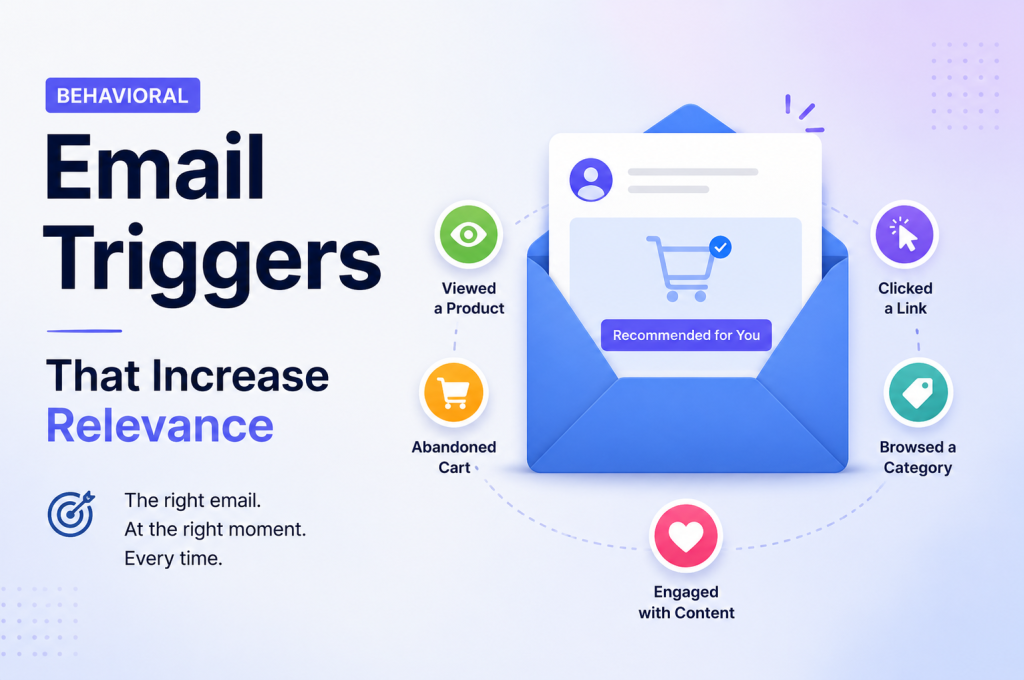
Modern customers expect timely communication, personalized experiences, and content that reflects their actual interests rather than generic sales messaging. Behavioral email marketing bridges that gap by using browsing patterns, purchase history, customer interactions, and engagement signals to automate relevant messaging throughout the customer lifecycle. In this guide, we explore how trigger-based emails, customer journey emails, and predictive personalization strategies improve customer engagement, conversion rates, and retention while creating automated customer journeys that feel genuinely human.
Behavioral Email Triggers That Increase Relevance
Email marketing has evolved far beyond mass newsletters and blanket promotions. Today’s most effective brands rely on behavioral segmentation, user action triggers, and dynamic email content to deliver messages that align with real customer intent.
When a visitor abandons a cart, revisits a product page multiple times, or stops engaging with a website altogether, those actions reveal valuable behavioral data. The difference between average campaigns and high-performing automated email workflows often comes down to how intelligently that data is used.
Businesses investing in personalized email marketing are no longer simply sending emails. They are building responsive systems powered by customer behavior analytics, CRM workflows, and predictive purchase intent.
A well-structured behavioral email automation strategy can help brands:
- Increase click-through rates
- Improve customer retention
- Recover abandoned sales
- Enhance customer engagement
- Strengthen lifecycle marketing
- Improve marketing ROI
- Deliver contextual messaging at scale
The result is a customer experience that feels less like advertising and more like assistance.
Why Behavioral Email Marketing Performs Better
Traditional campaigns often fail because they rely on assumptions rather than actual user behavior tracking. Sending the same message to every subscriber ignores customer activity, engagement lifecycle stages, and browsing history.
Behavior-based email triggers solve this problem by adapting messaging according to real-time customer signals.
For example:
| Customer Action | Triggered Response |
|---|---|
| Product page visits | Personalized recommendations |
| Cart abandonment | Reminder or incentive email |
| User inactivity | Re-engagement emails |
| Repeat purchases | Loyalty emails or upsell emails |
| Feedback submissions | Follow-up emails |
| First sign-up | Welcome emails |
These event-triggered emails create timely communication that aligns naturally with where a customer currently sits in the conversion funnel.
Instead of interrupting the customer journey, they support it.
The Psychology Behind Trigger-Based Emails
Human attention is heavily influenced by relevance. Customers are significantly more likely to engage with individualized content that reflects recent behavior or demonstrated interests.
This is why trigger-based workflows consistently outperform generic campaigns in:
- Open rates
- Engagement metrics
- Sales conversions
- Customer lifetime value
- Revenue attribution
The timing matters just as much as the message itself.
A browse abandonment email sent within an hour of a session ending feels contextual. The same email sent two weeks later feels disconnected and automated in the worst possible way.
Behavioral targeting succeeds because it mirrors natural customer intent signals.
The closer your messaging aligns with real-time customer behavior, the more likely it is to drive action.
This principle forms the foundation of smart automation and predictive customer analytics.
Core Behavioral Triggers Every Brand Should Use
Not every automated workflow delivers equal value. Some automation triggers consistently outperform others because they connect directly to buying intent and engagement forecasting.
Below are the most effective behavioral email triggers businesses should prioritize.
1. Welcome Emails
First impressions shape future engagement.
Welcome emails introduce subscribers to your brand while establishing expectations for future communication. They also create the perfect opportunity for customer profiling and audience segmentation.
Strong onboarding emails often include:
- Brand positioning
- Product education
- Personalized recommendations
- Social proof
- Helpful resources
- First-purchase incentives
Businesses that invest in high-converting onboarding sequences often pair them with optimized landing pages and strong UX foundations. Brands improving customer touchpoints through better digital experiences frequently see stronger engagement from automated customer journeys.
For companies refining their online presence, professional website design plays a major role in improving engagement-based segmentation and subscriber conversion quality.
2. Cart Abandonment Emails
Cart abandonment remains one of the highest-performing forms of ecommerce email automation.
A visitor who adds products to a cart has already demonstrated purchase intent. Failing to respond to that behavioral signal leaves revenue on the table.
Effective abandoned cart emails typically include:
- Product reminders
- Clear CTAs
- Trust-building elements
- Urgency triggers
- Personalized incentives
- Mobile optimization
Behavioral intelligence becomes especially powerful when combined with browsing patterns and click behavior.
For example:
- Customers repeatedly viewing the same category may respond better to tailored messaging.
- Users abandoning premium products may need additional reassurance or reviews.
- Returning visitors often benefit from contextual targeting based on prior customer interactions.
The most advanced workflows use AI-powered recommendations and recommendation engine technology to dynamically personalize products inside emails.
3. Browse Abandonment Workflows
Unlike cart abandonment, browse abandonment emails target users who explored products but never added them to a basket.
These workflows rely heavily on:
- Session tracking
- Page views
- User engagement signals
- Customer intent modeling
- Behavioral segmentation
Because these users sit earlier in the funnel, the messaging should feel educational rather than aggressive.
Good browse abandonment campaigns often include:
- Product comparisons
- Educational content
- Testimonials
- Personalized product recommendations
- Related categories
- Buyer guides
This approach supports lead nurturing while improving conversion optimization over time.
Businesses combining behavioral workflow automation with strong organic visibility often generate more qualified traffic entering these sequences in the first place. Investing in long-term SEO services can significantly strengthen customer acquisition quality and improve funnel behavior across lifecycle emails.
Using Predictive Analytics to Anticipate Customer Intent
Modern email personalization increasingly relies on predictive models rather than reactive automation alone.
Instead of waiting for customers to take action, brands can now use predictive segmentation and behavioral prediction to anticipate likely outcomes.
This includes identifying:
- Customers likely to churn
- High-intent shoppers
- Potential repeat purchasers
- Subscribers at risk of disengagement
- Users likely to respond to discounts
- Prospects nearing lead conversion
Predictive purchase intent allows marketers to create adaptive email campaigns that feel proactive rather than reactive.
For example:
| Behavioral Signal | Predicted Outcome |
|---|---|
| Multiple repeat visits | High buying intent |
| Reduced email opens | Potential disengagement |
| Frequent category browsing | Product interest growth |
| Long inactivity period | Churn risk |
| High click-through behavior | Strong conversion probability |
These insights improve workflow sequencing while supporting customer lifecycle automation strategies built around real behavior rather than assumptions.
The Importance of Dynamic Segmentation
Static subscriber lists are becoming increasingly ineffective.
Dynamic segmentation updates automatically based on behavioral analytics, customer signals, and interaction patterns. This allows businesses to maintain highly relevant messaging without constant manual intervention.
Dynamic email segmentation may include:
- Purchase history
- Geographic data
- Customer activity
- Email engagement
- Product interests
- Customer lifecycle stage
- Buying frequency
- Session duration
This level of contextual targeting improves subscriber engagement while reducing irrelevant communication.
More importantly, it creates scalable hyper-personalization without requiring marketers to manually build hundreds of separate campaigns.
Real-Time Personalization Changes Everything
The gap between customer action and brand response is shrinking rapidly.
Real-time email triggers now allow businesses to react instantly to customer behavior using automation rules and event-based automation systems.
Examples include:
- Price-drop alerts
- Back-in-stock notifications
- Live product recommendations
- Milestone emails
- Transactional triggers
- Customer reactivation workflows
When paired with CRM integration and customer data platforms, these systems create sophisticated automated customer journeys capable of adapting continuously.
Brands using intent-based targeting and real-time behavioral targeting consistently outperform static campaigns because their messaging evolves alongside customer interests.
AI-Driven Personalization and the Future of Email Automation
The evolution of AI email marketing has transformed how brands interpret customer behavior analytics and respond to engagement signals in real time.
Instead of relying solely on basic automation triggers, businesses can now use machine learning personalization to analyze:
- Browsing history
- Purchase frequency
- Click behavior
- Product affinity
- Customer inactivity
- Session tracking
- Customer touchpoints
- Historical conversion data
This enables predictive personalization that continuously improves itself over time.
A recommendation engine powered by behavioral intelligence can dynamically alter:
- Product recommendations
- Send times
- Subject lines
- Content blocks
- Discounts
- Messaging tone
- Email cadence
The result is highly individualized workflows that adapt automatically to changing customer preferences.
Why CRM Email Automation Matters
Without centralized customer data, even the best-triggered email campaigns become fragmented.
CRM email automation connects behavioral data across multiple customer interactions, allowing brands to create seamless omnichannel engagement strategies.
This includes integrating:
- Website behavior
- Purchase history
- Support interactions
- Social engagement
- Lead generation forms
- Sales activity
- Customer service tickets
Together, these data points improve customer intent modeling and create more effective trigger logic.
For example, a customer who:
- Visits multiple product pages
- Downloads a guide
- Opens three nurture emails
- Revisits pricing pages
…is displaying strong engagement scoring indicators and may be ready for a more conversion-focused workflow.
Rather than sending generic promotions, businesses can create adaptive content specifically designed for that customer’s current position in the funnel.
Companies combining behavioral targeting with paid acquisition strategies often see stronger conversion funnel performance because traffic sources become more aligned with customer intent. Businesses refining lead generation and audience targeting frequently benefit from integrated PPC management services that support high-intent customer acquisition.
Post-Purchase Emails Are Often Underused
Many businesses focus heavily on acquisition while neglecting customer retention.
This is a costly mistake.
Post-purchase emails consistently produce some of the strongest ROI across behavioral email marketing because they engage customers who have already demonstrated trust and buying intent.
Effective post-purchase sequences may include:
- Order confirmations
- Product education
- Usage tutorials
- Cross-sell emails
- Upsell emails
- Feedback request emails
- Loyalty emails
- Replenishment reminders
These workflows strengthen customer lifecycle automation while increasing customer lifetime value.
They also improve retention strategy performance by maintaining engagement after the initial sale.
Examples of Effective Post-Purchase Trigger Logic
| Customer Action | Triggered Workflow |
|---|---|
| Completed purchase | Thank-you email |
| Product delivery confirmed | Product education sequence |
| Repeat purchase detected | Loyalty rewards |
| High-value order | VIP retention campaign |
| Product review submitted | Personalized follow-up |
| No repeat purchase after 90 days | Customer reactivation email |
This level of workflow automation keeps customer communication relevant long after checkout.
Re-Engagement Emails and Customer Reactivation
Every subscriber list contains inactive users.
The problem is rarely inactivity itself. The real issue is failing to identify why engagement declined.
Re-engagement emails use behavioral segmentation to reconnect with subscribers before they disengage completely.
These campaigns typically target:
- Reduced email opens
- Lower click-through rates
- Long inactivity periods
- Decreased website visits
- Declining customer activity
Strong customer reactivation campaigns often include:
- Exclusive offers
- Preference updates
- Personalized recommendations
- Product discovery content
- Milestone reminders
- Limited-time incentives
The key is contextual messaging rather than aggressive sales language.
Subscribers who stopped engaging may simply require more relevant messaging or better timing.
Behavioral Segmentation Improves Customer Retention
Customer retention depends heavily on relevance.
The more precisely businesses segment audiences using behavioral data, the more likely customers are to continue engaging over time.
Behavioral segmentation commonly groups users according to:
- Purchase behavior
- Engagement frequency
- Product interests
- Funnel behavior
- Repeat purchases
- Website interactions
- Customer lifecycle stage
- Engagement lifecycle signals
This allows businesses to deliver customer-centric marketing experiences that feel personalized rather than automated.
Examples include:
High-Intent Users
Subscribers displaying strong customer intent signals may receive:
- Limited-time offers
- Product comparisons
- Case studies
- Personalized incentives
Low-Engagement Users
Subscribers with declining interaction patterns may receive:
- Re-engagement emails
- Educational content
- Subscriber preference surveys
- Customer feedback requests
Loyal Customers
Repeat buyers may receive:
- Loyalty rewards
- VIP access
- Early product releases
- Referral incentives
This type of smart segmentation dramatically improves engagement optimization.
The Role of First-Party and Zero-Party Data
Privacy changes are reshaping digital marketing.
As third-party tracking becomes less reliable, brands increasingly depend on first-party data and zero-party data to improve personalized email marketing.
First-Party Data Includes:
- Website behavior
- Email engagement
- Purchase history
- CRM records
- Session analytics
Zero-Party Data Includes:
- Survey responses
- Preference selections
- Quiz results
- Voluntary customer information
Together, these insights improve customer profiling while strengthening intent-based marketing strategies.
More importantly, they help brands maintain relevant messaging without relying on invasive tracking methods.
Send-Time Optimization and Engagement Forecasting
Timing has become one of the most overlooked factors in email personalization.
Even highly relevant emails can underperform if they arrive at the wrong moment.
Advanced automation platforms now use engagement forecasting and predictive customer analytics to determine optimal delivery windows based on:
- Historical open rates
- Click-through behavior
- Time-zone activity
- Device usage
- Engagement frequency
- Previous conversion timing
This process, often called send-time optimization, helps improve:
- Open rates
- Subscriber engagement
- Sales conversions
- Revenue growth
- Marketing ROI
The best systems continuously adapt as customer behavior changes.
Why Contextual Messaging Outperforms Generic Campaigns
Customers are overwhelmed by marketing messages.
Generic campaigns that ignore browsing patterns, customer interactions, or behavioral targeting often feel irrelevant immediately.
Contextual messaging changes that dynamic.
When emails align with:
- Current interests
- Recent activity
- Purchase intent
- Engagement history
- Lifecycle stage
…they naturally generate stronger customer engagement.
This is especially important in ecommerce email automation where buying decisions often happen quickly.
For example:
A customer repeatedly viewing running shoes responds far better to personalized product recommendations than to a generic sitewide promotion.
That level of relevance improves both customer experience and conversion prediction accuracy simultaneously.
Building Automated Customer Journeys That Feel Human
The ultimate goal of behavioral workflow automation is not simply efficiency.
It is relevance.
Customers should feel that communication reflects their interests, preferences, and behavior rather than rigid automation rules.
The most successful brands create automated customer journeys that combine:
- Behavioral targeting
- Dynamic segmentation
- AI-powered recommendations
- CRM workflows
- Personalized experiences
- Trigger-based workflows
- Predictive analytics
- Adaptive email campaigns
When executed properly, these systems become nearly invisible to the customer because every interaction feels timely and useful rather than promotional.
Advanced Lifecycle Marketing Strategies for Long-Term Growth
Lifecycle marketing is no longer limited to simple drip campaigns or scheduled newsletters. Modern customer lifecycle automation depends on adaptive systems capable of responding to customer behavior in real time.
Every interaction becomes part of a larger engagement ecosystem.
From the first website visit to repeat purchases years later, businesses now have the ability to build highly responsive automated customer journeys driven by behavioral analytics and customer intent signals.
The strongest lifecycle email strategies typically focus on five critical stages:
- Acquisition
- Activation
- Engagement
- Retention
- Reactivation
Each stage requires different trigger conditions, messaging strategies, and behavioral targeting methods.
Acquisition Emails Should Focus on Intent, Not Volume
Many businesses still prioritize subscriber quantity over subscriber quality.
However, high-performing personalized email marketing systems are built around customer intent modeling rather than mass acquisition.
This means using behavioral data to identify users who demonstrate genuine interest through:
- Product page visits
- Multiple session returns
- Content engagement
- Download activity
- Click behavior
- Form submissions
These engagement signals help businesses create smarter lead nurturing campaigns with stronger lead conversion potential.
For example, a user who repeatedly explores service pages and educational resources may require a completely different onboarding sequence than a customer entering through a transactional promotion.
Intent-driven automation allows businesses to tailor messaging accordingly.
Behavioral Retargeting Extends Beyond Email
Behavioral retargeting becomes significantly more effective when email workflows support broader omnichannel engagement strategies.
Customers rarely convert after a single interaction.
Instead, they move between:
- Search engines
- Websites
- Social platforms
- Paid ads
- Email campaigns
- Mobile devices
This creates multiple customer touchpoints throughout the engagement lifecycle.
Businesses integrating triggered messaging with coordinated digital campaigns often achieve stronger funnel optimization because messaging remains consistent across channels.
For example:
- A browse abandonment email can reinforce a remarketing campaign.
- A loyalty email can align with VIP advertising audiences.
- Product education emails can support content marketing initiatives.
This integrated approach strengthens customer retention while improving revenue attribution visibility.
Conversion Optimization Requires More Than Automation
Automation alone does not guarantee stronger conversion rates.
The quality of messaging, timing, design, and user experience still plays a major role in customer engagement and sales conversions.
High-performing triggered email campaigns often share several characteristics:
They Prioritize Clarity
Customers should immediately understand:
- Why they received the email
- What value it offers
- What action to take next
They Use Personalized Experiences
Emails referencing:
- Browsing history
- Customer activity
- Previous purchases
- Engagement patterns
…consistently outperform generic promotions.
They Focus on Timely Communication
Real-time behavioral targeting dramatically improves response rates because the customer’s intent remains fresh.
They Reduce Friction
Strong email workflows simplify the path toward action using:
- Clear CTAs
- Mobile optimization
- Fast-loading pages
- Consistent messaging
Email Deliverability Directly Impacts Revenue
Even the best automated email workflows fail if messages never reach inboxes.
Email deliverability is one of the most overlooked aspects of behavioral email marketing, yet it directly affects:
- Open rates
- Customer engagement
- Conversion rates
- Revenue growth
Poor deliverability often results from:
- Excessive sending frequency
- Weak list hygiene
- Low subscriber engagement
- Spam-triggering content
- Poor sender reputation
Behavioral segmentation helps reduce these issues because customers receive more relevant messaging based on actual engagement behavior.
This improves:
- Click-through rates
- Email opens
- Subscriber retention
- Overall engagement metrics
The Importance of Engagement-Based Segmentation
Not every subscriber should receive the same email cadence.
Engagement-based segmentation helps businesses adjust communication frequency according to user engagement levels.
For example:
| Subscriber Type | Recommended Strategy |
|---|---|
| Highly engaged users | Frequent product updates |
| Moderately active users | Educational nurture sequences |
| Inactive subscribers | Re-engagement workflows |
| Repeat customers | Loyalty campaigns |
| New subscribers | Onboarding emails |
This approach improves customer-centric marketing while reducing unsubscribe rates.
It also helps businesses maintain stronger customer relationships over time.
AI-Powered Recommendations Improve Revenue Per Email
One of the most valuable developments in ecommerce email automation is the rise of AI-powered recommendations.
Traditional recommendation systems often relied on static product categories or manual segmentation.
Modern predictive models now analyze:
- Browsing patterns
- Purchase history
- Similar customer behavior
- Session tracking
- Engagement forecasting
- Customer activity trends
This allows businesses to generate highly personalized product recommendations automatically.
Examples include:
- Frequently bought together suggestions
- Dynamic upsell offers
- Cross-sell recommendations
- Personalized collections
- Real-time product relevance
These systems improve customer lifetime value while increasing overall marketing ROI.
Trigger-Based Workflows Need Continuous Optimization
Behavioral workflow automation is not something businesses set once and ignore.
Customer behavior changes constantly.
The most effective email workflows are continuously refined through:
- A/B testing
- Engagement scoring
- Conversion prediction
- Funnel analysis
- Behavioral intelligence reviews
- Performance monitoring
Key metrics businesses should track include:
Engagement Metrics
- Open rates
- Click-through rates
- Email reply rates
- Subscriber growth
Conversion Metrics
- Revenue per email
- Conversion rates
- Lead conversion performance
- Cart recovery rates
Retention Metrics
- Customer retention
- Repeat purchase rates
- Churn reduction
- Customer lifetime value
This data improves workflow sequencing while identifying opportunities for stronger personalization and engagement optimization.
Customer Journey Emails Should Feel Natural
One of the biggest mistakes businesses make with automated customer journeys is over-automation.
Customers should never feel trapped inside rigid marketing sequences.
Instead, customer journey emails should adapt fluidly based on:
- Customer interactions
- Behavioral prediction
- Purchase intent
- Engagement signals
- Lifecycle stage changes
This creates adaptive content experiences that feel personalized rather than mechanical.
Successful brands understand that behavioral email marketing is fundamentally about communication quality, not automation volume.
Predictive Analytics Will Continue Reshaping Email Marketing
The future of email personalization lies in predictive customer analytics and behavioral intelligence.
As AI-driven personalization evolves, businesses will increasingly rely on:
- Predictive segmentation
- Intent scoring
- Recommendation engine systems
- Behavioral prediction models
- Next-best-action marketing
Rather than reacting to customer activity after it happens, brands will proactively guide customers toward relevant experiences before intent fully develops.
This creates:
- Faster customer journeys
- Improved purchase prediction
- Better customer retention
- Higher engagement optimization
- More efficient customer lifecycle automation
The businesses adopting these systems early will gain a significant competitive advantage.
Final Thoughts
Behavioral email automation is no longer optional for businesses that want sustainable growth and stronger customer engagement.
Modern consumers expect:
- Personalized experiences
- Relevant messaging
- Timely communication
- Contextual targeting
- Adaptive email campaigns
Brands relying on generic campaigns will continue struggling against declining engagement and rising acquisition costs.
The businesses succeeding today are those building intelligent systems around:
- Behavioral segmentation
- Real-time personalization
- Automated customer journeys
- CRM workflows
- Predictive purchase intent
- AI-powered recommendations
Ultimately, the goal is not simply sending more emails.
It is delivering the right message, to the right person, at exactly the right moment.
And when that happens consistently, email becomes one of the most powerful customer retention and revenue growth channels available.
Frequently Asked Questions About Behavioral Email Triggers
1. What is the difference between behavioral email marketing and traditional email marketing?
Traditional email marketing usually sends the same message to an entire subscriber list regardless of customer activity or interests. Behavioral email marketing uses user behavior tracking, customer interactions, and engagement signals to trigger highly personalized emails based on specific actions like page views, cart abandonment, or repeat purchases.
2. How quickly should trigger-based emails be sent after a customer action?
The ideal timing depends on the trigger type and customer intent. Real-time email triggers generally perform best because relevance decreases over time. For example:
- Cart abandonment emails often work best within 1–3 hours
- Browse abandonment emails may perform well within 6–24 hours
- Welcome emails should usually be delivered immediately after signup
- Re-engagement emails often require longer inactivity periods
Timely communication significantly improves click-through rates and customer engagement.
3. Can small businesses benefit from behavioral email automation?
Yes. Small businesses often see strong results because behavioral segmentation allows them to compete with larger brands using highly relevant messaging rather than large advertising budgets.
Even simple automated email workflows like:
- Welcome emails
- Follow-up emails
- Post-purchase emails
- Customer reactivation campaigns
…can improve customer retention and conversion optimization without requiring massive resources.
4. What data is needed to create effective behavioral email triggers?
Most trigger-based workflows rely on first-party data collected through:
- Website behavior
- Purchase history
- Email opens
- Click behavior
- Session tracking
- CRM integration
- Customer activity
The more accurate the behavioral data, the more effective personalized email marketing becomes.
5. Are behavioral email triggers only useful for ecommerce businesses?
No. Although ecommerce email automation heavily relies on trigger-based workflows, behavioral targeting is also valuable for:
- SaaS companies
- Service businesses
- Membership platforms
- Educational providers
- B2B companies
Any business with digital customer interactions can use behavioral analytics and automated customer journeys to improve engagement.
6. How many automated email workflows should a business have?
There is no fixed number. Most businesses begin with core workflows such as:
- Welcome sequences
- Cart abandonment emails
- Post-purchase sequences
- Re-engagement emails
- Loyalty campaigns
As customer lifecycle automation becomes more advanced, businesses often build additional workflows around predictive purchase intent, engagement scoring, and behavioral targeting.
7. What are the most important metrics for measuring behavioral email performance?
The most valuable engagement metrics typically include:
- Open rates
- Click-through rates
- Conversion rates
- Customer retention
- Revenue per email
- Customer lifetime value
- Sales conversions
- Unsubscribe rates
These metrics help businesses evaluate workflow sequencing, trigger logic, and overall marketing ROI.
8. How does AI improve behavioral email personalization?
AI-driven personalization helps businesses analyze large volumes of behavioral data to predict customer preferences and buying intent more accurately.
Machine learning personalization can improve:
- Personalized product recommendations
- Send-time optimization
- Dynamic email content
- Predictive segmentation
- Customer intent modeling
- Recommendation engine performance
This creates more adaptive email campaigns that evolve automatically based on customer behavior.
9. Can behavioral email marketing improve customer loyalty?
Yes. Personalized experiences help customers feel understood rather than marketed to. Loyalty emails, milestone emails, personalized recommendations, and retention automation all contribute to stronger customer relationships and higher repeat purchase rates.
Consistent contextual messaging also improves long-term subscriber engagement.
10. What are the biggest mistakes businesses make with behavioral email triggers?
Some of the most common mistakes include:
- Sending too many emails
- Poor audience segmentation
- Ignoring user inactivity
- Weak personalization
- Delayed trigger timing
- Failing to optimize for mobile devices
- Overcomplicated automation rules
- Neglecting email deliverability
Successful behavioral workflow automation focuses on relevance, timing, and customer-centric marketing rather than excessive automation.