
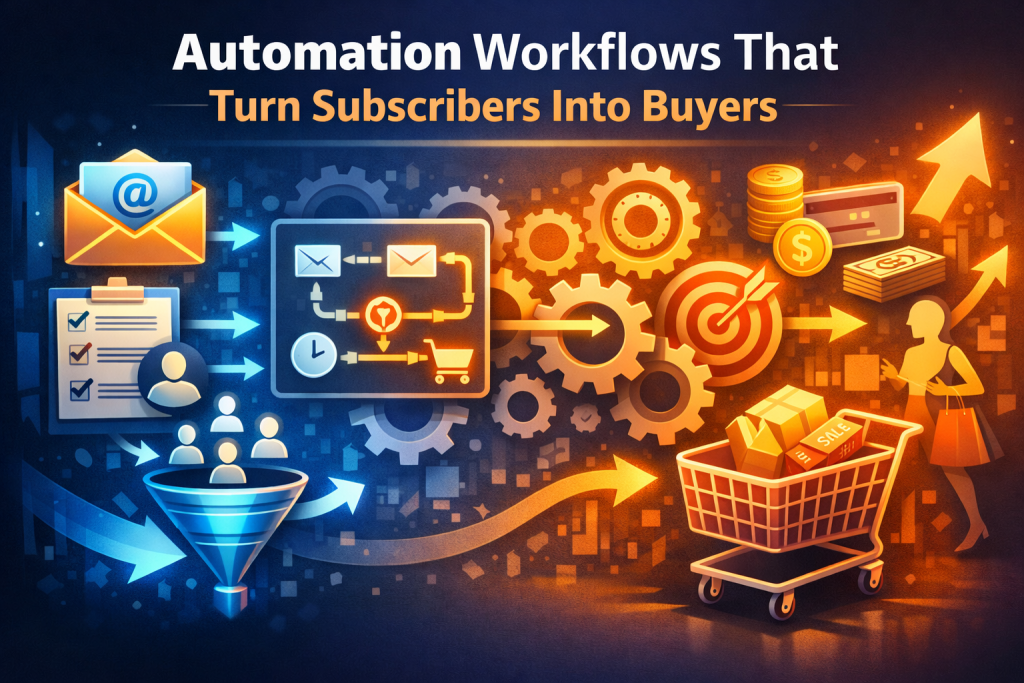
Modern marketing automation workflows are no longer optional—they are the engine behind scalable growth. By combining email marketing automation, behavioral targeting, and conversion-focused workflows, businesses can guide subscribers through automated customer journeys that increase conversion rates, boost average order value, and improve customer lifetime value. From welcome email sequences and onboarding automation flows to cart abandonment workflows and upsell automation campaigns, the key lies in delivering the right message at the right moment. When paired with strong SEO, high-performing website design, and targeted PPC campaigns, these systems create a seamless funnel that turns passive subscribers into loyal buyers.
The Shift From Subscribers to Buyers
Most businesses don’t struggle to generate subscribers—they struggle to convert them.
You can drive traffic through channels like SEO or paid acquisition via PPC campaigns, but without a structured system in place, those leads rarely progress beyond the awareness stage.
This is where marketing automation workflows become essential.
Instead of relying on one-off emails or manual follow-ups, automation enables:
- consistent lead nurturing workflows
- scalable subscriber-to-customer conversion
- intelligent, behavior-driven messaging
- fully automated sales funnels
The difference between a stagnant email list and a revenue-generating asset is not traffic—it’s automation.
What Are Conversion-Focused Automation Workflows?
At their core, these systems are conversion-focused workflows designed to guide users through each stage of the funnel using:
- email marketing automation
- customer journey automation
- lifecycle marketing automation
- automated customer journeys
Think of them as a series of interconnected triggers and responses:
- A user subscribes
- They receive a welcome email sequence
- Their behavior is tracked (clicks, visits, inactivity)
- Follow-up messages are triggered automatically
- Offers are personalized based on intent
This creates a dynamic funnel automation strategy that adapts to each individual user.
The Foundations of High-Converting Workflows
Before diving into specific workflows, it’s important to understand the core building blocks that drive results.
1. Behavioral Targeting & Triggered Messaging
Modern automation relies heavily on behavioral targeting and triggered messaging.
Instead of sending generic campaigns, you respond to actions like:
- visiting a product page
- abandoning a cart
- clicking a specific email
- engaging with a previous offer
This enables:
- real-time personalization
- customer intent tracking
- event-triggered messaging
When your messaging reacts to behavior, it feels less like marketing—and more like timing.
2. Segmentation & Personalization Engines
Not all subscribers are equal.
Using segmentation automation and audience segmentation workflows, you can group users based on:
- demographics
- purchase history
- browsing behavior
- engagement level
From there, dynamic content emails and AI-powered recommendations allow you to deliver:
- personalized offers automation
- hyper-personalization workflows
- predictive analytics marketing insights
3. Strong Funnel Infrastructure
Even the best automation fails without a solid foundation.
Your funnel should integrate:
- high-performing landing pages from website design services
- optimized traffic acquisition (SEO + PPC)
- CRM + marketing automation integration
This ensures your automated customer journeys don’t just exist—they perform.
The Core Automation Workflows That Drive Conversions
Now we move into the actual workflows that power subscriber-to-buyer transformation.
Welcome Email Sequence (First Impression Automation)
This is the most overlooked—and most powerful—automation.
A strong welcome email sequence or new subscriber nurture flow sets the tone for everything that follows.
What it should include:
- Brand positioning and value proposition
- Clear expectations (what they’ll receive and when)
- Early engagement triggers
- A soft introduction to your products/services
Why it matters:
- Builds trust immediately
- Improves engagement rates across future emails
- Starts the lead nurturing campaign process
First impressions in automation are permanent. A weak welcome sequence weakens the entire funnel.
Onboarding Automation Flow
Once a subscriber engages, the next step is education and activation.
An effective onboarding automation flow:
- introduces key features or benefits
- removes friction and objections
- guides users toward their first meaningful action
This is especially important for:
- service-based businesses
- SaaS tools
- high-consideration purchases
Key elements:
- step-by-step guidance
- micro-conversion tracking
- progressive profiling automation
Lead Nurturing Workflows
Not every subscriber is ready to buy immediately.
That’s why lead nurturing workflows and lead nurturing campaigns are essential.
These workflows focus on:
- delivering value-driven content
- building authority and trust
- addressing objections over time
They often include:
- email automation examples
- educational sequences
- case studies and social proof
This aligns with MOFU (consideration stage) keywords like:
- lead nurturing strategies
- marketing workflow templates
- best automation strategies
Behavioral Trigger Emails
This is where automation becomes truly powerful.
Behavioral trigger emails respond instantly to user actions, such as:
- viewing a pricing page
- clicking a product link
- returning to the site multiple times
These workflows enable:
- buying signal automation
- intent-based automation workflows
- trigger-based funnel acceleration
And ultimately:
- higher engagement
- faster sales cycle optimization
- improved conversion path optimization
Why Most Automation Fails (And How to Fix It)
Despite having access to the best marketing automation tools, many businesses still struggle.
The problem isn’t the tools—it’s the strategy.
Common mistakes:
- Over-reliance on generic email blasts
- Lack of segmentation or personalization
- Ignoring lifecycle stage automation
- No clear conversion optimization workflows
The fix:
- Focus on intent-driven messaging
- Build workflows around real user behavior
- Prioritize conversion rate optimization automation over vanity metrics
Traffic builds lists. Strategy turns those lists into revenue.
Cart Abandonment Workflows: Recovering Lost Revenue
Cart abandonment is one of the most immediate opportunities for conversion rate optimization automation.
A user who adds a product to their cart has already demonstrated clear intent. When they leave without purchasing, it’s rarely a lack of interest—it’s hesitation, distraction, or friction.
This is where cart abandonment workflows and abandoned cart recovery emails step in.
What makes an effective cart recovery workflow?
- Speed: First email sent within 30–60 minutes
- Relevance: Dynamic content emails showing the exact product left behind
- Incentives: Time-sensitive offers or free shipping
- Trust signals: Reviews, guarantees, or social proof
Example Flow:
- Cart abandoned
- Email #1: Reminder with product image
- Email #2: Social proof + benefits
- Email #3: Incentive (discount or urgency trigger)
This type of event-triggered messaging helps:
- reduce cart abandonment
- increase email revenue
- accelerate subscriber-to-customer conversion
A well-timed reminder often converts better than the original sales message.
Upsell & Cross-Sell Automation: Increasing Order Value
Once a customer converts, the journey doesn’t end—it evolves.
Upsell automation workflows and cross-sell automation campaigns are designed to:
- boost average order value (AOV)
- introduce complementary products
- maximize each transaction
The difference:
- Upsell: Encouraging a higher-value purchase
- Cross-sell: Suggesting related or complementary items
How automation enhances this:
Using a personalization engine and AI-powered recommendations, you can deliver:
- product recommendation engine outputs
- personalized offers automation
- real-time personalization
Trigger Examples:
- Post-checkout product suggestions
- “Customers also bought” sequences
- Time-based follow-ups after purchase
Post-Purchase Follow-Up Automation: Turning Buyers into Repeat Customers
The moment after a purchase is one of the most valuable—and underutilized—points in the customer journey.
Post-purchase follow-up automation and retention automation workflows focus on:
- building loyalty
- encouraging repeat purchases
- increasing customer lifetime value (CLTV)
Key components:
- Order confirmation and reassurance
- Product usage tips or onboarding
- Review and customer feedback automation
- Replenishment reminders
This is where lifecycle marketing automation becomes critical.
The first purchase is a conversion. The second is the beginning of a relationship.
Re-Engagement Campaigns: Reviving Cold Subscribers
Not every subscriber converts on the first attempt—and that’s expected.
Re-engagement campaigns are designed to bring inactive users back into your funnel.
Common triggers:
- No email opens for 30–60 days
- No website visits
- No purchase history
Effective strategies:
- “We miss you” messaging
- Exclusive offers or discounts
- Surveys for zero-party data collection automation
- Preference updates via progressive profiling automation
These campaigns support:
- retention automation workflows
- audience segmentation workflows
- improved deliverability and engagement
Multi-Channel Automation: Beyond Email
While email marketing automation is the backbone, modern workflows extend across multiple touchpoints.
Multi-channel automation (email, SMS, push) enables:
- consistent messaging across platforms
- better reach and engagement
- more complete customer journey automation
Example omnichannel flow:
- Email reminder (cart abandonment)
- SMS follow-up with urgency
- Push notification with incentive
This is known as omnichannel journey orchestration, and it plays a major role in:
- conversion optimization workflows
- pipeline generation automation
- sales enablement automation
Lead Scoring & Qualification: Prioritising Buyers
Not all leads are ready to convert—and treating them equally wastes time and resources.
Lead scoring workflows and lead qualification automation allow you to:
- assign value to user actions
- identify high-intent prospects
- trigger sales or offer-based messaging
Scoring signals might include:
- email engagement
- page visits (especially pricing pages)
- download activity
- repeat visits
This supports:
- CRM + marketing automation integration
- demo request automation
- free trial email sequences
The goal isn’t more leads. It’s better-qualified ones.
Promotional & Price-Based Automation
Sometimes, timing and pricing are the deciding factors.
Promotional automation workflows and price drop alerts automation are designed to capture these moments.
Examples:
- Flash sale announcements
- Limited-time discounts
- Price drop notifications on viewed products
When combined with behavioral targeting, these workflows become highly effective conversion-focused workflows.
Advanced Strategies: Where Automation Becomes Intelligent
For businesses ready to go beyond the basics, advanced automation unlocks exponential growth.
1. AI-Driven Customer Journeys
Using predictive analytics marketing and AI-driven customer journeys, you can:
- anticipate user behavior
- automate next-best actions
- optimize conversion paths dynamically
2. Intent-Based Automation Workflows
Rather than reacting, these workflows predict intent.
Powered by:
- customer intent tracking
- buying signal automation
- micro-conversion tracking
They allow you to engage users before they make a decision.
3. Hyper-Personalization at Scale
Combining:
- dynamic content emails
- segmentation automation
- real-time personalization
You can create hyper-personalization workflows that feel one-to-one—at scale.
Connecting Automation to Traffic & Acquisition
Even the most advanced workflows need consistent input—traffic.
That’s why automation should always be paired with:
- organic acquisition through SEO strategies
- paid traffic via PPC campaigns
Together, they create a closed-loop system:
- Traffic enters the funnel
- Automation nurtures and converts
- Data feeds back into acquisition strategies
Mapping Automation Across the Funnel: From Awareness to Conversion
To build automation that actually drives revenue, you need alignment across the entire funnel—not just isolated workflows.
A complete system connects:
- TOFU (Awareness) → attracting and engaging subscribers
- MOFU (Consideration) → nurturing and educating leads
- BOFU (Conversion) → converting intent into purchases
This is where automated customer journeys and funnel automation strategies become truly powerful.
TOFU: Capturing Attention & Building Lists
At the top of the funnel, the goal is simple: attract and engage.
This stage is driven by:
- what is marketing automation
- email marketing strategies
- how to build email lists
- subscriber engagement tips
Your automation here should focus on:
- welcome email sequences
- lead magnets and content delivery
- early-stage engagement tracking
But none of this works without visibility.
A strong foundation in SEO services ensures consistent organic traffic, while well-structured landing pages—built through website design expertise—convert visitors into subscribers.
You cannot automate conversions without first automating attention.
MOFU: Nurturing Interest & Building Trust
Once users enter your ecosystem, the focus shifts to education and trust-building.
This is where lead nurturing workflows and email automation examples come into play.
Key elements include:
- value-driven email sequences
- case studies and proof
- objection-handling content
- segmentation and personalization
At this stage, audience segmentation workflows and dynamic content emails are critical.
You’re no longer speaking to a crowd—you’re guiding individuals through a decision process.
This is also where many businesses fail.
They generate leads but don’t nurture them effectively, resulting in:
- low engagement
- poor conversion rates
- wasted acquisition spend
BOFU: Driving Conversions & Revenue
At the bottom of the funnel, everything becomes intent-driven.
Users here are searching for:
- best marketing automation tools
- marketing automation software pricing
- automation tools comparison
- best CRM automation tools
Your workflows must reflect that urgency.
This includes:
- personalized offers automation
- demo request automation
- free trial email sequences
- conversion optimization workflows
Combined with behavioral targeting and triggered messaging, this stage is where:
- sales happen
- revenue scales
- automation proves its value
Traffic brings opportunity. BOFU automation turns it into revenue.
Choosing the Right Tools for Automation Success
Even the best strategy needs the right infrastructure.
When evaluating email automation tools for conversions or sales funnel automation tools, focus on:
Core Capabilities:
- CRM + marketing automation integration
- segmentation automation and lead scoring workflows
- multi-channel automation (email, SMS, push)
- real-time personalization and dynamic content
Advanced Features:
- predictive analytics marketing
- AI-powered recommendations
- lifecycle stage automation
- conversion path optimization
What to Look For:
- ease of use vs scalability
- integration with your existing stack
- reporting and attribution capabilities
Tools don’t create results—how you use them does.
Building High-Converting Email Sequences That Drive Sales Automatically
At the heart of every successful system are email sequences that drive sales automatically.
These sequences are not random—they are structured, intentional, and optimized for conversion.
A Proven Sequence Framework:
1. Welcome & Positioning
- Introduce your brand
- Set expectations
- Deliver immediate value
2. Education & Value
- Share insights and strategies
- Provide solutions to pain points
- Build authority
3. Trust & Proof
- Case studies
- Testimonials
- Social validation
4. Offer & Conversion
- Clear, compelling call-to-action
- Personalized offers
- Urgency or scarcity triggers
5. Follow-Up & Reinforcement
- Address objections
- Reinforce benefits
- Provide additional incentives
This structure supports:
- subscriber-to-buyer funnel automation strategy
- lifecycle workflows that increase revenue
- conversion-focused workflows
The Role of Data: Turning Insights Into Action
Automation without data is guesswork.
To truly optimize performance, you need:
- micro-conversion tracking (clicks, scrolls, engagement)
- customer intent tracking (behavior patterns)
- progressive profiling automation (building user profiles over time)
This allows you to:
- refine segmentation
- improve personalization
- optimize timing and messaging
Ultimately leading to:
- increased conversion rate
- improved customer lifetime value (CLTV)
- more efficient pipeline generation automation
A Simple Framework for Revenue-Driven Automation
To bring everything together, here’s a simplified framework you can apply:
Step 1: Attract
- SEO + PPC for traffic generation
- Optimized landing pages
Step 2: Capture
- Lead magnets
- Signup forms
- Welcome email sequence
Step 3: Nurture
- Lead nurturing campaigns
- Educational content
- Segmentation and personalization
Step 4: Convert
- Behavioral trigger emails
- Cart abandonment workflows
- Personalized offers
Step 5: Retain & Grow
- Post-purchase follow-up automation
- Upsell and cross-sell workflows
- Re-engagement campaigns
Final Thoughts: Turning Automation Into a Growth Engine
The difference between average and high-performing businesses isn’t effort—it’s systems.
When implemented correctly, Automation Workflows That Turn Subscribers Into Buyers become:
- predictable
- scalable
- revenue-generating
They align:
- traffic acquisition (SEO and PPC)
- conversion infrastructure (website design and UX)
- customer journey automation (email, SMS, personalization)
The result is a seamless ecosystem where:
- subscribers are nurtured intelligently
- buyers are created consistently
- revenue grows sustainably
The future of marketing isn’t more campaigns—it’s smarter systems.
Ready to Build Smarter Automation?
If you’re looking to combine high-converting automation workflows with expert-led traffic and design strategies, explore how Red Frog Media can help you create a system that doesn’t just attract subscribers—but converts them into buyers.
Frequently Asked Questions
1. How long does it take to see results from marketing automation workflows?
Most businesses begin to see measurable improvements within 2–6 weeks, especially in engagement metrics like open rates and click-through rates. However, meaningful gains in subscriber-to-customer conversion and revenue typically occur over 2–3 months, as workflows optimize through data and behavior tracking.
2. What is the difference between email marketing and email marketing automation?
Email marketing involves sending campaigns manually, while email marketing automation uses triggers, segmentation, and behavioral data to send messages automatically. Automation enables conversion-focused workflows that adapt to each user, rather than sending the same message to everyone.
3. Do small businesses really need automation workflows?
Yes—automation is not just for large companies. In fact, small businesses benefit the most because it allows them to:
- scale communication without hiring more staff
- build consistent lead nurturing workflows
- compete with larger brands using smarter systems
4. What are the most important metrics to track in automation workflows?
To understand performance, focus on:
- conversion rate
- click-through rate (CTR)
- email revenue per subscriber
- customer lifetime value (CLTV)
- cart abandonment recovery rate
These metrics directly reflect how well your automated sales funnels are performing.
5. How often should automated emails be sent?
There’s no universal rule, but effective workflows balance consistency with relevance.
- Welcome sequences: daily or every 1–2 days
- Nurture sequences: 2–3 times per week
- Re-engagement campaigns: spaced over several days
The key is aligning frequency with user intent and lifecycle stage automation.
6. Can automation workflows work without a CRM?
Technically yes—but it’s not ideal. A CRM enables:
- better lead scoring workflows
- deeper personalization
- accurate tracking of the customer journey
Without CRM + marketing automation integration, your workflows will lack the data needed for real-time personalization.
7. What types of businesses benefit most from automation workflows?
Almost every industry can benefit, but automation is especially powerful for:
- eCommerce (cart abandonment, upsell flows)
- SaaS (onboarding and free trial sequences)
- service-based businesses (lead nurturing and qualification)
Any business with a multi-step buying journey can leverage customer journey automation effectively.
8. How do you avoid automation feeling too “robotic”?
The key is personalization.
Use:
- dynamic content emails
- behavioral targeting
- conversational copy
Automation should feel like a natural conversation, not a scripted sequence. Well-built hyper-personalization workflows make messages feel human, even at scale.
9. What is the biggest mistake businesses make with automation?
The most common mistake is focusing on tools instead of strategy.
Businesses often:
- overcomplicate workflows
- ignore segmentation
- fail to align messaging with intent
Successful funnel automation strategies prioritize simplicity, clarity, and relevance over complexity.
10. How do you continuously improve automation performance?
Optimization is ongoing.
You should regularly:
- A/B test subject lines and messaging
- refine segmentation and targeting
- analyze customer intent tracking data
- update workflows based on performance
Continuous improvement ensures your conversion optimization workflows remain effective as customer behavior evolves.