
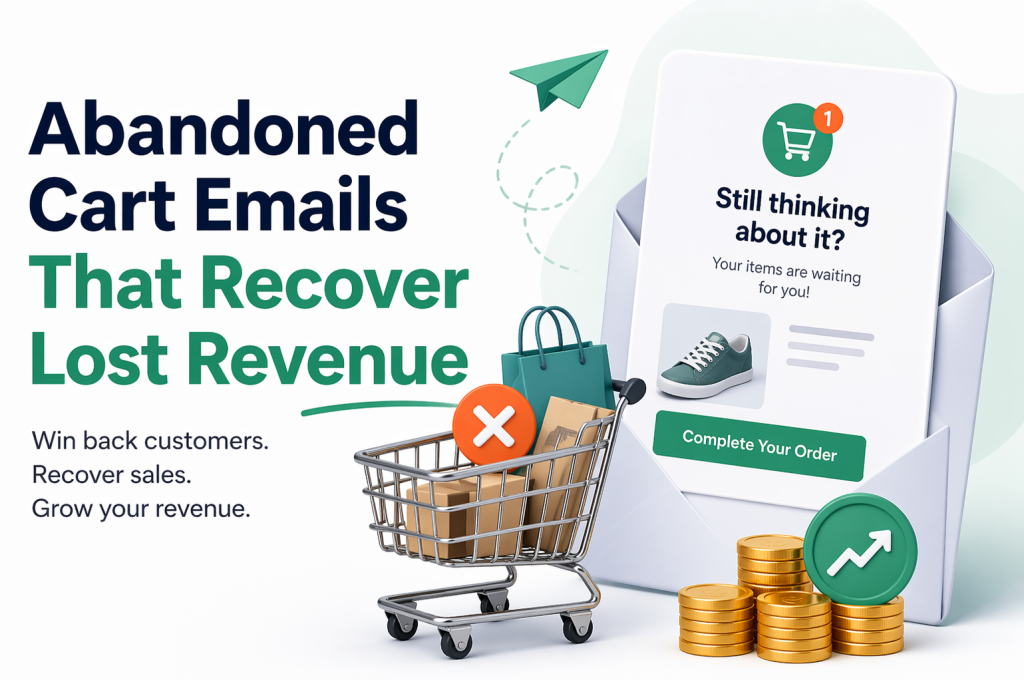
Abandoned cart emails are one of the most effective tools in ecommerce email marketing for recovering lost revenue. When a customer leaves without completing a purchase, automated follow-up emails—powered by email marketing automation—can re-engage high-intent customers and guide them back to checkout. A strong abandoned cart email strategy uses behavioural emails, personalised messaging, urgency tactics, and well-timed sequences to boost sales and increase conversions. By combining conversion rate optimization (CRO), customer segmentation, and persuasive techniques like discounts or social proof, brands can significantly reduce cart abandonment and improve their overall sales recovery funnel.
The Hidden Revenue Sitting in Your Checkout
Every ecommerce store experiences it: a customer browses, adds products to their basket, and then disappears.
This isn’t just a missed opportunity—it’s a measurable loss in revenue.
Shopping cart abandonment rates often sit between 60–80%, meaning the majority of potential customers leave before completing checkout. But here’s the key insight:
These aren’t cold leads. They’re high-intent customers who were already close to buying.
That’s where abandoned cart emails come in. They act as a direct line back to users who have already shown purchase intent, making them one of the highest-performing forms of email retargeting.
When paired with a well-structured ecommerce website—like those built through professional website design services—these emails become even more effective by reducing friction and improving the overall user journey.
What Are Abandoned Cart Emails (And Why They Work)?
At their core, abandoned cart emails are triggered emails—automated messages sent when a user leaves your site without completing a purchase.
They fall under the umbrella of:
- lifecycle email marketing
- behavioural targeting emails
- remarketing emails
- re-engagement emails
These emails are not random. They are powered by user behavior tracking and purchase intent signals, making them highly relevant and timely.
Why They Drive Conversion Recovery
Abandoned cart email campaigns work because they tap into three powerful psychological drivers:
- Intent – The user already wanted the product
- Memory – The email reminds them of what they left behind
- Motivation – Incentives or urgency push them to act
This combination creates a powerful conversion recovery mechanism that helps businesses recover lost sales without needing to acquire new traffic.
Understanding Why Customers Abandon Carts
Before you can reduce cart abandonment, you need to understand what causes it.
Here are the most common reasons:
1. Unexpected Costs
Shipping fees, taxes, or hidden charges introduced at checkout can quickly kill intent.
2. Complicated Checkout Process
A lack of frictionless checkout or poor checkout experience optimization leads to drop-offs.
3. Lack of Trust
Missing reviews, unclear policies, or weak branding can cause hesitation.
4. Distractions & Timing
Sometimes users simply get interrupted or aren’t ready to buy yet.
5. Poor Website Performance
Slow load times or clunky UX—often fixed through proper SEO optimisation and technical improvements—can push users away before they complete their purchase.
How Abandoned Cart Email Strategy Fits Into Your Sales Funnel
Think of your abandoned cart email flow as a critical stage in your revenue recovery funnel.
Instead of letting potential customers disappear, you create a multi-step email series that brings them back.
A Simple Cart Recovery Flow
- Initial Reminder (1–2 hours later)
- Gentle nudge
- No pressure
- Follow-Up Reminder (24 hours later)
- Reinforce value
- Add social proof or customer reviews
- Final Push (48–72 hours later)
- Introduce urgency or scarcity tactics
- Offer discount incentives or free shipping
This type of drip campaign transforms lost traffic into recovered revenue through structured, automated follow-up emails.
The Role of Personalisation in Cart Recovery Emails
Generic emails don’t convert. Personalised emails do.
Modern ecommerce email marketing relies heavily on:
- dynamic content
- product recommendations
- tailored messaging
- customer segmentation
For example, instead of sending a generic reminder, you can:
- show the exact product left in the cart
- recommend complementary items
- adjust messaging based on browsing behaviour
This level of AI email personalization and predictive email marketing dramatically improves engagement and click-through rate (CTR) improvement.
Key Elements of High-Converting Cart Abandonment Emails
To consistently boost sales and increase conversions, your emails need more than just a reminder.
They need to persuade.
Essential Components
- Compelling subject lines
(critical for email open rate optimization) - Clear call-to-action (CTA)
Direct users back to checkout instantly - Visual product reminders
Reinforce desire - Urgency & FOMO
Limited-time offers or low-stock alerts - Trust signals
Reviews, testimonials, guarantees - Incentives (when needed)
Discounts or free shipping offers
The goal isn’t just to remind—it’s to remove hesitation and create momentum.
Where Email Automation Meets Performance Marketing
Abandoned cart emails don’t exist in isolation. They work best as part of a broader omnichannel remarketing strategy.
This includes:
- SMS cart recovery
- push notification retargeting
- retargeting ads for cart abandonment
- onsite retargeting
For example, combining email campaigns with paid campaigns—like those managed through PPC services—can reinforce your messaging across multiple touchpoints.
This layered approach ensures your brand stays visible throughout the customer journey, increasing the likelihood of conversion.
Mastering Timing: When to Send Cart Recovery Emails
Timing isn’t just important—it’s everything.
Send too early, and you risk annoying the user. Send too late, and the intent fades. The most effective abandoned cart email flow is built on precision timing, aligned with user behaviour and purchase intent signals.
The Ideal Abandoned Cart Email Timing Strategy
A high-performing sequence typically follows this structure:
- First Email: 1–2 Hours After Abandonment
- Purpose: Gentle reminder
- Tone: Helpful, not pushy
- Content: Product left behind, simple CTA
- Second Email: 24 Hours Later
- Purpose: Reinforce value
- Tone: Persuasive
- Content: Benefits, social proof, customer reviews
- Third Email: 48–72 Hours Later
- Purpose: Create urgency
- Tone: Action-driven
- Content: Discount incentives, scarcity tactics, limited-time offers
- Optional Fourth Touchpoint: 4–5 Days Later
- Purpose: Final re-engagement
- Tone: Last chance
- Content: Strong offer or alternative product recommendations
This multi-step email series works because it mirrors how people make decisions—moving from awareness to hesitation, and finally to action.
Well-timed follow-up reminders can significantly increase conversions without increasing traffic spend.
High-Converting Abandoned Cart Email Examples (What Actually Works)
Looking at abandoned cart email examples across successful brands reveals clear patterns. The best-performing emails aren’t just reminders—they’re carefully engineered conversion tools.
1. The Minimalist Reminder
- Clean design
- Product image front and centre
- Simple CTA: “Complete Your Purchase”
Why it works:
It removes friction and gets straight to the point.
2. The Social Proof Email
- Includes customer reviews
- Highlights ratings or testimonials
- Reinforces trust
Why it works:
It addresses doubt, one of the biggest barriers in checkout abandonment emails.
3. The Incentive-Based Email
- Offers discount incentives
- Includes free shipping offers
- Uses urgency messaging
Why it works:
It gives users a reason to act now instead of later.
4. The Personalised Recommendation Email
- Uses dynamic content
- Suggests complementary products
- Adapts based on browsing behaviour
Why it works:
It increases perceived value and basket size while re-engaging the user.
Writing Subject Lines That Actually Get Opened
Even the best cart recovery emails fail if they’re never opened.
Your subject line is the gatekeeper.
Best Abandoned Cart Email Subject Line Principles
- Clarity over cleverness
- Personalisation where possible
- Curiosity without confusion
- Urgency without spamminess
Examples That Drive Email Open Rate Optimization
- “Did you forget something?”
- “Your cart is waiting…”
- “Still thinking it over?”
- “Complete your order before it’s gone”
- “Take 10% off your cart—today only”
These types of subject lines align with email engagement metrics and help improve open rates, which directly impacts overall conversion recovery.
Using Data to Improve Conversion Rates
The difference between average and high-performing campaigns lies in data.
To truly optimise your email conversion rate optimization, you need to track, test, and refine continuously.
Key Metrics to Monitor
- Open rate
- Click-through rate (CTR)
- Conversion rate
- Revenue per email
- Time to conversion
These insights help you identify what’s working—and what’s not.
A/B Testing: The Engine Behind Better Performance
A/B testing email campaigns allows you to systematically improve results.
Instead of guessing, you experiment.
What You Should Test
- Subject lines
- Email timing
- CTA wording
- Design layout
- Incentives vs no incentives
For example:
- Does “Free Shipping” outperform “10% Off”?
- Does sending at 1 hour beat 2 hours?
Over time, these small improvements compound into significant gains in recovered revenue.
Consistent testing is the foundation of any scalable ecommerce cart recovery strategy.
Beyond Email: Omnichannel Cart Recovery
Email alone is powerful—but combining it with other channels creates exponential impact.
Modern omnichannel cart recovery includes:
- SMS cart recovery (instant, high open rates)
- push notification retargeting
- retargeting ads for cart abandonment
- onsite retargeting prompts
This approach ensures your message reaches users wherever they are—not just in their inbox.
Why This Matters
Consumers don’t operate in one channel. They move between devices, platforms, and contexts.
By using intent-based marketing and behavioural targeting emails alongside other channels, you create a seamless customer journey recovery experience.
Reducing Cart Abandonment Before It Happens
While recovery is powerful, prevention is even better.
Improving your checkout experience optimization can dramatically reduce the need for recovery in the first place.
Key Improvements to Implement
- Simplify checkout steps
- Offer guest checkout
- Be transparent with pricing
- Improve site speed
- Add trust signals (reviews, guarantees)
These changes create a more frictionless checkout, reducing drop-offs and improving overall conversion rate optimization (CRO).
The Bigger Picture: Building a Scalable Revenue Engine
Abandoned cart emails are not just a tactic—they’re a system.
When executed correctly, they become a predictable part of your sales recovery funnel, working alongside:
- ecommerce email marketing
- paid acquisition
- SEO traffic strategies
- lifecycle email marketing
This integration ensures you’re not just driving traffic—but maximising the value of every visitor.
Advanced Strategies: Turning Recovery Into a Competitive Advantage
By now, you’ve seen how abandoned cart emails can recover lost sales. But the real opportunity lies in going beyond basic automation and building a data-driven, scalable system that continuously improves.
This is where advanced tactics—like AI, predictive modelling, and deeper behavioural insights—separate average campaigns from high-performing revenue engines.
AI & Predictive Email Marketing: Smarter Than Simple Automation
Traditional email marketing automation reacts to user actions. Modern systems anticipate them.
With predictive email marketing and AI email personalization, you can:
- Send emails at the exact moment a user is most likely to convert
- Adjust messaging based on past purchase behaviour
- Dynamically change incentives depending on price sensitivity
- Prioritise high-intent customers within your sales recovery funnel
This transforms standard triggered emails into intelligent, adaptive campaigns.
Instead of sending the same message to everyone, you deliver the right message to the right person at the right time.
Leveraging Cart Abandonment Analytics for Continuous Growth
If you’re not analysing performance, you’re leaving money on the table.
Strong cart abandonment analytics help you understand:
- Where users drop off in the checkout process
- Which products are abandoned most frequently
- Which email sequences generate the highest conversion recovery
- How different segments respond to incentives
Turning Data Into Action
Use your insights to:
- Refine your abandoned cart email strategy
- Improve customer segmentation
- Identify friction points in your checkout flow
- Optimise your overall ecommerce cart recovery strategy
This is how you move from reactive campaigns to a proactive revenue recovery strategy.
Building a Fully Automated Revenue Recovery System
A high-performing system doesn’t rely on manual input—it runs continuously in the background.
Core Components of a Complete System
- User Behaviour Tracking
Captures purchase intent signals - Automated Email Sequences
Drives re-engagement emails and follow-up reminders - Dynamic Content Engine
Powers personalised emails and product recommendations - A/B Testing Framework
Continuously improves performance - Omnichannel Integration
Supports SMS, ads, and push notifications
When these elements work together, you create a seamless customer journey recovery experience that maximises every opportunity to convert.
Common Mistakes That Kill Cart Recovery Performance
Even well-designed campaigns can underperform if key mistakes are overlooked.
1. Sending Too Many Emails
Overloading users with messages leads to unsubscribes and reduced engagement.
2. Weak or Generic Messaging
Failing to use tailored messaging or dynamic content results in low relevance.
3. Ignoring Mobile Optimisation
Most users open emails on mobile—poor design kills conversions instantly.
4. Over-Reliance on Discounts
Constant incentives can erode margins and train customers to wait for offers.
5. Poor Integration With Other Channels
Ignoring omnichannel remarketing limits your ability to re-engage effectively.
The goal isn’t just to send emails—it’s to create a cohesive, high-converting experience across every touchpoint.
A Practical Checklist for Implementation
If you want to implement a high-performing cart abandonment recovery system, start here:
Strategy & Setup
- Define your abandoned cart email flow
- Set up email marketing automation triggers
- Segment your audience based on behaviour
Email Execution
- Write compelling subject lines
- Use clear CTAs
- Include product visuals and social proof
- Add urgency and FOMO where appropriate
Optimisation
- Run A/B testing email campaigns regularly
- Track email engagement metrics
- Improve click-through rate (CTR) and conversions
Advanced Growth
- Introduce AI email personalization
- Expand into SMS cart recovery and retargeting ads
- Refine your revenue recovery funnel using analytics
Integrating Cart Recovery With Your Wider Marketing Strategy
To maximise impact, cart abandonment recovery should not exist in isolation.
It should connect with:
- Organic traffic strategies driven by SEO services
- Conversion-focused landing experiences supported by website design
- Paid acquisition channels like PPC advertising
This creates a full ecosystem where:
- Traffic is generated
- Users are converted
- Lost opportunities are recovered
Final Thoughts: From Missed Opportunities to Predictable Revenue
Abandoned carts are not failures—they’re opportunities.
With the right combination of:
- behavioural emails
- lifecycle email marketing
- conversion rate optimization (CRO)
- and intelligent automation
…you can transform lost opportunities into a consistent revenue stream.
The brands that win aren’t just the ones with the most traffic.
They’re the ones that:
- understand user behaviour
- act on intent
- and optimise every step of the journey
Master this, and your abandoned cart emails stop being a simple recovery tactic—and become one of the most powerful growth drivers in your entire ecommerce operation.
Frequently Asked Questions (FAQ)
1. How many abandoned cart emails should I send in total?
Most successful campaigns use 2–4 emails in a structured sequence. Sending too few limits recovery potential, while too many can overwhelm users. A balanced multi-step email series ensures consistent follow-up without damaging engagement.
2. What is the average conversion rate for cart recovery emails?
Conversion rates for cart recovery emails typically range between 5% and 15%, depending on the industry, timing, and level of personalisation. Highly optimised campaigns with strong email marketing automation and segmentation can exceed this.
3. Do abandoned cart emails work for all ecommerce businesses?
Yes—any business experiencing shopping cart abandonment can benefit. Whether you sell physical products, digital goods, or services, checkout abandonment emails help re-engage high-intent customers and recover lost revenue.
4. Should I always include a discount in my emails?
No. While discount incentives can boost conversions, they should be used strategically. Start with reminder emails first, then introduce incentives later in the sequence if needed. Overuse can reduce profit margins and condition customers to delay purchases.
5. What tools are needed to set up abandoned cart email automation?
You’ll need an email marketing automation platform that supports:
- triggered emails
- user behavior tracking
- customer segmentation
- dynamic content
Most modern ecommerce platforms integrate easily with these tools to enable full cart abandonment recovery workflows.
6. How do I measure the success of my abandoned cart email strategy?
Track key email engagement metrics such as:
- open rate
- click-through rate (CTR)
- conversion rate
- revenue recovered
These metrics help you refine your conversion rate optimization (CRO) efforts and improve long-term performance.
7. Can abandoned cart emails damage my brand reputation?
Only if executed poorly. Sending too many emails, using aggressive messaging, or failing to personalise content can harm your brand. Well-crafted behavioural emails with relevant messaging enhance trust and improve the customer experience.
8. What’s the difference between cart abandonment and browse abandonment emails?
- Cart abandonment emails target users who added items to their basket but didn’t check out
- Browse abandonment emails target users who viewed products but didn’t add them to the cart
Both are forms of email retargeting, but cart emails typically have higher conversion rates due to stronger purchase intent.
9. How important is mobile optimisation for cart recovery emails?
It’s critical. The majority of users open emails on mobile devices. Poor formatting, slow loading images, or difficult navigation can reduce conversions significantly. Mobile-friendly design supports better customer journey recovery.
10. Can abandoned cart emails be combined with other marketing channels?
Absolutely. The most effective strategies use omnichannel cart recovery, combining:
- SMS cart recovery
- push notification retargeting
- retargeting ads for cart abandonment
This ensures your message reaches users across multiple touchpoints, improving your chances to recover lost sales.