
Email personalization works best when the recipient notices the relevance, not the technology behind it. The goal isn’t to prove how much customer data you have. It’s to use the right pieces of information—preferences, behaviour, timing, purchase history, intent and customer journey stage—to make each email feel useful, timely and natural.
The short version: Great personalized emails combine customer data + context + behaviour + timing + natural language. Start with sensible audience segmentation, personalize around what somebody actually needs, write in a conversational tone, and use automation to deliver relevance at scale without making the message sound automated. A first name can help, but it isn’t a personalization strategy on its own.
Done properly, personalized email marketing feels less like being targeted and more like being understood. That distinction matters.
What Does Email Personalization Actually Mean?
At its simplest, email personalization means adapting an email to the person receiving it.
That could be something small, such as using a subscriber’s first name. Or it could involve changing the subject line, content, offer, product recommendation, call to action and send time according to what you know about that individual.
The problem is that the simplest version became the default.
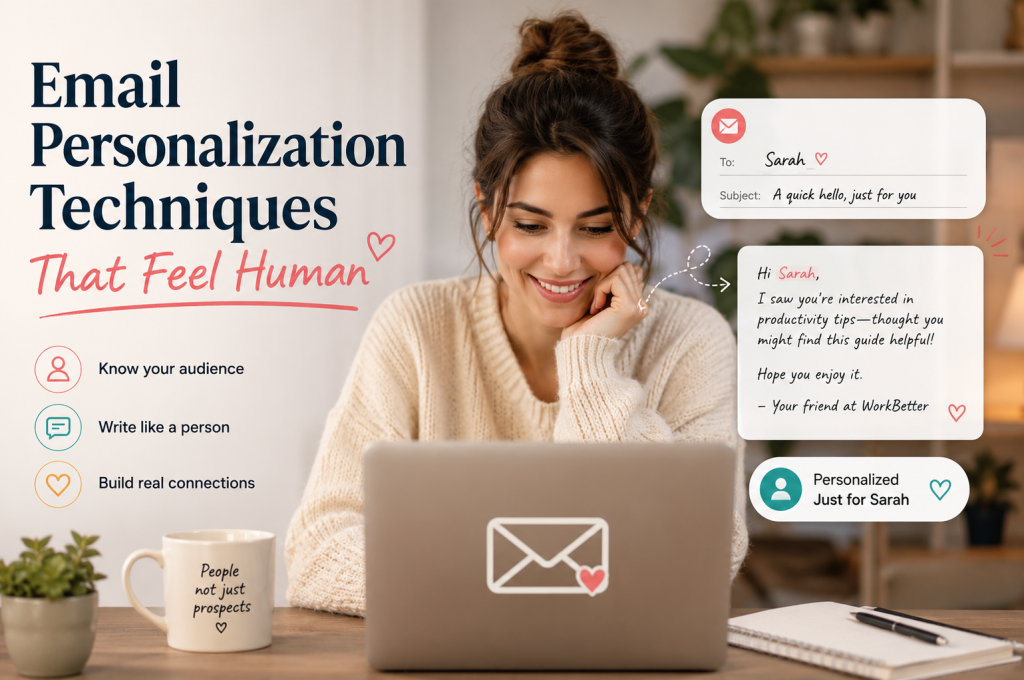
Hi, Sarah.
There. Personalized.
Except Sarah has seen her name inserted into hundreds of marketing emails. She knows it’s a merge tag. Everybody knows it’s a merge tag.
First-name personalization isn’t useless—it can still make an email warmer—but it is merely the starting point. Meaningful personalization asks better questions:
- What is this person interested in?
- What have they already looked at?
- Where are they in the customer journey?
- Have they bought from you before?
- What did they buy?
- What problem might they currently be trying to solve?
- Is this actually a sensible time to contact them?
- What information would be genuinely useful right now?
Answer those questions and personalized messaging starts to become genuinely personal.
This matters across digital marketing. A business investing in SEO might attract people through several completely different search intents, for example. Treating every one of those visitors identically once they join an email list throws away much of that context.
The same principle applies to email: relevance begins with understanding intent.
The Difference Between Personalization and a Mail Merge
There is a useful dividing line between personalized data and personalized meaning.
Consider these two emails.
Email A:
Hi James,
We thought you’d love our latest offer. Click here to find out more.
Email B:
Hi James,
You were looking at our beginner’s guide last week, so rather than sending you another introduction, here’s the next step. It covers the three questions people usually have once they’ve got the basics sorted.
Both technically contain personalization.
Only one demonstrates contextual relevance.
The second message uses website behavior to make a reasonable judgement about what James might find useful next. It doesn’t need to announce that behavioural data was involved. The relevance does the work.
This is the foundation of humanized email marketing:
Person → context → need → useful message.
Not:
Database field → personalization token → send.
That shift changes the way you approach everything from audience segmentation and email automation to personalized email copy.
Why Do Some Personalized Emails Still Feel Robotic?
Ironically, personalization can make an email feel less human when it is handled badly.
You’ve probably received one.
The email knows your name. It knows the company you work for. Perhaps it references something you recently did. Yet the message still has the unmistakable texture of automation.
Why?
Because information isn’t the same thing as empathy.
A human conversation doesn’t normally involve demonstrating every fact you know about somebody. You select the information that is relevant to the conversation and leave the rest alone.
Email should work the same way.
Imagine meeting someone at an event who says:
“Hi Alex. I noticed you visited our website three times this week, looked at the pricing page on Tuesday at 14:37 and opened our previous email twice.”
Accurate? Perhaps.
Comfortable? Absolutely not.
Now compare it with:
“Still weighing up your options? Here’s a quick comparison that might make the decision easier.”
The underlying intent data could be almost identical. The delivery is entirely different.
That’s why the best email personalization techniques don’t simply ask, What data can we insert?
They ask:
What would a thoughtful person do with this information?
That question is one of the most useful filters you can apply to personalization without being creepy.
The Human Personalization Formula
A practical framework for creating human-sounding emails is:
Relevant data + appropriate context + good timing + conversational delivery = useful personalization
Each element matters.
1. Relevant data
Collecting more customer data doesn’t automatically produce better personalized email campaigns.
Useful information might include:
- subscriber preferences;
- pages or content viewed;
- previous enquiries;
- purchase history;
- past purchases;
- products or services of interest;
- email engagement;
- customer journey stage;
- location, where genuinely relevant;
- explicitly provided zero-party data;
- appropriate first-party data.
The important word is useful.
If a piece of data doesn’t help you improve the customer’s experience, think carefully about why you’re collecting or using it.
2. Appropriate context
Context turns raw data into understanding.
Suppose somebody visits a PPC services page. The fact that they viewed the page is customer data. The potential context is that they may be researching paid advertising, comparing agencies, trying to improve an existing campaign or simply learning what PPC means.
Those aren’t the same intent.
Good contextual personalization avoids jumping to conclusions. Instead, it uses available signals to provide relevant content that helps somebody move forward.
3. Good timing
A perfectly relevant email sent at the wrong moment can still be irritating.
Email timing therefore deserves to be treated as part of personalization—not simply as a delivery setting.
This might mean:
- sending a welcome email immediately after signup;
- following up with educational material once somebody has had time to read the first message;
- triggering a reminder when behaviour indicates renewed interest;
- sending post-purchase guidance when the customer can actually use it;
- creating re-engagement emails after genuine inactivity rather than bombarding disengaged subscribers.
The principle is simple: right message, right time.
4. Conversational delivery
Finally, the email has to sound like something a person might reasonably say.
That means using natural language, an appropriate conversational tone and a recognisable brand voice.
Read the email aloud.
If you’d feel ridiculous saying it to a customer face-to-face, rewrite it.
That test catches a surprising amount of bad email copy.
Start With Segmentation, Not Personalization Tokens
If personalization tokens are the decoration, segmentation is the structure underneath them.
Trying to create one email for everybody and then inserting {First_Name} in a few places is backwards. Start by recognising that different subscribers have different needs.
Audience segmentation allows you to group people according to characteristics that actually affect what you should say to them.
Common approaches include:
| Segmentation type | What it considers | How it can improve email relevance |
|---|---|---|
| Demographic segmentation | Relevant demographic characteristics | Adjusts messaging for genuinely different audience needs |
| Geographic segmentation | Location | Supports location-specific information or services |
| Behavioral segmentation | Actions and interactions | Responds to what subscribers actually do |
| Psychographic segmentation | Interests, attitudes and motivations | Helps align messages with priorities |
| Technographic segmentation | Technology or platforms used | Useful when solutions depend on a customer’s technology |
| Needs-based segmentation | Specific problems or desired outcomes | Focuses emails around what somebody needs help achieving |
| Value-based segmentation | Customer or relationship value | Helps adapt retention and relationship strategies |
You don’t need all seven.
In fact, forcing customers into dozens of microscopic segments can make your marketing harder to manage without making it noticeably better.
Start with distinctions that change the conversation.
For example, someone researching a new website design has a different immediate need from somebody interested in increasing traffic to an existing site. Even if both people ultimately become customers of the same business, sending identical emails ignores their current context.
This is where contact segmentation becomes useful rather than administrative.
Behaviour Is Often More Revealing Than Demographics
Demographic data can tell you who somebody is.
Behavioral data can provide clues about what they want now.
That makes subscriber behavior particularly useful for timely personalized emails.
Potential signals include:
- browsing history;
- pages viewed;
- resources downloaded;
- links clicked;
- previous email engagement;
- products viewed;
- abandoned actions;
- previous enquiries;
- purchase history;
- repeat purchases;
- periods of inactivity;
- preference changes.
These intent signals aren’t instructions to immediately fire off an email every time somebody clicks something. That quickly becomes unsettling.
They’re clues.
Several signals together can help build a richer customer profile and support better behavior-based emails.
For example:
Weak personalization: “Hi Sam, here’s something we think you’ll like.”
Better personalization: “If you’re still comparing your options, here’s a straightforward guide to the differences that tend to matter most.”
The second doesn’t necessarily expose any of the data behind it. It simply uses that data to make the message more relevant.
That’s a recurring principle throughout this guide:
Good personalization reveals its usefulness—not its machinery.
Build Customer Profiles Without Becoming Creepy
The temptation with advanced email personalization is to believe that more data always equals more relevance.
It doesn’t.
Sometimes more data simply creates more opportunities to get personalization wrong.
A useful customer profile can combine information from several places—subscriber data, declared customer preferences, browsing behaviour, previous purchases and email engagement—but every additional signal should earn its place.
Think of it as progressive understanding rather than surveillance.
A subscriber might initially tell you very little. That’s fine. Over time, they may:
- choose topics they’re interested in;
- interact with particular content;
- make a purchase;
- change their subscriber preferences;
- respond to a survey;
- engage with particular email categories.
That produces a more nuanced understanding naturally.
It also creates opportunities for email preference management. A good preference center can let subscribers actively tell you what they want rather than forcing your marketing automation to guess everything from behavioural signals.
This is valuable zero-party data because the customer has deliberately provided it.
And there’s something distinctly human about asking rather than assuming.
Personalize Around Needs, Not Just Identity
One of the biggest improvements you can make to personalized email marketing is moving from identity-based personalization towards needs-based personalization.
Identity says:
We know who you are.
Needs-based personalization says:
We understand what you’re trying to accomplish.
The latter is usually far more useful.
Imagine two subscribers who look almost identical in a CRM. Same approximate age. Same region. Same type of business.
One needs help attracting more visitors.
The other has plenty of traffic but isn’t generating enough enquiries.
Demographic segmentation might put them together. Needs-based segmentation separates them because their problems require different conversations.
That distinction influences:
- the subject line;
- opening paragraph;
- educational content;
- examples;
- personalized CTAs;
- recommended next step;
- offer;
- follow-up sequence.
Suddenly, personalization isn’t cosmetic.
It shapes the entire message.
And that’s where email starts to feel genuinely human: not when it proves that the sender knows your name, but when it demonstrates that they understand why you’re there.
Use Dynamic Content to Change What Matters
Once you’ve segmented subscribers around meaningful differences, the next step is deciding what should actually change inside the email.
This is where dynamic content becomes powerful.
Dynamic content blocks allow sections of an email to change according to information you hold about the recipient. Instead of creating ten completely separate campaigns, you can build a core message and adapt selected elements for different audiences.
That might include:
- a different introduction based on customer journey stage;
- educational content matched to an expressed interest;
- different examples for new and existing customers;
- personalized recommendations based on previous behaviour;
- location-relevant information;
- a different call to action according to intent;
- post-purchase advice based on what somebody bought.
The important part is restraint.
Just because an email can contain six pieces of conditional content doesn’t mean it should.
A useful rule is:
Personalize the parts where knowing something about the recipient genuinely changes what you would say to them.
Everything else can remain consistent.
This keeps personalized email copy natural while making personalization at scale much easier to manage.
Conditional Content Should Feel Invisible
The recipient shouldn’t need to know that conditional content is being used.
Suppose one subscriber is relatively new to a topic while another has already spent weeks researching it. Showing both people exactly the same introductory material is unlikely to provide the best customer experience.
Instead, the beginner might receive:
“Not sure where to start? These three fundamentals will give you a solid foundation.”
The more informed subscriber might see:
“Already know the basics? Here are three areas worth looking at next.”
Same campaign. Different context.
That’s individualized email without making a theatrical display of personalization.
It also avoids one of the biggest problems with hyper-personalization: trying so hard to appear personal that the recipient becomes conscious of how much information is being processed behind the scenes.
The best dynamic content often goes unnoticed.
The reader simply thinks, this is useful to me.
Behavioural Triggers: Respond to What People Actually Do
Traditional email campaigns tend to revolve around the marketer’s calendar.
Monday: newsletter.
Wednesday: promotion.
Friday: reminder.
Trigger-based emails work differently. They can respond to something happening in the customer’s journey rather than waiting for an arbitrary campaign date.
A behavioral trigger could be:
- joining a mailing list;
- downloading a resource;
- showing interest in a particular subject;
- making an enquiry;
- purchasing a product or service;
- abandoning an action;
- repeatedly engaging with related content;
- becoming inactive;
- reaching a customer milestone.
This makes triggered emails naturally suited to contextual personalization because there is a reason for the message to exist.
The recipient did something. The email responds appropriately.
That’s much closer to a conversation.
Don’t Turn Every Click Into a Trigger
There is, however, an important distinction between responsive and reactive marketing.
If somebody clicks a link, they don’t necessarily need an immediate email about it.
If they view a page, that doesn’t automatically mean they’re ready to buy.
If they don’t open an email, that doesn’t mean they want three increasingly desperate reminders.
Customer behavior is evidence, not certainty.
Good behavioral targeting therefore considers the strength of the signal.
Low-intent signal: reading one article.
Stronger signal: repeatedly exploring closely related content.
Higher-intent signal: viewing decision-stage information, returning several times and actively requesting further details.
The stronger and clearer the intent data becomes, the more confidently you can adapt the next message.
This prevents marketing automation from becoming an overenthusiastic salesperson following the customer around the internet.
Think in Journeys, Not Isolated Emails
A personalized email rarely exists in isolation.
Someone may discover a business, read several pieces of content, join a mailing list, return to the website, compare alternatives, make an enquiry and eventually become a customer.
Every stage creates a different context.
That’s why lifecycle marketing is such a natural partner for personalization.
A simple customer journey might look like this:
Discovery → Learning → Consideration → Decision → Customer → Retention → Advocacy
The question at each stage changes.
During discovery:
Can this business help me?
During consideration:
Is this the right option for me?
After purchase:
How do I get the best result from what I’ve bought?
Later:
Is there anything else that’s relevant to me?
Sending the same promotional email throughout that journey ignores what the customer is actually experiencing.
Effective lifecycle emails adapt accordingly.
Welcome Emails
A welcome email has a very different job from a sales follow-up.
Somebody has just invited you into their inbox. Use that opportunity to establish expectations, introduce your brand personality and make the next step useful.
A strong welcome sequence might progressively:
- acknowledge why the subscriber joined;
- deliver whatever was promised;
- establish an authentic brand voice;
- ask about customer preferences;
- provide useful introductory content;
- offer a logical next step.
Notice what’s missing: an immediate barrage of sales messages.
Relationship building starts by providing value.
Follow-Up Emails
Good follow-up emails continue a conversation rather than restarting it.
If somebody has already engaged with introductory information, don’t repeatedly send them back to square one.
Use their customer journey stage to determine what would logically come next.
This is where personalized follow-ups can become particularly effective. The personalization isn’t necessarily a name or company reference; it is continuity.
“You’ve seen X, so Y is probably the useful next step.”
That feels human because it’s how a good conversation works.
Re-Engagement Emails
Inactivity is also behaviour.
But be careful how you interpret it.
A subscriber who hasn’t engaged recently may have lost interest. They may also be busy, no longer need the information or simply receive too many emails.
Good re-engagement emails don’t guilt people into clicking.
Instead, give them control.
Ask whether they still want to hear from you. Let them update subscriber preferences. Reduce frequency where appropriate. Make unsubscribing straightforward.
Paradoxically, respecting somebody’s desire to hear less from you can increase trust.
Personalize Recommendations Without Pretending to Read Minds
Personalized recommendations are one of the clearest ways customer data can produce tangible value.
If somebody has shown sustained interest in one subject, recommending closely related information saves them from searching for it themselves.
If an existing customer has already bought something, recommending the same introductory product again probably demonstrates that your systems aren’t talking to each other.
Good curated recommendations consider what came before.
That might mean using:
- browsing history;
- past purchases;
- stated interests;
- content engagement;
- customer preferences;
- related needs;
- journey stage.
The principle isn’t complicated:
Recommend what logically comes next, not simply what you most want to sell.
That difference can transform targeted messaging from promotional pressure into genuine assistance.
Make the Call to Action Personal Too
Personalization often stops just before one of the most important parts of the email: the call to action.
You’ve personalized the subject line.
You’ve adapted the content.
You’ve considered the recipient’s interests.
Then everybody gets:
BUY NOW
A personalized CTA should reflect where the recipient is in their decision-making process.
Someone early in the journey may respond better to:
See how it works
Someone comparing options might need:
Compare your options
A higher-intent prospect might be ready for:
Talk to us about your project
The CTA doesn’t have to contain personal data to be personalized.
It needs to offer the appropriate next action.
This is another example of contextual relevance being more valuable than cosmetic personalization.
Subject Line Personalization Goes Beyond a First Name
The subject line has one immediate job: give somebody a reason to consider opening the email.
Naturally, subject line personalization can help.
But:
“Sarah, you won’t BELIEVE this!”
is not suddenly a good subject line because Sarah’s name appears in it.
Effective personalized subject lines reflect the content and, where appropriate, the recipient’s situation.
Consider the difference:
Generic:
Our latest marketing tips
Contextual:
Three ideas for improving the traffic you already have
The second makes a more specific promise.
A first name could still be appropriate occasionally, but constantly inserting it into subject lines can make the technique feel mechanical.
Test different approaches through A/B testing or subject line testing rather than assuming personalization automatically improves open rates.
And don’t optimise open rates in isolation.
A curiosity-driven personalized subject line may generate an open but still disappoint the reader if the content doesn’t fulfil the promise.
Email optimization should look further down the chain:
Open → read → click → respond → convert → remain engaged
The best personalized email campaigns improve the quality of engagement, not simply the first metric on the dashboard.
Sender Personalization Is Easy to Overlook
Who an email appears to come from affects how human it feels before a single sentence is read.
Compare:
From: Marketing Department
with:
From: Chris at Red Frog Media
One sounds like a function.
The other sounds like a person.
Appropriate sender personalization can reinforce authentic communication, particularly when the named sender genuinely represents the business or customer relationship.
The same applies to sender details, signatures and replies.
If your email is written as though it comes from a real person, but replies disappear into an unmonitored abyss, the illusion collapses rather quickly.
Human-centered email marketing should leave room for actual humans.
That means making two-way communication possible where appropriate.
Invite responses.
Ask questions.
Listen to customer feedback.
Let email conversations become conversations.
Email Automation Should Handle Repetition, Not Personality
Automation isn’t the enemy of human communication.
Bad automation is.
There is nothing inherently impersonal about sending a welcome message automatically. If somebody joins your list at 9:47pm, they probably don’t expect a member of your team to be sitting beside a keyboard waiting for the notification.
Automation makes timely communication possible.
The problem begins when the system dictates the conversation instead of supporting it.
Think of email automation as infrastructure.
It can decide:
- when an email should be sent;
- which audience receives it;
- which dynamic content blocks appear;
- which behavioural triggers apply;
- when a sequence should stop;
- when somebody should enter another segment.
But the message itself still needs judgement.
Marketing automation should create the opportunity for relevance. Your brand voice creates the human connection.
This distinction becomes even more important as AI personalization becomes commonplace.
Using AI Without Making Every Email Sound Like AI
AI-assisted email writing can dramatically accelerate personalization at scale.
It can help interpret customer profiles, generate variations, adapt messaging for different segments and produce individualized emails much faster than manually rewriting every campaign.
But speed introduces a new problem.
You can now produce generic copy much faster.
AI-generated emails often become obvious when they rely on polished but empty language, exaggerated enthusiasm, predictable structures and phrases no human in the business would normally use.
The solution isn’t to avoid AI.
It’s to give it stronger boundaries.
Give AI a Real Brand Voice
Before asking an AI writing assistant to generate personalized email copy, define what your brand voice actually sounds like.
Useful guidance could include:
- words and phrases you naturally use;
- words you would never use;
- preferred sentence length;
- level of formality;
- sense of humour, if appropriate;
- how directly you speak;
- how you explain complicated ideas;
- how sales-focused emails should feel;
- examples of genuine communication written by your team.
“Make it sound human” is vague.
“Use straightforward British English, vary sentence length, avoid corporate jargon, don’t manufacture enthusiasm and explain the idea as you would to a customer on a call” gives the system something much more useful to work with.
Keep Humans in the Loop
Human-in-the-loop email marketing is particularly valuable when AI is generating or adapting messages at scale.
Let automation and AI handle repetitive work.
Keep human judgement around:
- unusual customer circumstances;
- sensitive messaging;
- important sales conversations;
- high-value relationships;
- complaints or negative feedback;
- claims that require verification;
- tone and brand consistency.
AI with human oversight can increase efficiency without surrendering judgement.
And judgement is precisely what makes communication feel personal.
Hyper-Personalization: Powerful, but Use It Carefully
Hyper-personalization combines multiple data points to produce highly individualized messaging, potentially in real time.
Instead of simply segmenting someone as “interested in marketing”, a system might consider their recent website behavior, previous email interactions, expressed preferences, customer history and current intent signals simultaneously.
Used intelligently, this can produce remarkably relevant communication.
Used carelessly, it produces the marketing equivalent of someone saying:
“I’ve been watching you.”
The dividing line is usefulness.
Before using a piece of customer data in an email, ask three questions:
- Does this information materially improve the message?
- Would the recipient reasonably expect us to know or use it?
- Will mentioning or acting on it make the email more helpful rather than more uncomfortable?
If the answer to any of those questions is no, leave it out.
Deep personalization isn’t about demonstrating how much you know. It’s about knowing which details matter.
That is the difference between advanced personalization and over-personalization.
And ultimately, it is the difference between an email that feels intelligently tailored and one that simply feels watched.
Measure Whether Personalization Is Actually Working
Personalization can sound impressive in a strategy meeting.
That doesn’t mean it’s improving your emails.
The only reliable way to know is to measure what recipients actually do—and to look beyond vanity metrics while you’re doing it.
Open rates can provide useful directional information, particularly when you’re testing subject lines and sender details. But an open doesn’t tell you whether the email was relevant, useful or persuasive.
Someone can open an email and immediately regret it.
That’s why meaningful email optimization should consider several measures together:
| Metric | What it can tell you |
|---|---|
| Open rate | Whether the sender and subject line encouraged an open |
| Click-through rate (CTR) | Whether recipients engaged with links or CTAs |
| Conversion rate | Whether email engagement contributed to the intended action |
| Response rate | Particularly useful for conversational and relationship-led emails |
| Unsubscribe rate | Whether frequency, relevance or expectations may be wrong |
| Email conversions | Whether campaigns are contributing to commercial outcomes |
| Long-term engagement | Whether subscribers continue finding your emails worthwhile |
| Email marketing ROI | Whether the overall programme generates sufficient value |
Don’t judge personalized email marketing solely by whether inserting somebody’s first name increased opens by a fraction of a percentage point.
Ask the bigger question:
Did personalization make the customer’s experience better and produce a more valuable interaction?
That is the metric underneath all the metrics.
A/B Test the Idea, Not Just the Wording
A/B testing is particularly useful because assumptions about personalization are often wrong.
You may assume that personalized subject lines outperform generic ones.
Test them.
You may believe that a product recommendation based on browsing history is more persuasive than one based on purchase history.
Test it.
You might expect highly individualized emails to outperform simpler segment-based messaging.
Again: test it.
Useful split tests can compare:
- personalized vs non-personalized subject lines;
- first-name personalization vs contextual subject lines;
- broad vs narrow audience segmentation;
- different personalized CTAs;
- dynamic content vs static content;
- conversational vs more formal copy;
- recommendation strategies;
- different email timing;
- shorter vs longer personalized email copy;
- person-based vs company-based sender details.
Change one meaningful variable where possible so you can understand what influenced the result.
Otherwise, you end up knowing that Email B performed better than Email A without knowing why.
Don’t Optimize the Humanity Out of Your Emails
Testing has a trap of its own.
If every sentence is endlessly optimized according to immediate clicks, the resulting email can become a collection of conversion tactics rather than coherent communication.
Numbers tell you what happened.
They don’t always tell you why.
Combine quantitative performance data with customer feedback, replies, sales conversations and wider audience insights.
If people reply positively to an email, mention it to your team, forward it or start genuine email conversations, those signals matter—even if they aren’t displayed prominently on your marketing dashboard.
The aim isn’t to produce mathematically perfect emails.
It’s to communicate effectively with people.
Personalization Should Build Trust, Not Spend It
Every piece of customer data creates a small responsibility.
Subscribers may reasonably expect a business to remember preferences they’ve deliberately provided. They may appreciate relevant recommendations based on a previous purchase. They might find a useful follow-up after an enquiry perfectly natural.
But personalization can cross a line.
This often happens when marketers confuse available data with appropriate data.
Just because a system can use information doesn’t automatically mean an email should draw attention to it.
A simple test is to imagine the same conversation happening face-to-face.
Would mentioning the information feel helpful?
Natural?
Expected?
Or would the customer wonder how on earth you knew that?
Trust and credibility are difficult to build and remarkably easy to damage.
Personalization should strengthen both.
Avoid the “Creepy Personalization” Problem
Personalization becomes uncomfortable when the recipient can see too much of the machinery.
For example:
“We noticed you visited this page three times yesterday but didn’t enquire.”
Even when technically accurate, that can feel intrusive.
A more natural version could be:
“Still considering your options? Here’s a straightforward comparison that may help.”
The behavioral data informs the message without becoming the message.
That is the essence of personalization without being creepy.
Use data to improve your understanding of customer needs. Don’t recite the evidence back to them.
A Useful Privacy Filter
Before deploying a personalized campaign, ask:
- Did the customer knowingly provide this information?
- Would they reasonably expect it to influence their emails?
- Is using it genuinely beneficial to them?
- Are we exposing unnecessary behavioural detail?
- Would the personalization still feel comfortable if explained openly?
- Are we giving subscribers meaningful control over preferences?
- Can they easily stop receiving messages they don’t want?
If the campaign feels questionable when you answer those questions plainly, rethink it.
Good customer-centric messaging respects boundaries.
Common Email Personalization Mistakes
Sometimes the fastest way to understand good personalization is to look at what makes it fail.
1. Treating a First Name as the Strategy
Hi {{first_name}} isn’t a personalization programme.
It’s a personalization token.
Merge tags can support a human touch, but they cannot manufacture relevance.
If the rest of the email has nothing to do with the recipient’s interests, needs or behaviour, their name won’t rescue it.
2. Using Bad Customer Data
Nothing destroys the illusion of personal communication faster than:
Hi FNAME,
or:
Hi NULL,
or calling somebody by the wrong name altogether.
Poor data quality turns personalization into anti-personalization.
Regularly review customer profiles, contact records, integrations and fallback values. If a personalization field isn’t reliable, don’t make the sentence depend on it.
“Hello there” sounds considerably more human than “Hi {ERROR_452}.”
3. Over-Segmenting Your Audience
Micro-segmentation can be useful.
It can also become absurd.
If you’ve created 84 segments that each contain six people and require separate content, you’ve probably moved beyond useful segmentation into administrative archaeology.
Segments should exist because the people within them require meaningfully different communication.
If two segments would receive essentially the same email, consider combining them.
4. Personalizing Irrelevant Details
Knowing someone’s location doesn’t mean every email needs:
“How’s the weather in Newcastle?”
Knowing their job title doesn’t mean it needs to appear in the opening paragraph.
Knowing they bought something eleven months ago doesn’t mean you should awkwardly mention it today.
Use data when it improves personal relevance.
Otherwise, leave it alone.
5. Pretending Automation Is a Person
There’s nothing wrong with automation.
There is something wrong with pretending an automated interaction is personally written when it clearly isn’t.
Authentic automation doesn’t need to hide the fact that systems are involved. It simply needs to communicate naturally and appropriately.
A useful automated email sent at the right moment is still useful.
6. Automating the Wrong Moments
Some communication requires judgement.
Complaints, sensitive circumstances, complex enquiries and important customer relationships may need an actual person.
Build exit points into automated sequences.
When a subscriber replies, complains, makes a significant enquiry or requires individual attention, consider whether marketing automation should stop and a human conversation should begin.
That is what automation with a human touch actually means.
7. Sending Too Much
More personalization does not justify more email.
In fact, effective behavioral targeting can sometimes help you send less because you’re better able to identify which messages are genuinely relevant.
Frequency is part of customer experience.
Don’t make subscribers regret giving you their email address.
What Human-Sounding Personalized Email Looks Like in Practice
Theory becomes clearer with examples.
Imagine a subscriber has downloaded an introductory resource about improving online visibility.
A generic automated follow-up might say:
Subject: Don’t miss these amazing marketing opportunities!
Hi Sarah,
We hope you’re enjoying our guide. At [Company], we provide industry-leading solutions designed to supercharge your growth. Book a consultation today!
It contains a first name and refers to the download.
Technically personalized.
Human? Not especially.
Now consider:
Subject: A useful next step
Hi Sarah,
If you’ve had a chance to go through the guide, you may be wondering which improvements are worth tackling first.
A good place to start is figuring out where you’re currently losing visibility rather than trying to change everything at once.
We’ve put together a simple way to prioritise that. Have a look when you have five minutes.
If you have a question afterwards, reply to this email.
The second version isn’t dramatically more complicated.
It simply demonstrates empathy, understands the likely next question and uses a conversational tone.
The CTA also fits the journey stage.
That’s the difference between inserting personal data and creating personalized messaging.
The Personalization Ladder
It can help to think about email personalization as a progression rather than a binary choice between “personalized” and “not personalized.”
Level 1: Identification
Basic details such as:
- first name;
- company;
- location where relevant.
Useful, but limited.
Level 2: Segmentation
Emails change according to meaningful groups, such as:
- interests;
- customer type;
- lifecycle stage;
- needs;
- previous customer status.
Now the content itself begins to become more relevant.
Level 3: Behaviour
Messages respond to:
- website behavior;
- email engagement;
- previous interactions;
- browsing history;
- purchase history;
- behavioral triggers.
The email begins reflecting what somebody actually does.
Level 4: Context
Multiple signals are interpreted together.
Instead of merely knowing that somebody clicked something, you consider why that action may matter within their broader customer journey.
This is where contextual targeting becomes particularly valuable.
Level 5: Individualization
Dynamic content, timing, recommendations and messaging adapt around the individual.
This moves closer to one-to-one personalization.
Level 6: Predictive Personalization
Advanced systems may use patterns in first-party data and behavioural information to anticipate the next useful message, offer or action.
This could involve:
- predictive recommendations;
- next-best-action models;
- propensity data;
- real-time personalization;
- AI-powered personalization.
The sophistication increases at every level.
But there’s an important catch:
More sophisticated doesn’t automatically mean more human.
A simple Level 2 email written with genuine empathy can outperform a badly executed Level 6 campaign.
Technology creates capability.
Judgement creates relevance.
A Practical Framework for Every Personalized Email
Before sending a campaign, run it through this framework.
Step 1: Who is receiving it?
Define the audience properly.
Not simply:
“Our mailing list.”
Instead:
“Existing subscribers interested in X who have engaged with Y but haven’t yet done Z.”
That creates a useful context for writing.
Step 2: Why are they receiving it?
There should be a reason.
Did they subscribe?
Express a preference?
Reach a lifecycle stage?
Make a purchase?
Show meaningful interest?
Become inactive?
If you can’t explain why this particular person should receive the message, your segmentation may be too broad.
Step 3: What do they probably need?
Move from the marketer’s objective to the customer’s need.
You may want a conversion.
They may want an answer.
Solve for their need first.
Step 4: What data genuinely helps?
Choose only the customer data necessary to improve relevance.
Don’t personalize simply because fields are available.
Step 5: What should change?
Decide whether personalization belongs in:
- the subject line;
- introduction;
- body content;
- recommendation;
- offer;
- CTA;
- send time;
- follow-up sequence.
You rarely need to personalize everything simultaneously.
Step 6: Does it sound natural?
Read the finished email aloud.
Remove corporate filler.
Remove unnecessary personalization.
Replace stiff language with conversational copywriting.
Check that the authentic voice still sounds like your business.
Step 7: Is the next step appropriate?
Don’t ask someone who has just discovered you to behave like a loyal customer.
Match the CTA to intent and journey stage.
Step 8: What happens after they act?
Personalization doesn’t stop at the click.
The page or experience after the email should continue the conversation.
If an email promises a highly specific solution and then sends everybody to a generic homepage, you’ve broken the contextual journey you worked so hard to create.
Step 9: How will you measure success?
Choose meaningful metrics before sending.
Clicks?
Replies?
Conversions?
Preference updates?
Revenue?
Continued engagement?
Knowing what success means prevents you from optimizing campaigns around whichever number happens to look nicest afterwards.
The Ultimate Test: Would a Good Human Send This?
Tools will become more sophisticated.
AI personalization will improve.
Predictive systems will get better at interpreting intent.
Dynamic content will become easier to deploy.
Automation will get faster.
None of that changes the fundamental standard.
Before sending an email, ask:
If a thoughtful member of our team knew what we know about this customer, is this roughly what they would say—and is this when they would say it?
If the answer is yes, you’re probably on the right track.
If the answer is:
“No human would ever phrase it like that, but our automation platform generated it,”
you’ve found the problem.
A Final Checklist for Human-First Email Personalization
Before your next personalized email campaign goes live:
- Segment people according to meaningful differences, not arbitrary database fields.
- Use customer data only where it improves relevance.
- Treat first-name personalization as a detail, not the strategy.
- Consider customer journey stage before choosing the message.
- Use behavioral data as a clue rather than proof of intent.
- Match content to genuine customer needs and pain points.
- Use dynamic content where different audiences genuinely require different information.
- Keep personalized recommendations relevant to what came before.
- Match personalized CTAs to the recipient’s likely readiness.
- Consider email timing as part of personalization.
- Write in natural language and preserve a consistent human brand voice.
- Use AI-assisted email writing to support judgement, not replace it.
- Keep humans involved where context or sensitivity requires them.
- Avoid revealing unnecessary browsing or behavioural information.
- Give subscribers control through clear preference management.
- Test meaningful personalization choices rather than relying on assumptions.
- Measure clicks, responses, conversions and long-term engagement—not opens alone.
- Make it easy for recipients to reply when a conversation would be useful.
- Check that the experience after the click continues the personalized journey.
- Read the finished email aloud before pressing send.
Personalization Should Feel Like Recognition, Not Surveillance
The best Email Personalization Techniques That Feel Human have surprisingly little to do with repeatedly proving that you know somebody’s name.
They are about recognition.
Recognising what somebody needs.
Recognising what they’ve already done.
Recognising where they are in their journey.
Recognising when another email would be helpful—and when silence would be better.
That requires customer data, audience segmentation, behavioral signals, contextual relevance, good email timing and personalized content. Technology can connect those pieces and make personalization at scale possible.
But the technology should remain backstage.
What the customer experiences should be much simpler:
“This is relevant to me.”
That’s the standard worth aiming for.
Personalized email marketing shouldn’t feel like a database talking to a contact record. It should feel like communication from a business that has paid attention.
Use automation to remember.
Use data to understand.
Use AI to assist.
Use testing to learn.
But use human judgement to decide what is worth saying.
Because the most sophisticated personalization strategy in the world still comes down to something remarkably ordinary:
Know who you’re talking to. Understand what they need. Say something useful. Say it like a human.
Frequently Asked Questions About Email Personalization
1. How much customer data do you need to personalize an email effectively?
You don’t need an enormous customer profile to create effective personalized emails. A few reliable signals are often more valuable than dozens of loosely relevant data points.
Start with information that can genuinely change what you communicate, such as stated interests, subscriber preferences, previous interactions, purchase history or customer journey stage.
The objective isn’t to collect as much customer data as possible. It’s to have enough context to make the message more useful.
Even a single piece of zero-party data—such as a subscriber telling you what they’re interested in—can enable meaningful personalization without requiring complex behavioral tracking.
2. Can email personalization work for small businesses with limited customer data?
Yes. In fact, smaller businesses can have an advantage because they often understand their customers more directly.
You don’t need sophisticated predictive personalization or hundreds of audience segments to get started. A small business could segment subscribers according to:
- what they enquired about;
- what they purchased;
- which resources they requested;
- whether they’re a prospect or existing customer;
- preferences they’ve explicitly provided.
Combine that with a strong brand personality, natural language and genuinely useful follow-ups and you already have the foundations of humanized email marketing.
Start simple. Better information can be added as the customer relationship develops.
3. How often should personalized marketing emails be sent?
There isn’t a universal frequency that works for every audience.
The better question is: how often do you have something sufficiently relevant to say?
Some subscribers may benefit from frequent lifecycle emails while actively researching or onboarding. Others might prefer occasional updates.
Look at subscriber behavior, engagement, customer feedback and preference data rather than assuming everyone should receive the same number of emails.
Giving subscribers some control over frequency through a preference center can be particularly useful.
Personalization isn’t only about deciding what somebody receives. Sometimes it means recognising that they should receive less.
4. Should every email in a campaign be personalized?
No.
Personalization should have a purpose.
A company announcement, general update or universally relevant piece of information may not need individual-level personalization at all. Trying to force personal details into every message can make otherwise straightforward communication feel artificial.
Use contextual personalization when knowing something about the recipient materially changes what would be useful to them.
If it doesn’t, a clear, relevant email written in an authentic voice may be the better option.
Personalization is a tool, not a requirement.
5. Can you personalize emails for anonymous website visitors?
Not in quite the same way as you can for known subscribers, because you may not know who an anonymous visitor is.
However, website behavior can become useful first-party data once a visitor knowingly identifies themselves—for example, by subscribing, making an enquiry or creating an account—provided the data is collected and used appropriately.
The important point is not to confuse tracking with understanding.
A handful of anonymous page views doesn’t necessarily reveal somebody’s intentions. Meaningful personalization becomes more reliable as you gain legitimate customer context, explicit preferences and stronger intent signals.
6. What should you do when personalization data is missing?
Always create sensible fallback content.
Never build an email that only reads naturally if every personalization token contains perfect data.
Instead of:
“Hi {{first_name}}, we have something for you…”
you might structure a system so that subscribers with reliable first-name data receive an appropriate greeting while those without it receive a natural alternative.
The same principle applies to dynamic content blocks, recommendations, location information and customer attributes.
Test missing, incomplete and unexpected values before launching a campaign.
A graceful fallback is invisible.
A broken merge tag is memorable for all the wrong reasons.
7. How do you personalize emails for new subscribers when you know almost nothing about them?
Ask rather than guess.
A new subscriber may initially provide little more than an email address, so the early stages of the relationship are an opportunity to gather zero-party data naturally.
You could ask what topics they’re interested in, what they’re hoping to achieve or what type of information they would find useful.
Keep those questions proportionate. Don’t turn a welcome email into an interrogation.
Then use subsequent engagement as additional context.
Over time:
stated preferences + subscriber behavior + interactions + customer feedback
can create a much richer customer profile.
This approach allows genuine personalization to develop progressively rather than pretending you understand a new subscriber before you actually do.
8. What’s the difference between personalization and customization in email marketing?
The terms are sometimes used interchangeably, but there is a useful distinction.
Personalization is generally driven by information the business or marketing system knows about the recipient. For example, content could adapt according to purchase history, behavioral data, customer journey stage or an existing preference.
Customization gives the recipient more direct control over their experience—for example, choosing which topics they want to receive or selecting an email frequency.
The two work particularly well together.
Customization provides explicit information about customer preferences, while personalization uses those preferences to deliver more relevant communication.
In other words:
Customization lets customers tell you what they want. Personalization helps you act on it.
9. How can you tell when email personalization has gone too far?
A useful warning sign is when the personalization draws more attention to your data collection than to the value of the message.
Ask yourself how the recipient is likely to react.
“That’s useful—they remembered what I’m interested in.”
Good.
“That’s oddly specific. How do they know that?”
Potential problem.
Highly detailed behavioral targeting, excessive familiarity, sensitive inferences and unexpected use of personal information can undermine trust even when the underlying data is accurate.
Human-first personalization uses restraint.
You don’t need to demonstrate everything you know about a customer. Use the minimum amount of information necessary to improve the interaction.
The customer should notice the relevance before they notice the personalization.
10. What is the future of human email personalization?
Email personalization is likely to become increasingly predictive, contextual and automated.
AI-powered personalization can already help businesses analyse behavioral signals, generate content variations, identify audience patterns and adapt messaging at scale. More advanced systems can combine real-time personalization, predictive recommendations and next-best-action models to determine what information might be useful next.
But greater technical capability makes the human element more important, not less.
As AI-generated content becomes commonplace, an authentic brand voice, empathy, restraint and genuine customer understanding become differentiators.
The future therefore isn’t simply about creating more individualized emails.
It’s about combining:
better data + smarter automation + AI assistance + customer choice + human judgement.
The businesses that do this well won’t necessarily be the ones demonstrating the most sophisticated technology.
They’ll be the ones whose customers barely notice the technology is there.