
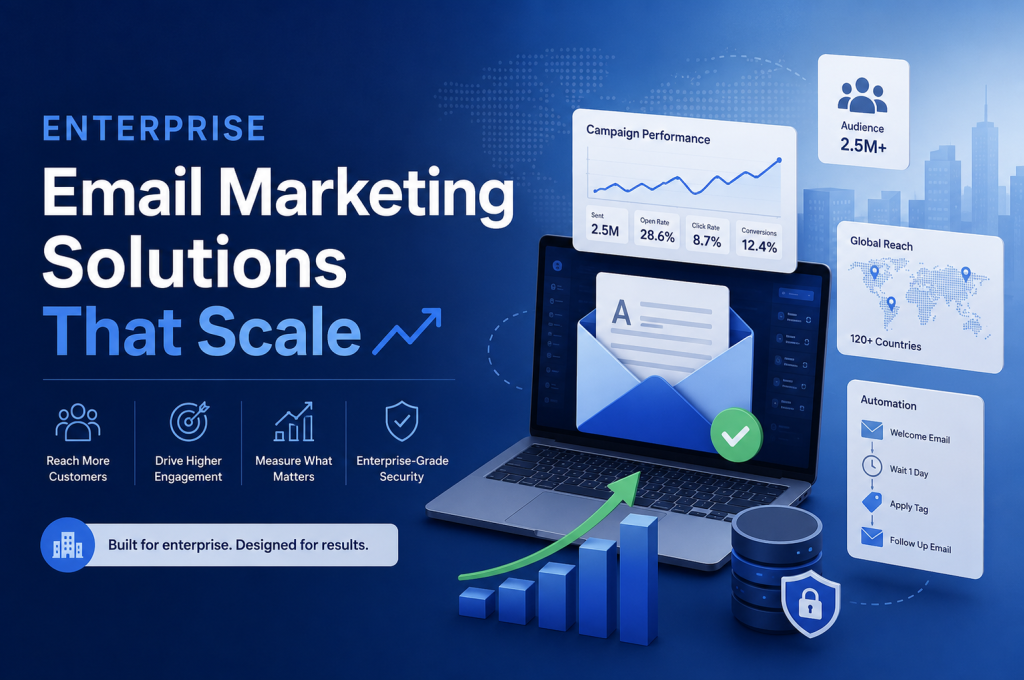
Growing an enterprise business requires far more than sending bulk email campaigns. Modern organisations need intelligent marketing automation, real-time customer data, advanced audience segmentation, AI-powered personalisation and enterprise-grade security to create meaningful customer experiences at scale. This guide explores how enterprise email marketing has evolved, the technologies that underpin high-performing campaigns, and the strategies businesses use to increase customer engagement, improve deliverability, boost revenue attribution and maximise ROI. You’ll also discover how email integrates with SEO, paid advertising and web development to create a unified digital marketing strategy that supports sustainable long-term growth.
Enterprise Email Marketing Solutions That Scale: Why Modern Businesses Need More Than Bulk Email
Email remains one of the highest-performing digital marketing channels available, but enterprise organisations face challenges that simply don’t exist for smaller businesses. Managing millions of customer records, coordinating campaigns across multiple regions, maintaining GDPR compliance and delivering highly personalised experiences all require technology capable of operating on an entirely different level.
Today’s enterprise email marketing isn’t about sending newsletters to massive databases. It’s about building intelligent systems that understand customer behaviour, adapt in real time and deliver the right message to the right individual at precisely the right moment.
As businesses expand, customer expectations grow alongside them. Buyers now expect brands to remember previous interactions, recommend relevant products, respond instantly to behavioural triggers and maintain consistent messaging across every digital touchpoint. Meeting those expectations requires far more than an email platform—it requires an integrated marketing ecosystem.
Enterprise marketing succeeds when every customer interaction feels personal, even when millions of emails are being delivered every month.
What Makes Enterprise Email Marketing Different?
While many businesses begin with simple email campaigns, enterprise organisations quickly outgrow basic functionality.
Large organisations require:
- Enterprise scalability
- High-volume email sending
- Enterprise security
- Advanced segmentation
- Dynamic content
- Customer journey orchestration
- AI-powered email marketing
- Unified customer profiles
- Enterprise CRM integration
- Comprehensive reporting dashboards
Rather than operating as a standalone communication channel, enterprise email becomes part of a wider customer engagement platform that combines customer data, behavioural insights and intelligent automation.
This creates an environment where every interaction contributes towards a richer customer profile, allowing marketing teams to improve customer engagement while simultaneously increasing operational efficiency.
The Shift Towards Data-Driven Customer Experiences
One of the biggest changes in enterprise marketing has been the movement away from demographic segmentation alone.
Modern businesses now combine multiple data sources including:
- Purchase history
- Browsing behaviour
- Customer preferences
- First-party data
- Zero-party data
- Customer attributes
- Real-time customer data
- Customer behaviour tracking
The result is far richer customer intelligence.
Instead of sending identical promotional emails to an entire database, businesses can build highly targeted customer journeys based upon actions rather than assumptions.
For example:
| Customer Action | Automated Response |
|---|---|
| Downloads a guide | Educational nurture campaign |
| Visits pricing pages | Sales-focused email sequence |
| Abandons checkout | Triggered abandoned cart email |
| Makes a purchase | Post-purchase lifecycle campaign |
| Stops engaging | Re-engagement workflow |
Behavioural email marketing transforms static mailing lists into dynamic customer journeys that evolve alongside individual customer behaviour.
Why First-Party Data Has Become Essential
As privacy regulations continue to evolve and third-party cookies disappear, first-party data has become one of the most valuable assets an enterprise business can own.
Collecting information directly from customers creates numerous advantages:
- Higher data accuracy
- Better personalisation
- Improved customer trust
- Stronger GDPR compliance
- Greater marketing flexibility
- Increased customer lifetime value (LTV)
Businesses that invest in robust customer data platforms (CDPs) can unify information from websites, CRM platforms, ecommerce systems and mobile applications into a single customer view.
This unified customer profile enables:
- Personalised email marketing
- Predictive segmentation
- AI recommendations
- Customer lifecycle automation
- Revenue attribution
- Customer retention strategies
Without clean, connected data, even the most advanced marketing automation software struggles to deliver relevant experiences.
Building an Enterprise Marketing Technology Stack
Successful enterprise marketing depends on seamless integration rather than isolated software.
A modern marketing technology stack often combines:
- Customer Data Platform (CDP)
- Enterprise CRM
- Marketing automation platform
- Analytics platform
- Ecommerce platform
- Business intelligence software
- API integrations
- Customer engagement platform
These systems communicate continuously through API connectivity and webhooks, allowing data synchronization across every customer touchpoint.
When properly implemented, customer interactions on a website immediately influence automated workflows, audience segmentation and future campaign performance.
For many organisations, improving the website itself is often the first step towards collecting higher-quality customer data. Investing in professional website design helps create faster, more intuitive digital experiences that encourage visitors to engage, convert and willingly share valuable first-party information.
Marketing Automation Has Evolved Beyond Scheduled Emails
Many businesses still associate marketing automation with simple drip campaigns.
Enterprise automation is considerably more sophisticated.
Today’s automated workflows respond instantly to customer behaviour using:
- Behavioural triggers
- Event-triggered emails
- AI decisioning
- Predictive customer behaviour
- Machine learning
- Send-time optimisation
- Workflow automation
- Intelligent automation
Rather than following rigid schedules, campaigns adapt dynamically to customer interactions.
Someone researching a product today may receive educational content, while another customer showing strong buying intent could receive product comparisons, testimonials or consultation invitations—all generated automatically from the same enterprise email marketing platform.
The result is greater relevance without increasing manual workload.
Personalisation Is No Longer Optional
Modern consumers recognise generic email immediately.
Personalisation has progressed far beyond including a customer’s first name in the subject line.
Leading enterprise organisations now deliver:
- Hyper-personalisation
- Dynamic content
- Predictive personalisation
- Individual customer journeys
- AI personalisation
- Real-time personalisation
Content changes based on location, purchasing behaviour, browsing history, engagement patterns and customer lifecycle stage.
The outcome is significantly stronger customer engagement alongside improvements in:
- Open rate
- Click-through rate (CTR)
- Conversion rate
- Revenue per email
- Campaign performance
- Customer loyalty
As artificial intelligence continues to mature, generative AI, AI copywriting and AI subject line optimisation are helping marketing teams produce more relevant campaigns while reducing production time.
These technologies enhance marketers rather than replace them, allowing creative teams to focus on strategic messaging while automation handles repetitive execution.
Deliverability: The Foundation of Every Successful Enterprise Email Strategy
Even the most compelling email is ineffective if it never reaches the inbox. As databases grow into hundreds of thousands—or even millions—of subscribers, email deliverability becomes a strategic priority rather than a technical afterthought.
Enterprise organisations must protect their sender reputation while maintaining consistent inbox placement across multiple campaigns, brands and geographic regions.
Key factors that influence deliverability include:
- Email authentication
- Sender reputation
- Domain reputation
- IP reputation
- List hygiene
- Email validation
- Spam filtering
- Deliverability monitoring
- Subscriber preferences
- Consent management
Strong authentication protocols such as SPF, DKIM and DMARC help verify legitimate senders while reducing spoofing and phishing attempts. Combined with permission-based marketing practices, these measures improve trust with both internet service providers and subscribers.
Maintaining clean mailing lists is equally important. Removing inactive contacts, validating email addresses and monitoring engagement metrics all contribute to healthier databases and stronger long-term performance.
Deliverability isn’t achieved through volume—it is earned through consistency, trust and relevance.
Enterprise Security and Compliance Cannot Be an Afterthought
Enterprise businesses often operate across multiple territories, each with its own privacy regulations and compliance requirements.
Protecting customer data is not only a legal obligation but also an essential component of building lasting customer relationships.
An enterprise email marketing solution should support:
- GDPR compliance
- CAN-SPAM compliance
- Data privacy
- Data governance
- Global compliance
- Data encryption
- Role-based permissions
- Audit logs
- Version control
- Enterprise governance
These capabilities ensure marketing teams can collaborate efficiently without compromising security or exposing sensitive customer information.
Clear consent management processes and transparent subscriber preference centres also give customers greater control over how they interact with your brand, strengthening trust over time.
AI Is Transforming Enterprise Marketing Automation
Artificial intelligence is no longer an emerging technology within enterprise marketing—it has become a practical tool for improving efficiency, accuracy and campaign performance.
Rather than replacing marketers, AI strengthens decision-making across every stage of the customer lifecycle.
Modern enterprise platforms increasingly support:
- Predictive analytics
- AI recommendations
- Recommendation engines
- Predictive segmentation
- AI content generation
- AI email optimisation
- AI copywriting
- AI subject line optimisation
- Predictive revenue forecasting
- Marketing intelligence
Instead of relying solely on historical reporting, machine learning models can identify patterns that humans may overlook.
For example, AI can determine:
- Which customers are most likely to convert
- Which subscribers are becoming disengaged
- When individuals are most likely to open emails
- Which products should be recommended
- Which customer segments require different messaging
This level of intelligence allows businesses to automate decisions while still maintaining highly personalised customer experiences.
Customer Journey Orchestration Across Multiple Channels
Email performs best when it supports a broader omnichannel marketing strategy.
Today’s customers frequently move between websites, search engines, social media, paid advertising and email before making a purchasing decision.
Rather than treating these channels independently, enterprise businesses coordinate communications through customer journey orchestration.
A simplified customer journey might include:
- A customer discovers the business through organic search.
- They download a valuable resource from the website.
- Behavioural triggers place them into an automated nurture campaign.
- AI-powered segmentation adapts messaging based on engagement.
- Paid advertising reinforces the same messaging.
- Triggered emails encourage conversion.
- Post-purchase automation increases retention and repeat purchases.
This creates a consistent customer experience regardless of where interactions take place.
Organic visibility remains an important contributor to these journeys, as search often represents the first touchpoint in the buying process. Businesses that invest in long-term https://redfrogmedia.co.uk/seo/ strategies frequently generate higher-quality first-party data because visitors arrive with stronger intent and are more likely to engage with content, subscribe and convert.
CRM Integration Creates a Single Source of Truth
Enterprise marketing becomes significantly more effective when customer information is shared seamlessly between systems.
CRM integration connects marketing, sales and customer service teams around unified customer profiles.
Common enterprise integrations include:
- Salesforce integration
- Microsoft Dynamics
- HubSpot integration
- Shopify Plus
- Magento
- BigCommerce
- Enterprise APIs
- Customer data integration
- Marketing integrations
Rather than storing disconnected records across multiple platforms, businesses gain a unified customer view that updates continuously.
This enables:
- Better lead nurturing
- More accurate lead scoring
- Improved customer activation
- Faster sales follow-up
- Consistent customer communications
- Smarter audience segmentation
When every department works from the same customer intelligence, the entire organisation becomes more responsive.
Measuring Success Beyond Open Rates
Open rates remain useful, but they tell only part of the story.
Enterprise organisations increasingly evaluate email performance through commercial outcomes rather than vanity metrics.
Important KPIs include:
| Business Metric | Why It Matters |
|---|---|
| Revenue attribution | Measures campaign contribution to sales |
| Customer lifetime value (CLV) | Indicates long-term profitability |
| Conversion optimisation | Evaluates landing page effectiveness |
| Incremental revenue | Identifies additional revenue generated |
| Marketing attribution | Shows the role email plays across the buying journey |
| ROI | Measures overall marketing efficiency |
| Customer retention | Reflects long-term relationship strength |
| Revenue growth | Connects marketing directly to business objectives |
Sophisticated reporting dashboards allow executives to understand not only what happened but why it happened.
Business intelligence platforms combine campaign analytics with CRM data, ecommerce reporting and financial metrics to provide a much clearer picture of marketing effectiveness.
Supporting Global Growth Without Losing Relevance
Enterprise scalability isn’t simply about sending more emails.
It’s about maintaining relevance while operating across increasingly complex organisations.
Large businesses often need to manage:
- Multi-brand management
- Multi-region campaigns
- Multi-language campaigns
- Localisation
- Distributed marketing teams
- Enterprise workflows
- High-performance email delivery
- Large customer databases
Successful organisations establish brand governance frameworks that ensure messaging remains consistent while still allowing regional teams the flexibility to tailor campaigns for local audiences.
This balance between central control and local execution becomes increasingly important as businesses expand internationally.
Enterprise platforms also streamline workflow approvals and content governance, reducing bottlenecks while maintaining compliance across every campaign.
Building for the Future with Flexible Enterprise Architecture
Technology evolves quickly, and enterprise organisations cannot afford to build marketing systems that become obsolete within a few years. Scalability depends not only on handling larger audiences but also on adapting to changing customer expectations, emerging technologies and new business models.
Modern enterprise architecture is increasingly built around flexibility.
Rather than relying on a single, all-in-one platform, many organisations are adopting composable ecosystems that allow specialist applications to work together seamlessly.
Common architectural approaches include:
- Composable commerce
- Headless commerce
- MACH architecture
- Microservices
- API-first platforms
- Enterprise APIs
- Cloud platforms
- Enterprise infrastructure
- Enterprise deployment
This modular approach allows businesses to introduce new technologies without replacing their entire marketing technology stack.
As artificial intelligence, automation and customer engagement platforms continue to evolve, organisations with flexible infrastructures can innovate much faster than competitors tied to legacy systems.
Lifecycle Marketing Creates Long-Term Customer Value
Acquiring new customers is only one part of sustainable growth.
Enterprise organisations generate significantly greater returns by investing in lifecycle marketing that nurtures customers throughout every stage of their relationship with the brand.
An effective lifecycle strategy typically includes:
- Welcome emails
- Educational nurture campaigns
- Promotional emails
- Transactional emails
- Browse abandonment campaigns
- Abandoned cart emails
- Post-purchase emails
- Cross-selling campaigns
- Upselling campaigns
- Win-back campaigns
- Re-engagement campaigns
Each stage should be supported by behavioural triggers, customer insights and dynamic content that reflects where an individual sits within the customer journey.
Instead of repeatedly focusing on acquisition, businesses create systems that naturally increase:
- Customer retention
- Customer loyalty
- Repeat purchases
- Customer lifetime value (LTV)
- Revenue growth
Over time, these improvements often produce a greater commercial impact than simply increasing advertising spend.
Aligning Email with Your Wider Digital Marketing Strategy
Enterprise email marketing delivers its strongest results when it complements every other marketing channel rather than operating in isolation.
Search engine optimisation, paid advertising, content marketing and website experience all contribute valuable first-party data that strengthens audience segmentation and personalisation.
For example:
- Organic search attracts high-intent visitors.
- Paid advertising introduces new audiences.
- Website interactions generate behavioural data.
- CRM systems record customer history.
- Marketing automation delivers relevant follow-up communications.
- Analytics platforms measure commercial impact.
When these channels work together, customer journeys become more consistent and significantly more effective.
Businesses looking to accelerate customer acquisition alongside automated lifecycle marketing often combine enterprise email campaigns with professionally managed PPC services, allowing paid traffic to flow directly into personalised nurture sequences that maximise conversion opportunities.
Common Challenges Enterprise Organisations Face
Even with sophisticated technology, enterprise email marketing initiatives can struggle if the underlying strategy is unclear.
Some of the most common obstacles include:
- Poor data quality
- Disconnected customer systems
- Inconsistent branding
- Weak audience segmentation
- Overly complex automation
- Low-quality customer data
- Limited cross-functional collaboration
- Insufficient reporting
- Failure to monitor deliverability
- Lack of ongoing optimisation
These issues often develop gradually as organisations expand.
Regular audits of customer data, automation workflows and campaign performance help ensure systems continue supporting business objectives rather than creating unnecessary complexity.
Best Practices for Sustainable Enterprise Growth
Successful enterprise marketing teams share several common characteristics.
They prioritise:
- Clean, accurate customer data.
- Unified customer profiles across departments.
- Personalisation driven by real customer behaviour.
- Intelligent automation that supports—not replaces—human decision-making.
- Continuous testing and optimisation.
- Strong governance and security.
- Meaningful commercial reporting rather than vanity metrics.
- Consistent customer experiences across every digital touchpoint.
Rather than viewing technology as the solution, they focus on creating better customer experiences supported by the right technology.
The Future of Enterprise Email Marketing
Enterprise marketing continues to evolve at an extraordinary pace.
Several trends are likely to shape the next generation of customer engagement platforms.
These include:
- Greater use of generative AI for content production.
- More advanced predictive personalisation.
- Real-time customer orchestration across every channel.
- Enhanced privacy controls and consent management.
- Increased adoption of machine learning for campaign optimisation.
- Deeper integration between customer data platforms and business intelligence systems.
- Greater automation of reporting, attribution modelling and decision-making.
As these technologies mature, enterprise marketing teams will spend less time managing campaigns manually and more time developing creative strategies that differentiate their brands.
Businesses that invest in flexible infrastructure, high-quality first-party data and customer-centric experiences today will be well positioned to take advantage of these innovations tomorrow.
Frequently Asked Questions
What defines an enterprise email marketing platform?
An enterprise email marketing platform is designed to manage high-volume campaigns, advanced automation, customer segmentation, CRM integrations, security, analytics and personalised communications across large customer databases and multiple business units.
Why is first-party data so important?
First-party data is collected directly from customers through your own digital channels. It is generally more accurate, privacy-compliant and valuable for personalisation than third-party data, making it essential for modern enterprise marketing.
How does AI improve enterprise email marketing?
Artificial intelligence supports predictive analytics, audience segmentation, send-time optimisation, recommendation engines, automated content generation and personalised customer journeys, enabling marketing teams to deliver more relevant communications at scale.
Which metrics matter most?
While open rates and click-through rates remain useful indicators, enterprise organisations should focus on commercial metrics such as ROI, revenue attribution, customer lifetime value, conversion rate, customer retention and incremental revenue.
Can enterprise email marketing support international businesses?
Yes. Enterprise platforms are designed to manage localisation, multi-language campaigns, multi-region campaigns, enterprise governance, distributed marketing teams and compliance requirements across multiple markets.
Final Thoughts
Enterprise email marketing has evolved into one of the most sophisticated disciplines within digital marketing. Success is no longer determined by the number of emails sent but by how intelligently organisations use customer data, automation and technology to create meaningful, personalised experiences.
The most effective enterprise strategies combine advanced segmentation, AI-powered automation, customer journey orchestration, robust security, seamless integrations and continuous optimisation. Together, these capabilities allow businesses to communicate with millions of customers while maintaining the relevance and consistency that modern audiences expect.
Ultimately, organisations that embrace scalable infrastructure, invest in high-quality first-party data and align email with their broader digital marketing strategy are better equipped to improve customer engagement, strengthen loyalty, increase lifetime value and drive sustainable long-term growth in an increasingly competitive marketplace.