
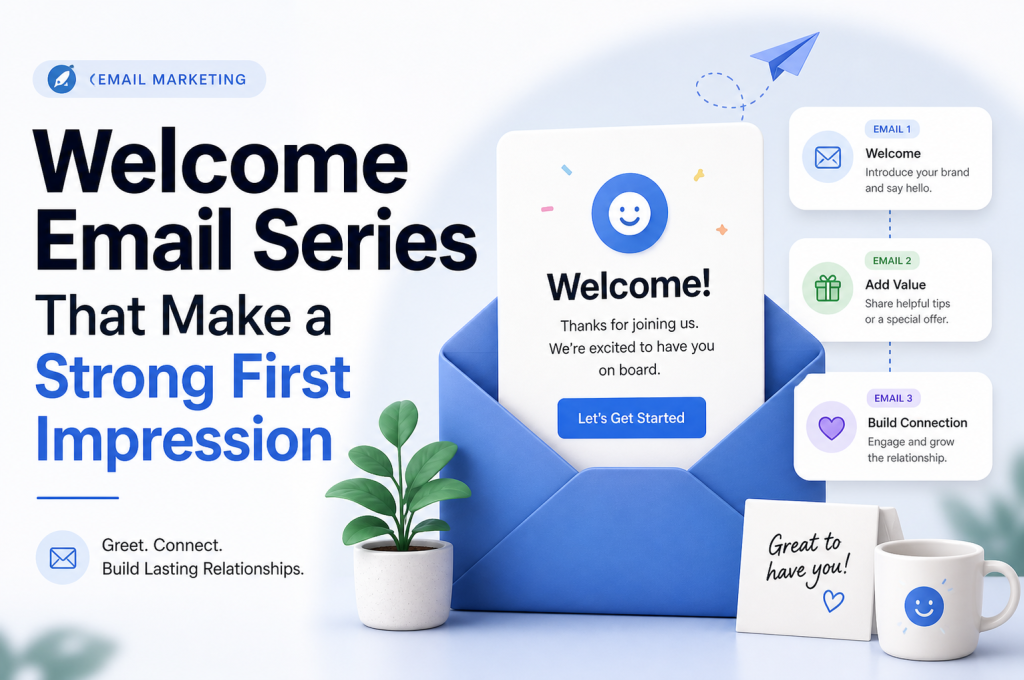
A high-performing welcome email series is not just a polite hello—it’s a strategic, automated onboarding experience designed to guide new subscribers through their first interaction with your brand. By combining personalization, storytelling, and conversion-focused messaging, businesses can improve open rates, engagement, and long-term customer retention. The most effective sequences blend incentives like discount codes with trust-building elements such as social proof and brand storytelling, all while leveraging email automation, segmentation, and optimisation techniques like A/B testing and responsive design. When executed well, this first touchpoint becomes the foundation of your entire lifecycle marketing strategy.
Why First Impressions in Email Marketing Matter More Than You Think
The moment someone subscribes to your list, they’ve opened the door—just slightly. What happens next determines whether they step inside or walk away entirely.
A welcome email series is your chance to shape that decision.
Unlike a one-off campaign, a welcome email flow is a carefully timed, triggered email sequence that introduces your brand, sets expectations, and begins the process of lead nurturing. It’s the digital equivalent of a first handshake—firm, confident, and memorable.
A weak first impression doesn’t just lose a sale—it damages future engagement across your entire email funnel.
Brands that invest in a structured email onboarding series often see:
- Higher open rate optimisation
- Increased click-through rate (CTR)
- Stronger customer retention
- Faster movement through the conversion funnel
The Anatomy of a High-Converting Welcome Email Flow
Creating an effective onboarding email sequence requires more than good design. It’s about aligning messaging, timing, and user intent within a broader email flow strategy.
1. The First Touchpoint: Your Initial Welcome Email
This is your first impression email—and it sets the tone for everything that follows.
It should:
- Deliver a clear value proposition
- Reinforce why the user subscribed
- Introduce your brand voice
- Include a compelling call to action (CTA)
Many brands also include a signup incentive, such as:
- A discount code
- A welcome offer
- An exclusive deal
These aren’t just perks—they tap into the reciprocity principle, a key concept in first impression psychology that encourages users to give back (often through a purchase).
2. Building Momentum with a Drip Campaign
Once the initial email is sent, your drip campaign begins.
This is where email automation shines.
Each email in the sequence should serve a purpose within the user journey:
- Brand Introduction
Share your brand story, company mission, and what makes you different. - Education & Onboarding
Provide product education, “how it works” guides, or onboarding instructions. - Trust Building
Use social proof, testimonials, and customer trust signals. - Conversion Push
Highlight best sellers, featured products, and tailored product recommendations.
3. Personalization: The Engine Behind Engagement
Modern automated welcome emails are no longer generic.
They rely on:
- Behavioral segmentation
- Predictive personalization
- Dynamic content
This allows you to tailor messaging based on:
- User behaviour
- Purchase intent
- Engagement patterns
For example, an ecommerce brand might:
- Recommend products based on browsing history
- Adjust messaging for new vs returning users
- Trigger an activation email when a user shows intent
This level of personalization dramatically improves both engagement rate and conversions.
Designing for Experience: Where Strategy Meets Execution
Even the best strategy fails without proper execution.
A high-performing email marketing welcome series must consider user experience across every touchpoint.
Key Design Principles
- Mobile-optimized emails are essential—most users open emails on their phones
- Use responsive email design to ensure consistency across devices
- Prioritise email accessibility for inclusivity
- Consider dark mode email design compatibility
If your broader digital presence isn’t aligned, your emails will struggle to convert. That’s why brands investing in cohesive platforms—like professional website design—often see stronger onboarding performance.
The Role of Lifecycle Marketing in Welcome Sequences
A welcome email isn’t an isolated interaction—it’s the beginning of a long-term relationship.
Through lifecycle marketing, your customer onboarding emails become part of a larger system that includes:
- Retention marketing
- Re-engagement strategy
- Churn prevention emails
This approach ensures that every email contributes to increasing customer lifetime value (CLV).
Think of your welcome series not as a campaign—but as the opening chapter of a much longer story.
Where Most Welcome Email Campaigns Go Wrong
Despite the potential, many brands underperform due to common mistakes:
- Sending only one new subscriber welcome email instead of a full sequence
- Ignoring email timing optimisation
- Failing to segment audiences
- Overloading emails with too much information
- Neglecting email deliverability optimisation and inbox placement
Even worse, some brands treat welcome emails as an afterthought—missing the opportunity to integrate them with broader channels like SEO or paid acquisition strategies such as PPC.
Laying the Foundation for High-Converting Sequences
Before building your sequence, you need clarity.
Ask yourself:
- What does the user expect after signing up?
- What action do you want them to take first?
- How can you build trust quickly?
- What friction might stop them converting?
Answering these questions allows you to design an automated welcome email strategy that aligns with both user intent and business goals.
Structuring a Welcome Email Series That Converts
If the first part of your strategy sets the foundation, this is where performance is engineered. A successful welcome email campaign is not guesswork—it’s a deliberate sequence built on timing, psychology, and data.
Let’s break down a proven framework used in many of the best welcome email series examples.
The 5-Email Welcome Sequence Framework
While there’s no universal template, most high-performing customer onboarding email flow examples follow a structure like this:
Email 1: Immediate Welcome (Send Instantly)
Goal: Capture attention and deliver value fast
- Reinforce the value proposition
- Deliver a welcome offer or first purchase discount
- Set expectations for the email onboarding series
- Include a clear CTA
This is your highest-performing email. Treat it like prime real estate.
Email 2: Brand Story & Emotional Hook (Day 1–2)
Goal: Build connection through storytelling
- Share your brand story
- Highlight your company mission
- Use emotional branding to create resonance
This stage taps into cognitive bias marketing, helping users justify why they chose to subscribe.
Email 3: Education & Product Discovery (Day 3–4)
Goal: Reduce friction and guide the new user experience
- Provide product education
- Offer tips and resources
- Showcase product recommendations
- Link to browse categories or collections
This is where your getting started email helps users feel confident taking the next step.
Email 4: Social Proof & Trust Signals (Day 5–6)
Goal: Strengthen customer trust
- Include testimonials and reviews
- Highlight user-generated content
- Reinforce customer trust signals
People trust people more than brands. Let your customers do the selling.
Email 5: Conversion Push (Day 7+)
Goal: Drive action and close the loop
- Reintroduce your discount code or exclusive deal
- Highlight best sellers or featured products
- Create urgency with time-sensitive messaging
This final step is where your conversion funnel fully activates.
Timing, Frequency, and Flow Optimization
A great welcome email flow isn’t just about content—it’s about when that content arrives.
Best Practices for Email Timing
- Send Email 1 immediately (within seconds)
- Space emails 1–2 days apart
- Adjust timing based on engagement signals
Advanced brands use:
- Email timing optimisation
- Intent-based email targeting
- Lifecycle segmentation
This ensures that users who engage move faster through the funnel, while colder leads receive more nurturing.
Advanced Personalization and Segmentation
Generic emails no longer compete.
To build a high-performing onboarding email series for ecommerce, you need to embrace:
Behavioral Segmentation
Segment users based on:
- Pages visited
- Products viewed
- Time spent on site
Predictive Personalization
Use data to anticipate:
- What users are likely to buy
- When they’re most likely to convert
AI Email Marketing
Modern tools now enable:
- Automated content variation
- Smart product recommendations
- Dynamic subject lines
The future of email automation is not just triggered—it’s predictive.
Optimisation: Turning Good Into Exceptional
Even a well-structured email marketing welcome series can underperform without ongoing refinement.
Key Areas to Optimise
1. Subject Lines
- Use A/B testing email subject lines
- Focus on curiosity, urgency, or value
2. Email Content
- Test different CTAs
- Experiment with dynamic content
- Adjust tone to match your brand voice
3. Deliverability
- Monitor inbox placement
- Ensure spam compliance (GDPR, CAN-SPAM)
- Clean your email list regularly
4. Performance Metrics
Track:
- Open rate optimisation
- Click-through rate (CTR)
- Engagement rate
- Conversion rates across the email funnel
The Hidden Psychology Behind High-Performing Welcome Emails
What separates average campaigns from exceptional ones often comes down to psychology.
Key Psychological Drivers
- Reciprocity Principle
Offer value first (e.g. discount code), and users feel compelled to respond. - First Impression Psychology
Users form opinions within seconds—your design and messaging must align instantly. - Social Proof
Reduces uncertainty and builds trust quickly. - Consistency Bias
Once users engage with your first email, they’re more likely to continue engaging.
Integrating Your Welcome Series with Your Wider Marketing Ecosystem
Your welcome email flow strategy shouldn’t exist in isolation.
To maximise performance, align it with:
- Landing pages and site experience
- Paid acquisition funnels
- Organic traffic strategies
For example, brands that combine onboarding emails with strong search visibility—through services like SEO—often attract higher-intent subscribers.
Similarly, pairing your email funnel with targeted acquisition channels like PPC ensures a steady flow of qualified leads entering your email funnel.
Common Pitfalls to Avoid at This Stage
Even well-designed sequences can fail if you overlook critical details:
- Over-segmentation that complicates your flow
- Ignoring mobile responsiveness
- Weak or unclear CTAs
- Lack of continuity between emails
- Sending too many emails too quickly
Consistency beats complexity. A clear, well-paced sequence will outperform an over-engineered one every time.
Preparing for Scale
Once your sequence is live and optimised, the next challenge is scaling it effectively.
This involves:
- Expanding segmentation rules
- Introducing re-engagement strategy flows
- Building churn prevention emails
- Increasing customer lifetime value (CLV)
At this stage, your welcome series evolves from a simple onboarding tool into a core driver of retention marketing.
Real-World Welcome Email Examples That Convert
Theory is useful—but execution is everything. Let’s translate strategy into tangible examples you can model, adapt, and deploy.
Below are simplified versions inspired by high-converting welcome email templates used across ecommerce and SaaS brands.
Example 1: The High-Impact First Email
Subject Line:
“Here’s 10% off—welcome to something better”
Structure:
- Strong headline reinforcing the value proposition
- Personalised greeting (first-name basis)
- Clear welcome offer with a discount code
- Short, benefit-driven copy
- Prominent call to action (CTA)
Why it works:
- Immediate reward triggers the reciprocity principle
- Clean structure improves click-through rate (CTR)
- Sets expectations for the rest of the email onboarding series
Example 2: The Brand Story Email
Subject Line:
“Why we started (and why it matters to you)”
Structure:
- Founder-led storytelling
- Mission-driven messaging
- Subtle product positioning
- Soft CTA (“Discover more”)
Why it works:
- Builds emotional connection through emotional branding
- Strengthens customer loyalty early in the journey
- Differentiates your brand voice
Example 3: Product Discovery Email
Subject Line:
“Start here: our most-loved products”
Structure:
- Curated product recommendations
- Sections for best sellers and featured products
- Visual-first layout
- CTA to browse categories
Why it works:
- Reduces decision fatigue
- Enhances the shopping experience
- Moves users deeper into the conversion funnel
Example 4: Social Proof Email
Subject Line:
“Don’t just take our word for it”
Structure:
- Customer reviews and testimonials
- User-generated content
- Trust badges and guarantees
Why it works:
- Reinforces customer trust signals
- Leverages social proof to remove hesitation
- Increases engagement rate
Example 5: The Final Conversion Push
Subject Line:
“Last chance: your exclusive deal ends tonight”
Structure:
- Reminder of the exclusive deal
- Urgency-driven messaging
- Highlight of key benefits
- Strong CTA
Why it works:
- Combines urgency with value
- Re-engages inactive subscribers
- Drives immediate action
A Simple Welcome Email Template You Can Use Today
Here’s a flexible structure you can adapt into your own automated welcome email strategy:
Email 1: Welcome + incentive
Email 2: Brand story + mission
Email 3: Product education + recommendations
Email 4: Social proof + trust
Email 5: Urgency + conversion
This framework works across industries and can be refined using behavioral segmentation and predictive personalization.
Turning Your Welcome Series Into a Revenue Engine
At this stage, your welcome email series should no longer be seen as a simple onboarding tool—it’s a scalable system.
To maximise results, focus on:
1. Continuous Testing
- Run A/B testing on subject lines and CTAs
- Test different content formats
- Experiment with email timing optimisation
Small improvements here can significantly impact your conversion rate.
2. Deep Segmentation
Move beyond basic lists and embrace:
- Lifecycle segmentation
- Engagement-based triggers
- Purchase behaviour tracking
This allows your triggered email sequence to adapt dynamically to each user.
3. Full Funnel Integration
Your email strategy should align with every other touchpoint.
For example:
- Ensure your landing pages match your email messaging
- Maintain consistency with your site’s UX—especially if you’ve invested in professional website design
- Support acquisition efforts through paid and organic channels
When all channels work together, your email funnel becomes far more effective.
Measuring Success: What Actually Matters
To understand whether your welcome email campaign is working, focus on metrics that reflect real engagement and revenue impact.
Key Metrics to Track
- Open rate optimisation – Are people opening your emails?
- Click-through rate (CTR) – Are they engaging?
- Conversion rate – Are they taking action?
- Customer retention – Are they staying?
- Customer lifetime value (CLV) – Are they buying again?
Vanity metrics mean nothing without conversion. Always tie performance back to revenue.
Future-Proofing Your Welcome Email Strategy
Email marketing is evolving quickly—and your strategy needs to keep pace.
Trends to Watch
- AI email marketing for smarter automation
- Intent-based email targeting for precision messaging
- Greater focus on email accessibility and inclusive design
- Enhanced mobile-optimized emails as mobile usage continues to dominate
Brands that embrace these trends will outperform those relying on static, outdated flows.
Final Thoughts
A well-crafted Welcome Email Series That Make a Strong First Impression does more than greet new subscribers—it builds momentum.
It introduces your brand, nurtures trust, guides decisions, and ultimately drives revenue.
But most importantly, it sets the tone for the entire relationship.
Get the first impression right, and everything that follows becomes easier.
Whether you’re building your first email onboarding sequence or refining an existing one, the principles remain the same:
- Deliver value early
- Build trust consistently
- Optimise relentlessly
Do that, and your welcome emails won’t just be opened—they’ll convert.
Frequently Asked Questions (FAQ)
1. How many emails should be in a welcome email series?
Most high-performing welcome email series include between 3 to 7 emails. The exact number depends on your audience, industry, and sales cycle. Ecommerce brands often benefit from shorter sequences, while SaaS or service-based businesses may require longer onboarding email sequences to properly educate users.
2. How long should a welcome email flow last?
A typical welcome email flow lasts between 5 to 10 days. However, this can vary depending on your email flow strategy and how quickly your audience moves through the conversion funnel. The key is to maintain momentum without overwhelming subscribers.
3. What is the best time to send welcome emails?
The first email should be sent immediately after signup. For the rest of your automated welcome emails, spacing them 24–48 hours apart is a solid starting point. Advanced strategies use email timing optimisation based on user behaviour and engagement patterns.
4. Should every welcome email include a discount code?
Not necessarily. While a discount code or signup incentive can boost conversions, overusing them may reduce perceived value. Instead, balance incentives with brand storytelling, product education, and customer trust signals to build a stronger long-term relationship.
5. How do I improve my welcome email open rates?
To improve open rate optimisation, focus on:
- Compelling subject lines (test using A/B testing)
- Recognisable sender names
- Clear expectations set during signup
Strong personalization and consistent brand voice also increase trust and engagement.
6. What’s the difference between a welcome email and an onboarding email?
A new subscriber welcome email is typically the first message sent immediately after signup. An email onboarding series goes further—it includes multiple emails designed to guide users through the customer onboarding process and improve activation and retention.
7. Can welcome email series work for service-based businesses?
Absolutely. While ecommerce focuses on product recommendations, service-based businesses can use customer onboarding emails to:
- Explain services
- Share case studies
- Build authority and trust
This approach is especially effective when combined with strong digital foundations like SEO to attract high-intent leads.
8. How important is mobile optimisation in welcome emails?
It’s critical. The majority of users open emails on mobile devices, so mobile-optimized emails and responsive email design are essential. Poor mobile experiences can drastically reduce your engagement rate and conversions.
9. What tools or platforms are best for creating automated welcome emails?
Popular platforms include Klaviyo, Mailchimp, and HubSpot, all of which support email automation, behavioral segmentation, and triggered email sequences. The best choice depends on your business size, technical needs, and integration requirements.
10. How often should I update or optimise my welcome email series?
You should review your welcome email campaign every 3–6 months, or sooner if performance drops. Regular updates should include:
- Refreshing content and offers
- Testing new subject lines and CTAs
- Improving email deliverability optimisation
Continuous refinement ensures your email marketing welcome series stays effective as customer expectations evolve.