
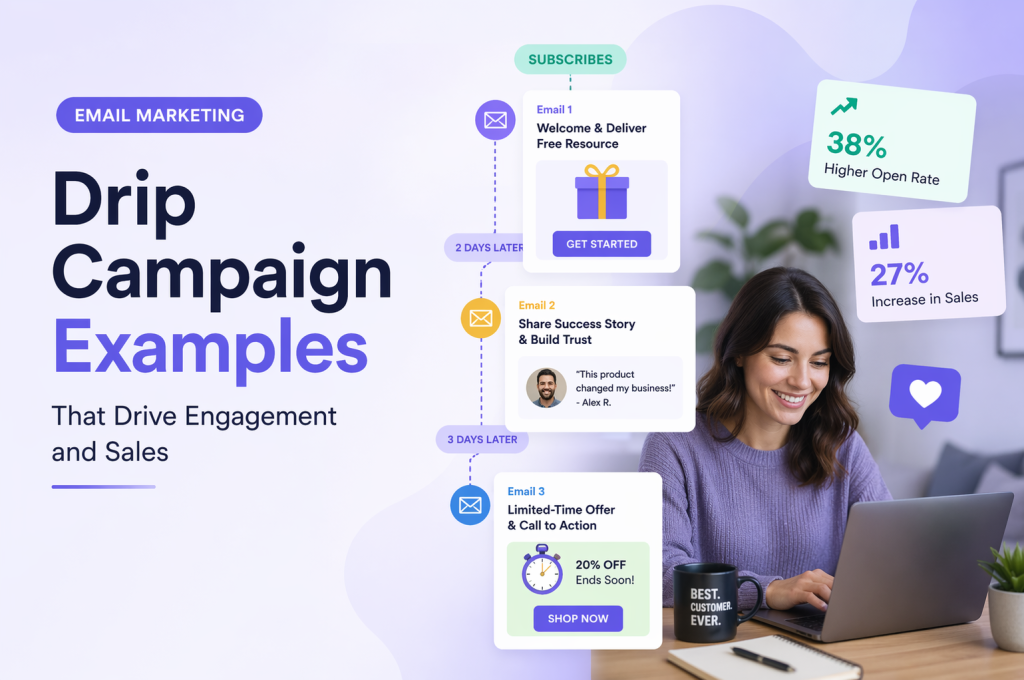
Drip campaigns are automated, behavior-triggered email sequences designed to guide users through the customer journey—from first interaction to loyal customer. When executed correctly, they combine audience segmentation, email personalization, and strategic timing to deliver highly relevant messages that increase open rates, click-through rates, and ultimately revenue. This guide explores real-world drip campaign examples, core campaign types, and the underlying strategies that power conversion-focused email campaigns—while showing how businesses can integrate them into broader marketing automation funnels for measurable growth.
The Anatomy of High-Performing Drip Campaigns
At their core, drip campaign examples are not just about sending emails—they’re about sending the right message at precisely the right moment. Every successful campaign is rooted in trigger-based automation, responding to user behavior, timing, or intent signals.
Think of email drip campaigns as a digital conversation. Instead of overwhelming users with a single push, you guide them through a structured narrative using automated email sequences that adapt to their actions.
A well-designed drip campaign doesn’t feel automated—it feels intentional, timely, and personal.
This is where email marketing automation intersects with strategy. Businesses that master this balance create engagement-driven email sequences that nurture relationships rather than interrupt them.
Why Drip Campaigns Drive Engagement and Sales
Modern consumers expect relevance. Generic blasts no longer work. Instead, behavior-triggered emails and customer journey emails ensure that each interaction aligns with user intent.
Key Benefits of Lifecycle Email Marketing
- Builds trust through consistent, value-driven communication
- Improves conversion rates via targeted messaging
- Enhances customer retention with ongoing engagement
- Supports scalable growth through automated workflows
When combined with a strong digital foundation—such as optimised landing pages from website design services—drip campaigns become significantly more effective.
The Core Framework Behind Conversion-Focused Email Campaigns
To truly understand what separates average campaigns from high-performing ones, we need to look at the underlying structure.
1. Audience Segmentation and Behavioral Targeting
Not all subscribers are equal. Effective campaigns rely on audience segmentation to group users based on:
- Purchase history
- Engagement level
- Browsing behaviour
- Demographic data
This enables behavioral targeting, allowing businesses to deliver dynamic email content that feels tailored rather than templated.
2. Trigger-Based Automation and Timing
Every interaction can act as a trigger:
- Signing up to a newsletter
- Abandoning a cart
- Downloading a resource
- Visiting a pricing page
These triggers activate automated workflows, ensuring emails are sent when users are most receptive.
Timing is equally critical. Poor campaign timing and frequency can reduce effectiveness, while well-timed messages significantly improve email engagement metrics like open rates and click-through rates.
3. Messaging That Converts
Even the best automation fails without compelling content. High-performing campaigns rely on:
- Strong email subject lines that spark curiosity
- Clear call-to-action (CTA) optimisation
- Persuasive, value-driven content
- Strategic use of urgency and scarcity tactics
Incorporating storytelling in email marketing also helps create emotional connections, making campaigns more memorable and impactful.
Drip Campaign Examples Across the Customer Lifecycle
The most effective email drip campaigns align with the customer lifecycle marketing model. Each stage requires a different approach, tone, and objective.
Welcome Email Series (Acquisition Stage)


The welcome email series is often the highest-performing sequence in any marketing automation funnel. It sets the tone for future interactions and introduces users to your brand.
What Makes It Effective:
- Immediate engagement after sign-up
- Clear expectations about future emails
- Strong brand positioning
- Early-stage email personalization
Example Flow:
- Email 1: Welcome and brand introduction
- Email 2: Value proposition and key benefits
- Email 3: Social proof emails or testimonials
- Email 4: Incentive-based offer
This sequence acts as the foundation for lead nurturing campaigns, helping transform cold leads into engaged prospects.
Onboarding Email Sequence (Activation Stage)


Once a user signs up or makes a purchase, the next goal is activation. The onboarding email sequence ensures users understand how to get value from your product or service.
Core Elements:
- Step-by-step guidance
- Educational email series
- Clear product benefits
- Behaviour-based follow-ups
These sequences often include email course sequences or tutorials designed to reduce friction and increase engagement.
Businesses that align onboarding with broader strategies—such as SEO optimisation to attract qualified traffic—see significantly better results across their funnel.
Re-Engagement Email Campaigns (Retention Stage)


Not every subscriber stays active. That’s where re-engagement email campaigns and win-back email sequences come into play.
Common Triggers:
- No email opens for 30–60 days
- Inactive account usage
- No purchases over a defined period
Effective Tactics:
- Personalised subject lines
- Exclusive offers or discounts
- Reminder of value or benefits
- Emotional storytelling
These campaigns are essential for retention email marketing, helping maintain long-term relationships and improve customer lifetime value (CLV) optimisation.
The Hidden Engine: Data, Automation, and Optimisation
Behind every successful drip campaign is a sophisticated system of email automation tools, CRM integration, and triggered workflows.
Key Technical Components:
- Drip email scheduling for consistent delivery
- Database-triggered campaigns based on user actions
- Integration with marketing automation platforms
- Continuous testing through A/B testing email campaigns
Advanced brands are now leveraging:
- AI-powered email marketing for predictive insights
- Hyper-personalization in email marketing
- Customer intent signals to refine targeting
When combined with paid acquisition strategies like PPC campaigns, these systems create a powerful ecosystem that drives both engagement and revenue.
Setting the Stage for High-Converting Campaigns
Before diving into more advanced drip campaign examples—like cart abandonment emails, upsell email campaigns, and product launch sequences—it’s important to understand one key principle:
Automation amplifies strategy. Without a clear strategy, it simply scales inefficiency.
Turning Engagement Into Revenue: Conversion-Focused Email Sequences
If the first stage of drip campaigns builds trust, the next stage is where momentum turns into measurable revenue. This is where conversion-focused email campaigns shine—designed not just to inform, but to move users toward action.
At this stage, every message is intentional. Every delay, every CTA, every piece of dynamic content is engineered to support micro-conversion optimization and guide users through decision-stage email targeting.
Cart Abandonment Emails: Recovering Lost Revenue


Cart abandonment emails are among the most profitable behavior-triggered emails in any strategy. When a user leaves without completing a purchase, it signals strong intent—making this the perfect opportunity for recovery.
Why They Work
- Target high-intent users
- Leverage urgency and scarcity tactics
- Offer timely incentives
- Reinforce product value
High-Converting Cart Abandonment Flow
- Email 1 (1–2 hours later): Friendly reminder
- Email 2 (24 hours): Highlight benefits + social proof
- Email 3 (48–72 hours): Incentive-based email (discount or bonus)
This type of sequence is a cornerstone of drip campaign strategy for ecommerce sales, often delivering some of the highest ROI within email marketing automation.
Product Launch Email Sequence: Building Anticipation and Demand


A well-executed product launch email sequence does more than announce—it builds anticipation, nurtures curiosity, and creates demand before the product is even available.
Key Phases of a Launch Sequence
- Teaser Emails: Spark intrigue without revealing everything
- Educational Emails: Demonstrate value and use cases
- Launch Announcement: Clear CTA with urgency
- Follow-Up Emails: Reinforce benefits and address objections
This approach combines storytelling in email marketing with persuasive email copy, creating a narrative that pulls users through the funnel.
Promotional Drip Campaigns: Driving Immediate Conversions


Promotional campaigns are often misunderstood. When done poorly, they feel pushy. When executed well, they feel like opportunities.
What Separates High-Performing Promotional Campaigns
- Clear value proposition
- Strong CTA optimisation
- Strategic use of urgency
- Personalised offers based on behaviour
These promotional drip campaigns are particularly effective when aligned with audience segmentation, ensuring that offers are relevant rather than generic.
Post-Purchase Emails: Maximising Customer Value


The moment after a purchase is one of the most underutilised opportunities in customer lifecycle marketing.
Instead of ending the conversation, smart brands extend it through post-purchase emails, designed to:
- Reinforce trust
- Encourage repeat purchases
- Introduce complementary products
- Build long-term loyalty
Common Post-Purchase Sequence Structure
- Order Confirmation: Transactional but branded
- Product Education: Tips, tutorials, or usage guides
- Cross-Sell Email Sequences: Related product recommendations
- Upsell Email Campaigns: Premium or upgraded options
These campaigns play a crucial role in customer lifetime value (CLV) optimisation, turning one-time buyers into repeat customers.
Upsell and Cross-Sell Campaigns: Expanding Revenue Per Customer
While acquisition often gets the spotlight, true growth comes from maximising existing relationships.
Key Strategies
- Use predictive email targeting to recommend relevant products
- Leverage customer intent signals from browsing or purchase history
- Deliver offers at the right moment using trigger-based automation
These sales enablement email sequences are subtle but powerful—focused on enhancing value rather than forcing a sale.
Re-Engagement and Win-Back Sequences: Reviving Dormant Users
Even the best lists decay over time. That’s why re-engagement email campaigns are essential for maintaining performance.
Effective Win-Back Framework
- Identify inactive users through email engagement metrics
- Segment based on inactivity duration
- Deliver targeted messaging with incentives
Example Sequence:
- “We Miss You” message
- Value reminder or product update
- Exclusive offer or incentive
- Final reactivation attempt
These win-back email sequences not only recover lost users but also improve sender reputation management and overall deliverability.
Advanced Strategy Layer: From Automation to Intelligence
As competition increases, basic automation is no longer enough. The most effective email drip campaigns that increase conversions now rely on advanced strategy layers.
AI and Predictive Systems
Modern campaigns are evolving through:
- AI-powered email marketing
- Predictive behaviour modelling
- Automated optimisation of send times and content
These systems analyse email engagement psychology to determine what users are most likely to respond to—and when.
Hyper-Personalisation and Zero-Party Data
Generic personalisation (like using a first name) is no longer sufficient. Today’s campaigns leverage:
- Hyper-personalization in email marketing
- Zero-party data email strategies (data users willingly provide)
- Deep behavioural insights
This enables highly relevant messaging that aligns with buyer intent email triggers.
Omnichannel Integration
Email doesn’t exist in isolation. The most effective strategies integrate with:
- Paid media campaigns
- Website experiences
- Retargeting ads
For example, aligning drip campaigns with conversion-focused landing pages built through website design expertise ensures consistency across every touchpoint.
Measuring What Matters: Optimisation and Performance
Without measurement, even the best campaigns lose direction. That’s why optimisation is at the heart of every successful strategy.
Core Metrics to Track
- Open rates and click-through rates
- Conversion rates
- Revenue attribution in email marketing
- Inbox placement rate
Continuous Improvement Tactics
- A/B testing email campaigns
- Refining email subject lines
- Testing different CTA placements
- Adjusting timing and frequency
This process feeds into broader conversion rate optimization (CRO) efforts, ensuring campaigns improve over time rather than plateau.
The Shift Toward Privacy and Deliverability
Modern email marketing must also adapt to changing regulations and user expectations.
Key Considerations
- Privacy-first email marketing (GDPR, consent-based)
- Maintaining strong sender reputation
- Ensuring spam filter avoidance
- Improving email deliverability optimization
Ignoring these factors can undermine even the most sophisticated campaigns.
Building a Scalable Drip Campaign Framework
By now, the mechanics of high-performing email drip campaigns should be clear. But execution is where most businesses fall short. The difference between scattered automation and a revenue-generating system lies in structure.
This final section brings everything together into a repeatable framework you can apply across your marketing automation funnels.
Step-by-Step: Creating High-Converting Automated Workflows
A successful system isn’t built in isolation—it connects acquisition, engagement, and conversion into one seamless journey.
1. Map the Customer Journey
Start by identifying key stages in your customer lifecycle marketing:
- Awareness
- Consideration
- Conversion
- Retention
- Expansion
Each stage should have its own engagement-driven email sequences, tailored to user intent and behaviour.
If your emails don’t reflect where the user is in their journey, they won’t convert.
2. Define Triggers and Behavioural Signals
Next, assign triggers to each stage. These power your trigger-based automation and ensure relevance.
Common Triggers Include:
- Email sign-ups → welcome email series
- Product views → educational email series
- Cart abandonment → checkout recovery emails
- Purchase → post-purchase emails
- Inactivity → re-engagement email campaigns
This is where database-triggered campaigns and CRM integration become essential, allowing real-time responses to user behaviour.
3. Build Segmented, Personalised Sequences
Once triggers are defined, layer in audience segmentation and email personalization.
Segment by:
- Behaviour (clicks, purchases, inactivity)
- Intent (research vs ready-to-buy)
- Value (high vs low customer lifetime value)
Then adapt your messaging using:
- Dynamic email content
- Personalised offers
- Contextual recommendations
This approach transforms generic campaigns into conversion-focused email campaigns that feel tailored at scale.
4. Align Messaging With Intent
Each email should serve a purpose. Avoid sending content for the sake of it.
Instead, focus on:
- Value-driven content that educates or solves problems
- Clear and compelling CTAs
- Strategic use of social proof emails and testimonials
- Emotional resonance through storytelling
At this stage, email engagement psychology plays a critical role. Understanding what motivates action allows you to craft more persuasive sequences.
5. Integrate With Your Wider Marketing Ecosystem
Drip campaigns don’t operate in isolation—they perform best when integrated into your broader strategy.
For example:
- Use SEO strategies to attract high-intent organic traffic
- Combine with paid campaigns for immediate acquisition
- Ensure landing pages are optimised through conversion-focused website design
This creates a cohesive system where every channel supports your marketing automation funnels.
Common Mistakes That Kill Campaign Performance
Even well-intentioned campaigns can underperform if key mistakes aren’t addressed.
1. Over-Automation Without Strategy
Automation should enhance strategy—not replace it. Without a clear plan, even the most advanced tools will fail.
2. Poor Segmentation
Sending the same message to everyone reduces relevance and engagement. Lack of segmentation leads to:
- Lower open rates
- Reduced conversions
- Increased unsubscribes
3. Ignoring Data and Optimisation
Failing to monitor email engagement metrics prevents improvement.
Always track:
- Open rates and click-through rates
- Conversion performance
- Drop-off points within sequences
4. Weak Messaging
Even perfectly timed emails won’t convert if the message lacks clarity or value.
Focus on:
- Strong subject lines
- Clear CTAs
- Concise, persuasive copy
5. Neglecting Deliverability
Technical performance matters. Poor sender reputation management or lack of spam filter avoidance can prevent emails from reaching inboxes altogether.
Advanced Scaling Strategies
Once your foundation is solid, the next step is scaling intelligently.
Leverage AI and Predictive Targeting
Modern campaigns increasingly rely on:
- Predictive email targeting
- AI-driven content recommendations
- Automated send-time optimisation
These tools help identify buyer intent email triggers, enabling more precise targeting.
Implement Omnichannel Drip Campaigns
Email is powerful—but even more effective when combined with other channels.
Example:
- Email sequence → retargeting ad → landing page → follow-up email
This creates a unified experience, reinforcing messaging across touchpoints.
Focus on Revenue, Not Just Engagement
Ultimately, success isn’t measured by clicks—it’s measured by revenue.
Shift your focus toward:
- Revenue attribution in email marketing
- Pipeline contribution
- Customer lifetime value
This ensures your campaigns align with business growth, not just vanity metrics.
A Practical Blueprint You Can Apply Today
To simplify everything covered, here’s a streamlined blueprint:
Phase 1: Setup
- Map customer journey
- Define triggers
- Choose email automation tools
Phase 2: Build
- Create segmented sequences
- Write high-converting email copy
- Design email templates
Phase 3: Launch
- Activate automated workflows
- Monitor early performance
- Adjust timing and frequency
Phase 4: Optimise
- Run A/B tests
- Refine segmentation
- Improve messaging
Phase 5: Scale
- Introduce AI and predictive systems
- Expand into omnichannel campaigns
- Focus on revenue growth
Final Thoughts
The most effective drip campaign examples aren’t defined by complexity—they’re defined by clarity, timing, and relevance.
When done right, email drip campaigns become more than just a marketing tactic. They evolve into a system that:
- Nurtures leads automatically
- Converts prospects consistently
- Retains customers long-term
- Scales revenue predictably
The goal isn’t to send more emails. It’s to send better ones—at the exact moment they matter most.
By combining automated email sequences, intelligent segmentation, and continuous optimisation, businesses can build high-converting email automation workflows that drive both engagement and sales—sustainably and at scale.
Frequently Asked Questions (FAQ)
1. How long should a drip campaign be?
There’s no universal length, but most effective email drip campaigns range between 3–10 emails depending on the goal. Shorter sequences work well for conversion-focused campaigns (like cart abandonment), while longer sequences are better suited for lead nurturing campaigns or educational content.
2. How often should emails be sent in a drip campaign?
Timing depends on user intent and campaign type. For example:
- Welcome email series: immediate + daily follow-ups
- Onboarding email sequence: every 1–3 days
- Re-engagement email campaigns: spaced over weeks
Balancing campaign timing and frequency is essential to avoid overwhelming users while maintaining engagement.
3. What tools are best for creating automated email sequences?
Popular email automation tools include platforms with strong CRM integration and workflow builders. The best choice depends on your business size, but key features to look for include:
- Trigger-based automation
- Audience segmentation
- A/B testing capabilities
- Analytics dashboards
4. How do I improve open rates in drip campaigns?
Improving open rates starts with better email subject lines and sender reputation. Focus on:
- Personalisation
- Curiosity-driven headlines
- Clear value propositions
Also ensure strong email deliverability optimization to reach inboxes consistently.
5. What is the difference between drip campaigns and newsletters?
Drip campaigns are automated email sequences triggered by user behaviour or timing, while newsletters are typically one-off broadcasts sent to a broader audience. Drip campaigns are more targeted and aligned with customer journey emails.
6. Can drip campaigns work for small businesses?
Absolutely. In fact, small businesses benefit greatly from email marketing automation because it allows them to scale communication without increasing workload. Even simple automated workflows can significantly improve engagement and sales.
7. How do I measure the success of a drip campaign?
Key email engagement metrics to track include:
- Open rates
- Click-through rates
- Conversion rates
- Revenue generated
Advanced strategies also include revenue attribution in email marketing to understand true ROI.
8. What type of content works best in drip campaigns?
High-performing campaigns focus on:
- Value-driven content
- Educational insights
- Product benefits
- Social proof
Combining these with persuasive email copy and strong CTAs leads to better results.
9. How can I personalise my drip campaigns effectively?
Go beyond using first names. Effective email personalization includes:
- Behaviour-based recommendations
- Purchase history targeting
- Dynamic email content
More advanced strategies use hyper-personalization in email marketing and customer intent signals.
10. Are drip campaigns still effective in 2026?
Yes—more than ever. With advancements in AI-powered email marketing, predictive targeting, and privacy-first email marketing, drip campaigns continue to evolve. Businesses that adapt to these trends see higher engagement and stronger long-term results.