
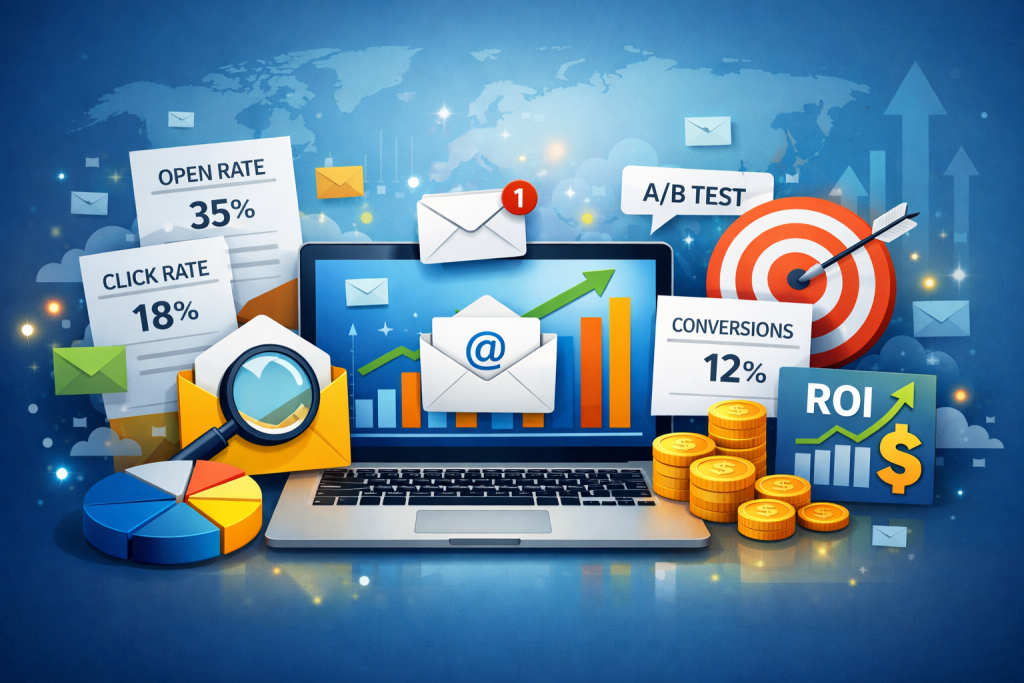
Email marketing can generate extraordinary returns—but only if you measure the right things. Too many businesses obsess over vanity metrics while ignoring the indicators that actually drive revenue, engagement, and long-term audience growth.
This guide breaks down the email marketing metrics and KPIs that genuinely impact growth, including engagement signals like open rate and click-through rate, revenue-focused indicators such as email conversion rate and revenue per email, and deliverability metrics like bounce rate and inbox placement rate.
You’ll also learn how list health, subscriber growth, and email marketing ROI connect to broader marketing performance across channels like SEO, PPC, and website optimization. By understanding which numbers matter—and which don’t—you can transform email campaigns from simple newsletters into predictable revenue engines.
If your email analytics only track opens and clicks, you’re missing most of the picture.
Why Email Marketing Metrics Matter More Than Ever
Email marketing remains one of the most powerful digital channels available. When executed properly, it consistently outperforms many other marketing channels in terms of return on investment (ROI).
However, success rarely comes from sending more emails. It comes from understanding your data.
Modern marketers rely on a complex ecosystem of email marketing analytics, campaign performance metrics, and engagement indicators to understand how subscribers interact with their content.
Without these insights, you’re effectively marketing blind.
The Problem With Vanity Metrics
Many businesses focus on surface-level data:
- Open rate
- Clicks
- Subscriber count
While these numbers can provide some insight, they don’t always reflect real performance or revenue impact.
Consider this example:
A campaign with a high open rate but zero conversions may look successful on paper but produces no meaningful growth.
What matters is the deeper layer of email marketing performance indicators, including:
- Email conversion rate
- Revenue per subscriber
- Email-attributed revenue
- Subscriber retention rate
- Email list health
These metrics reveal how email actually contributes to business growth and customer lifetime value.
The Three Pillars of Email Marketing Performance
Nearly every effective email strategy revolves around three fundamental categories of metrics:
- Engagement metrics – how subscribers interact with your emails
- Deliverability metrics – whether your emails reach inboxes
- Revenue and growth metrics – how emails generate sales and leads
Understanding these pillars allows businesses to connect email campaign analytics with broader marketing strategies, including website optimization and SEO-driven traffic acquisition. For example, a well-optimized site built through professional website design services can significantly improve email conversion rates by providing a smoother user journey after subscribers click through from campaigns.
Each pillar tells a different story about campaign performance.
Engagement Metrics: The First Layer of Email Analytics
Engagement metrics measure how subscribers interact with your emails once they reach the inbox. These are often the first indicators of campaign health.
Email Open Rate
The email open rate measures the percentage of recipients who open an email.
Common variations include:
- Unique open rate – counts each subscriber once
- Total open rate – includes multiple opens by the same recipient
These metrics help assess:
- Subject line performance
- Audience interest
- Timing effectiveness
However, open rate alone is not enough to measure success.
Privacy changes and email client restrictions have made this metric less reliable than it once was.
Why Open Rate Still Matters
Despite its limitations, open rate still provides useful signals about:
- Brand recognition
- Subject line appeal
- Audience engagement trends
More advanced analysis often includes email open rate variation across segments, devices, and audience groups.
You may also track:
- Opens per customer
- Mobile open rate
- Device open rate
- Email client share
These indicators reveal how different users interact with campaigns.
Click-Through Rate (CTR)
If open rate measures interest, click-through rate (CTR) measures action.
CTR calculates the percentage of recipients who click a link within an email.
This is one of the most important email campaign performance metrics because it shows whether your content motivates readers to continue their journey.
A strong CTR typically indicates:
- Relevant messaging
- Clear value proposition
- Effective call-to-action design
Other related metrics include:
- Email click rate
- CTA click rate
- Email interaction rate
These engagement indicators often correlate with website conversion performance, making them especially important for businesses that rely on landing pages or product pages to drive sales.
Click-to-Open Rate (CTOR)
While CTR measures clicks from the entire audience, click-to-open rate (CTOR) focuses only on people who actually opened the email.
This metric answers an important question:
Once someone opens your email, how compelling is the content inside?
CTOR is calculated by dividing total clicks by total opens.
It is particularly useful for analyzing:
- Email design effectiveness
- Message clarity
- CTA positioning
When CTOR is low but open rate is high, the issue usually lies within the email content rather than the subject line.
Email Engagement Rate
The email engagement rate provides a broader view of subscriber interaction.
Instead of focusing on a single action, engagement rate often includes multiple behaviors:
- Opens
- Clicks
- Forwards
- Replies
More advanced engagement analytics track:
- Email engagement time
- Email response rate
- Email forward rate
- Email sharing rate
These insights help marketers understand not just whether users clicked—but how deeply they interacted with the content.
Deliverability Metrics: Ensuring Emails Reach the Inbox
Even the most engaging email campaign fails if it never reaches subscribers.
This is why deliverability metrics are among the most important email marketing KPIs.
Email Delivery Rate
The email delivery rate measures the percentage of emails successfully delivered to recipients.
It is calculated as:
Emails delivered ÷ emails sent
This metric helps identify issues with:
- Invalid email addresses
- Spam filtering
- Technical sending errors
A low delivery rate signals problems that can severely damage campaign performance.
Email Bounce Rate
The email bounce rate measures how many emails fail to reach recipients.
There are two main types:
Hard Bounce Rate
A hard bounce occurs when an email address is permanently invalid.
Examples include:
- Nonexistent addresses
- Misspelled domains
- Deactivated accounts
Hard bounces damage sender reputation and should be removed from lists immediately.
Soft Bounce Rate
A soft bounce occurs when delivery fails temporarily.
Common causes include:
- Full inboxes
- Server errors
- Message size issues
Monitoring both bounce types helps maintain strong email deliverability rates.
Inbox Placement Rate
Sending emails successfully doesn’t guarantee they reach the inbox.
Some messages may land in:
- Spam folders
- Promotions tabs
- Filtering systems
The inbox placement rate measures the percentage of emails that reach the primary inbox.
This metric connects directly to several deliverability indicators:
- Sender reputation score
- Spam score
- Inbox rate
- Email authentication metrics
Consistently poor inbox placement can severely limit email marketing ROI.
Why Deliverability Influences Marketing Growth
Deliverability doesn’t just affect email performance—it impacts overall marketing effectiveness.
For example, businesses investing heavily in traffic acquisition through channels like PPC advertising often rely on email to nurture leads generated through paid campaigns.
If emails fail to reach those leads, marketing spend becomes significantly less efficient.
This highlights the importance of email deliverability monitoring as part of a broader digital marketing strategy.
Revenue Metrics: The Numbers That Truly Matter
While engagement metrics indicate interest, revenue metrics reveal business impact.
These indicators measure how email campaigns influence purchasing behaviour, customer value, and overall marketing performance.
Email Conversion Rate
The email conversion rate measures how many recipients complete a desired action after clicking through an email.
Typical conversions include:
- Purchases
- Lead submissions
- Account registrations
- Demo bookings
- Content downloads
It is calculated as:
Conversions ÷ total delivered emails
A strong email conversion rate usually reflects:
- Effective targeting
- Relevant messaging
- Optimised landing pages
- Clear calls to action
Email conversion performance is also heavily influenced by website usability and page experience. Businesses that invest in strong site infrastructure—such as professional website design—often see significantly higher conversion rates because visitors encounter fewer friction points after clicking from emails.
Email Revenue and Revenue Per Email
Tracking total email revenue reveals how much money email campaigns generate directly.
However, total revenue alone doesn’t tell the full story. That’s why marketers often measure:
- Revenue per email
- Revenue per subscriber
- Revenue per email campaign
These metrics provide clearer insight into the efficiency of each message sent.
For example:
| Metric | What It Reveals |
|---|---|
| Revenue per email | Profitability of individual sends |
| Revenue per subscriber | Long-term value of your list |
| Revenue per campaign | Performance of specific campaigns |
Businesses with mature email strategies often optimise campaigns based on revenue per subscriber, since it reflects the true economic value of the audience.
Email Marketing ROI
Few marketing channels rival the potential email marketing ROI when campaigns are executed effectively.
Return on investment is typically calculated as:
Revenue generated – campaign costs ÷ campaign costs
Costs may include:
- Email platform software
- Creative production
- Copywriting
- List acquisition costs
- Marketing automation tools
Tracking return on investment from email campaigns allows marketers to evaluate email against other channels such as SEO and paid advertising.
For example, businesses investing in long-term traffic acquisition through SEO services often use email campaigns to convert organic traffic into repeat customers, significantly improving the overall ROI of search marketing.
Growth Metrics: Measuring Audience Expansion
Revenue metrics reveal the value of your list. Growth metrics reveal how that list evolves over time.
Without steady audience expansion, email performance eventually stagnates.
Email List Growth Rate
The email list growth rate measures how quickly your subscriber base expands.
It accounts for:
- New subscribers
- Unsubscribes
- Spam complaints
- List removals
The formula typically looks like this:
(New subscribers – unsubscribes) ÷ total subscribers
Strong list growth ensures:
- Expanding reach
- Increased campaign revenue potential
- Stronger marketing resilience
However, rapid growth without quality control can create serious problems.
This leads to the next critical metric.
Email List Decay Rate
Email lists naturally decline over time.
Subscribers may:
- Change email addresses
- Lose interest
- Mark emails as spam
- Stop engaging
The email list decay rate measures how quickly your list becomes inactive.
A high decay rate can indicate problems with:
- Content relevance
- Audience targeting
- Email frequency
- Subscriber expectations
Healthy email programs actively combat list decay through:
- Segmentation
- Personalisation
- Re-engagement campaigns
These strategies help maintain a strong active audience size.
Active Audience Size
The active audience size measures how many subscribers consistently engage with campaigns.
This is often defined as users who:
- Open emails regularly
- Click links
- Purchase products
- Interact with campaigns within a specific timeframe
Closely related metrics include:
- Active subscriber rate
- Subscriber retention rate
- Inactive subscriber rate
Maintaining a large active audience significantly improves email campaign performance metrics.
Subscriber Sentiment Metrics
Subscriber sentiment metrics reveal how audiences feel about your emails.
While engagement metrics measure actions, these indicators measure satisfaction and tolerance.
Unsubscribe Rate
The unsubscribe rate tracks how many recipients opt out after receiving an email.
A rising unsubscribe rate may signal:
- Poor targeting
- Over-sending emails
- Irrelevant content
- Misleading subject lines
Occasional unsubscribes are normal, but consistently high rates can indicate serious email engagement issues.
Spam Complaint Rate
The spam complaint rate measures how often recipients report emails as spam.
This metric is closely monitored by email providers because it affects:
- Sender reputation score
- Inbox placement rate
- Overall deliverability
High complaint rates can lead to emails being blocked or filtered automatically.
Other related indicators include:
- Email spam report rate
- Spam score
- Email authentication metrics
Maintaining low complaint rates is essential for strong email deliverability monitoring.
Advanced Behaviour and Engagement Analytics
Beyond basic metrics, modern email platforms provide deeper insights into subscriber behaviour.
These advanced indicators help marketers refine campaigns with greater precision.
Opens Per Customer
Opens per customer measures how frequently individual subscribers engage with emails.
This metric helps identify:
- Highly engaged subscribers
- Potential brand advocates
- Ideal targets for upsell campaigns
Email Engagement Time
The email engagement time metric measures how long subscribers spend reading emails.
Longer engagement time typically indicates:
- Strong content relevance
- Compelling messaging
- Well-designed email layouts
This metric often correlates strongly with email conversion rate.
Device and Client Analytics
Understanding how users access emails can reveal important optimisation opportunities.
Key metrics include:
- Mobile open rate
- Device open rate
- Email client share
For many industries, over 60% of email opens now occur on mobile devices.
This makes responsive design and clear mobile-friendly layouts essential for improving email interaction rates.
Email Audience Health Metrics
Audience health metrics provide a holistic view of subscriber engagement trends over time.
These include:
- Email audience trend
- Subscriber churn rate
- Email list health
- Email engagement segmentation
Healthy lists tend to show:
- Stable engagement levels
- Low churn
- High active subscriber rates
Monitoring these metrics helps marketers maintain long-term campaign effectiveness.
The Hidden Metric: Customer Lifetime Value From Email
One of the most powerful—but often overlooked—metrics is customer lifetime value from email (Email LTV).
This metric measures the total revenue generated by subscribers over their lifetime.
It connects email marketing with broader growth indicators such as:
- Average order value from email (Email AOV)
- Email-attributed revenue
- Revenue per subscriber
High-performing email strategies often focus on maximising long-term subscriber value rather than short-term campaign revenue.
Attribution, Benchmarking, and Optimisation for Sustainable Email Growth
The final layer of email marketing measurement focuses on attribution, optimisation, and long-term strategy. By this stage, you’ve already measured engagement, deliverability, and revenue metrics. But the next step is understanding how email fits into your entire marketing ecosystem.
Email rarely operates in isolation. It works alongside channels like search engines, paid advertising, and website experiences to nurture leads and convert customers.
This is why modern marketers analyse email campaign attribution, benchmarking data, and funnel performance metrics to understand the full picture.
Email Attribution: Understanding the True Impact of Campaigns
Many businesses underestimate the value of email because they measure only last-click conversions.
In reality, email often plays a critical role earlier in the buyer journey.
For example, a customer might:
- Discover your brand through search
- Subscribe to your email list
- Receive several nurture emails
- Convert weeks later through another channel
Without proper attribution tracking, email’s influence would be invisible.
Email Campaign Attribution
Email campaign attribution determines how email contributes to conversions across the customer journey.
Key attribution metrics include:
- Email-attributed revenue
- Revenue per email campaign
- Lead conversion rate from email
- Email lead generation rate
Understanding attribution allows marketers to evaluate how email contributes to multi-channel growth strategies.
For example, a business generating traffic through PPC campaigns may rely on email to nurture leads captured through landing pages. Paid traffic initiatives such as PPC marketing often generate large volumes of leads that require consistent follow-up through email sequences before they convert.
Without email nurturing, those leads may never become customers.
Email Funnel Performance Metrics
Beyond single campaigns, businesses should track how email contributes to the entire marketing funnel.
Key funnel metrics include:
- Email funnel performance
- Email lead nurturing metrics
- Lead conversion rate from email
- Email lead generation rate
A healthy funnel often looks like this:
- Traffic enters through search, ads, or social media
- Visitors subscribe to email lists
- Automated email sequences nurture the relationship
- Subscribers convert into customers
- Email campaigns encourage repeat purchases
In this framework, email acts as the central relationship-building channel that moves prospects through the buying journey.
Campaign Benchmarking: Measuring Performance Against Industry Standards
Understanding your own performance is important—but it becomes far more useful when compared to benchmarks.
Email marketing benchmarking helps businesses understand whether their campaigns are performing above or below industry averages.
Benchmarking metrics commonly include:
- Average open rate
- Average click-through rate
- Average email conversion rate
- Average unsubscribe rate
These comparisons reveal whether performance issues are caused by:
- Content quality
- Audience targeting
- Deliverability problems
- Offer relevance
Closely related metrics include email campaign benchmarking, which compares performance between different campaigns within the same business.
This allows marketers to identify:
- Which subject lines perform best
- Which content formats generate clicks
- Which offers drive revenue
Optimising Engagement: The Metrics That Improve Performance
Once core analytics are established, the next step is optimisation.
Several specific metrics reveal opportunities to improve campaign results.
Subject Line Performance
The subject line often determines whether an email is opened at all.
Tracking subject line performance helps marketers evaluate:
- Emotional triggers
- Personalisation effectiveness
- Curiosity-driven messaging
Improving subject lines can significantly increase open rate without changing any other campaign elements.
CTA Click Rate
Calls-to-action are the bridge between email engagement and website activity.
The CTA click rate measures how often recipients click on primary action links.
High-performing CTAs typically:
- Use clear action language
- Provide immediate value
- Stand out visually within the email layout
Optimising CTA placement and design can dramatically increase the email interaction rate.
Email Content Performance
Beyond individual elements, marketers should evaluate email content performance holistically.
This includes analysing:
- Email engagement rate
- Email engagement analytics
- Email response rate
- Email forward rate
When subscribers share or forward emails, it often signals strong content relevance.
Tracking email sharing rate can reveal which campaigns resonate most with audiences.
Maintaining List Quality and Subscriber Health
A growing list is valuable—but only if subscribers remain engaged.
Monitoring email list health ensures your database continues to generate value.
Important list quality metrics include:
- Subscriber retention rate
- Inactive subscriber rate
- Active subscriber rate
- Subscriber churn rate
Businesses should regularly remove or re-engage inactive subscribers to protect:
- Sender reputation
- Deliverability rates
- Engagement performance
A clean list also improves email deliverability monitoring, ensuring that messages reach genuine audiences rather than abandoned inboxes.
Email Marketing in a Broader Digital Strategy
Email marketing performs best when integrated into a wider digital ecosystem.
Channels like organic search help drive new traffic and subscribers into email lists. Businesses investing in search visibility through SEO strategies often use email to convert organic visitors into repeat customers and long-term brand advocates.
This relationship between channels creates a growth loop:
- Search drives new visitors
- Visitors subscribe to email lists
- Email nurtures relationships
- Subscribers convert into customers
- Customers return through future email campaigns
When these systems work together, email becomes one of the most powerful tools for sustained revenue growth.
The Complete Framework for Measuring Email Marketing Success
To truly understand Email Marketing Metrics That Actually Matter for Growth, businesses should monitor metrics across five categories.
1. Engagement Metrics
- Email open rate
- Unique open rate
- Total open rate
- Click-through rate (CTR)
- Click-to-open rate (CTOR)
- Email engagement rate
2. Deliverability Metrics
- Email delivery rate
- Email deliverability rate
- Email bounce rate
- Hard bounce rate
- Soft bounce rate
- Inbox placement rate
3. Revenue Metrics
- Email conversion rate
- Email revenue
- Revenue per email
- Revenue per subscriber
- Email marketing ROI
4. Growth Metrics
- Email list growth rate
- Subscriber growth rate
- Email audience growth
- Active audience size
- Email list decay rate
5. Audience Health Metrics
- Unsubscribe rate
- Spam complaint rate
- Email spam report rate
- Subscriber retention rate
- Email list health
Together, these indicators form a complete picture of email campaign performance metrics and long-term marketing effectiveness.
Final Thoughts
Email marketing remains one of the most reliable and scalable digital marketing channels available. But its true power comes from understanding and tracking the right metrics.
By focusing on the indicators that connect engagement, deliverability, and revenue, businesses can transform email campaigns from simple newsletters into data-driven growth systems.
When measured correctly, email marketing analytics reveal far more than campaign performance. They reveal how audiences interact with your brand, how customers progress through the marketing funnel, and how marketing strategies contribute to long-term revenue growth.
And in a digital landscape increasingly driven by measurable outcomes, those insights are invaluable.
Frequently Asked Questions About Email Marketing Metrics
Below are some of the most commonly asked questions related to measuring and improving email marketing performance. These questions address important topics that were not covered in the main sections of the article but are highly relevant for businesses trying to grow through email.
1. How often should you review email marketing metrics?
Email marketing metrics should be monitored at multiple intervals depending on the campaign type.
Typical review cycles include:
- Immediately after sending: track delivery rate and bounce rate
- 24–48 hours later: analyse open rate, click-through rate, and engagement
- Weekly or monthly: evaluate email conversion rate, revenue per email, and subscriber growth
Regular monitoring allows marketers to quickly identify performance issues and adjust campaigns accordingly.
2. What is a good email open rate?
A “good” email open rate varies by industry, audience type, and email frequency.
However, many industries typically see:
- 15–25% open rate as an average baseline
- 25–35% for highly engaged audiences
- 35%+ for segmented or highly targeted campaigns
Instead of focusing purely on industry averages, businesses should track open rate trends over time to measure improvement.
3. What is considered a strong email click-through rate?
A typical click-through rate (CTR) for email campaigns often falls between 2% and 5%, though this can vary depending on the audience and campaign objective.
Higher CTRs are usually achieved when:
- Emails are highly personalised
- The call-to-action is clear
- The offer is directly relevant to the audience
Segmented campaigns often outperform generic campaigns by a significant margin.
4. Which email marketing metric predicts long-term growth the best?
While many metrics are useful, revenue per subscriber and customer lifetime value from email are often the best predictors of long-term growth.
These metrics reveal:
- The financial value of your email list
- The long-term profitability of subscribers
- The effectiveness of retention strategies
Tracking these indicators helps marketers focus on building relationships rather than just increasing short-term sales.
5. Why is email segmentation important for improving metrics?
Email segmentation divides subscribers into smaller groups based on characteristics such as:
- Purchase history
- Engagement level
- Demographics
- Behaviour on your website
Segmentation improves metrics because it allows marketers to send more relevant and personalised content, which can increase:
- Open rates
- Click-through rates
- Email conversion rates
- Revenue per campaign
6. How does email frequency affect performance metrics?
Sending emails too often can lead to:
- Higher unsubscribe rates
- Increased spam complaints
- Lower engagement rates
Sending emails too infrequently may cause subscribers to forget your brand.
Finding the right balance often requires testing different send frequencies and monitoring engagement trends.
7. What tools are commonly used to track email marketing analytics?
Most businesses use email marketing platforms with built-in analytics dashboards.
Common tools include:
- Email automation platforms
- CRM integrations
- Marketing analytics platforms
- Website tracking tools
These systems help marketers measure metrics such as:
- Email campaign performance
- Subscriber engagement
- Revenue attribution
8. How can A/B testing improve email marketing performance?
A/B testing allows marketers to compare two versions of an email to determine which performs better.
Common elements tested include:
- Subject lines
- Email layouts
- CTA wording
- Send times
- Personalisation strategies
By continuously testing and refining campaigns, businesses can gradually improve key performance metrics.
9. How do privacy changes affect email marketing metrics?
Recent privacy updates from email providers have affected the reliability of some metrics—particularly open rates.
Because of this, many marketers are shifting focus toward more reliable performance indicators, including:
- Click-through rate
- Conversion rate
- Revenue per email
- Engagement over time
These metrics provide a clearer view of actual user behaviour and campaign effectiveness.
10. What is the biggest mistake businesses make when analysing email marketing metrics?
One of the most common mistakes is focusing on single metrics in isolation.
For example:
- High open rate with low conversions
- Strong clicks but poor revenue
- Growing list size but declining engagement
Successful email strategies analyse metrics collectively, combining engagement, deliverability, and revenue indicators to understand the full impact of campaigns.